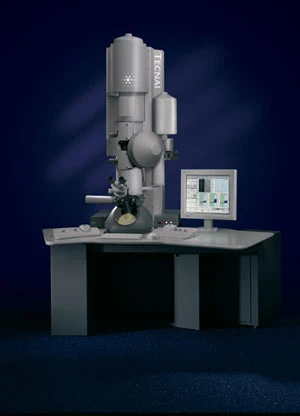
FEI, producer of the world's first Transmission Electron Microscope (TEM), now manufactures of a full range of microscopes, including scanning (SEM) and TEM types, plus dual-beam lab-based and related equipment. The company's tools, featuring focused ion- and electron-beam technologies, deliver 3D characterization, analysis and modification capabilities with resolution down to the sub-Ångström (0.1nm) level.
Joint Development Project
FEI first teamed up with Bosch Rexroth because of its close proximity and inhouse capabilities. Ten years later, the relationship has led to a breakthrough in both performance and cost reductions for FEI.
The two companies have embarked on a project called "NewMotion," which targets a modular motion control system comprising various hardware and software packages from Bosch Rexroth's NYCe4000 industrial motion control system. The Technical University of Eindhoven (TU/e) is aiding the project with research into the necessary new control techniques.

NYCe4000 reduces project costs.
FEI will equip high-precision mechatronic systems with the NewMotion system NYCe4000 and integrate them into electron microscopes. TU/e's role is to study and develop new measurement and control algorithms in the field of motion control technology. With fundamental applied scientific research, they will develop principles that will be used in the motion control systems to increase the motions accuracy at the atomic level, and achieve fluid motion in the nm/sec range.
Speed Paradox
At the heart of an electron microscope are mechatronic specimen-manipulator stages that FEI develops. The company is developing new stages that will make it possible to work in the one nanometer wor ld in three dimensions (one nanometer corresponds to a millionth of one millimeter). This new manipulator demands a movement and positioning accuracy down to the atomic level, which will be realized through a combination of special stage mechatronics and the new motion control system.
More for Less
Although accurate positioning, speed of placement, and the ability to overcome vibration generated by the machine itself are important, machines capable of working on the nanometer scale are increasingly sold to customers in the industrial sector. And in this respect, Bosch Rexroth's NYCe4000 motion control platform with integrated amplifier technology is both robust and priced low enough to have broad appeal. With everything necessary for controlling a complex machine contained in a single unit, the NYCe4000 takes up a small amount of space and reduces the amount of cabling and the number of PCBs in a machine. This means that system and integration costs are reduced while availability and service level are increased.

NYCe4000 safety settings
All of these aspects are increasingly important as the electron microscope continues to evolve into an industrial measuring machine.
Pushing the Limits
The expectations from this project center on a new generation of motion control systems whereby reliance will shift from electronic hardware to software and system components. There will also be significant improvements in terms of performance, functionality and price savings.
Similarly, a new generation of manipulators with multiple axis coordinates will improve the performance of the motion system and the dynamic behavior by a factor of ten in all respects. This will be largely the result of new, balanced mechatronic constructions that make use of thermal compensation, vibration damping, and a new type of linear measurement scale coupled with play-free transmission. In concrete terms, this will deliver a positional accuracy in the magnitude of 100nm and a drift of 0.1nm/min. To achieve this extremely high level of stability, a special balanced thermal-compensation system is being developed whereby temperature as a function of time is held constant.
The movement accuracy of a sample using the multi-axis manipulator on a TEM, for example, is critical for the quality of the electronic scan. This demands very slow movements at speeds of no more than 1nm/sec. In turn, this requires a high resolution with a step size of 1nm. With this project, the targeted speeds are a 15-fold improvement on current capabilities. A big challenge to overcome is the achievement of shock-free movement. Since just a small number of encoder steps are made per increment of time, huge demands are placed on the regulator in the control unit. This unit must be able to generate a homogenous speed profile so that the actual speed of the sample being manipulated remains constant. In addition, there is always a certain amount of vibration in a mechatronic system that can affect the end position accuracy—a factor that is being taken into account in the design and construction phase.
Although slowness of motion appears more relevant than speed in microscopy applications, the measurement speed of the manipulator will be improved by a factor of five to 10, compared with existing systems. This raises the possibility to carry out measurements on multiple products in a reduced number of operations. The measurements in this case would take place sequentially, but samples would be placed in the measurement room in a single charge. All thermal and movement-critical effects would be much smaller than in the existing situation where just a single measurement sample is loaded.
In addition, new possiblities for simulation and tooling will inevitably emerge from the NewMotion project, offering better and faster ways of reaching an end result and/or solving a motion problem.
Motion Control Platform
Bosch Rexroth is supplying hardware modules for various application areas, such as low power, high power and piezo control—all with electronic drive and the control in a single unit. The hardware architecture enables the required functionality to be developed with software. Similarly, software modules for applications, configuration, tuning, simulation, path generation, testing and measurement are being developed to support the customer in implementing motion in a machine. A FireWire communication bus forms the backbone of the architecture, whereby the generated motion commands are fed to the appropriate motion controllers at high speed.
This platform targets applications where speed and accuracy, combined with low cost and fast time-to-market are essential. The NYCe4000 is less than the size of a compact industrial PC, yet it provides multi-axis motion control and configurable safety functionality. A single control system supports a standard eight axes per unit, with a maximum of 62 units in a network.
Compliant with both UL and EMC standards, the NYCe4000 includes integrated drives that make it possible to control a machine or a machine subsystem with up to 10 axes, and with a total of 110 digital inputs/outputs and 20 analog inputs/outputs. Measurement systems supported include traditional S0/S90 encoders, SinCos encoders, analog position signal, EnDat and others. All related motion, input/output and digital/analog interfaces are onboard.
The integration of a flexible, universal drive with the motion control system makes it suitable for low-power servo axes and stepper axes (driven by motors up to 500W), opening up the possibility of controlling all motors in a machine with the same drive type. Because it is easy to integrate a customer-specific connector board into the system, no additional external connector panels are required, since the sensor connectors in a machine can be plugged directly into the motion control system itself.
The combination of high-speed motion control with the drive and inputs/outputs in one box reduces cabling, extends uptime and improves serviceability while lowering system and integration costs. Moreover, using one compact system to replace a separate control system, separate drives, separate input/output blocks, and separate distribution boards saves space.

Explore the March 2008 Issue
Check out more from this issue and find your next story to read.
Latest from Today's Medical Developments
- NextDent 300 MultiJet printer delivers a “Coming of Age for Digital Dentistry” at Evolution Dental Solutions
- Get recognized for bringing manufacturing back to North America
- Adaptive Coolant Flow improves energy efficiency
- VOLTAS opens coworking space for medical device manufacturers
- MEMS accelerometer for medical implants, wearables
- The compact, complex capabilities of photochemical etching
- Moticont introduces compact, linear voice coil motor
- Manufacturing technology orders reach record high in December 2025