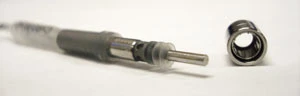
Hypertac socket contacts are hyperboloid-shaped baskets of individual spring wires strung at an angle to the socket's axis. This wire basket inside the female contact mates to a male pin, which, when inserted into the sleeve, causes the wires to stretch around it, creating a number of linear contact paths. Developed and manufactured by Hypertronics Corp., the Hypertac contact system is used throughout a range of demanding applications such as medical, military, aerospace, industrial and more.
"Hypertac socket contacts are designed using materials that provide the best electrical current-carrying capability and mechanical performance," explains Tom Kannally, medical industry manager at Hypertronics. "Generally, the contacts would be made of gold-plated beryllium copper and goldplated brass." Today, Hypertac socket contacts have expanded to include biocompatible variations called ImplanTac - contacts used in implantable medical devices.
The biocompatible materials used for ImplanTac can vary from customer to customer depending on the specific mating lead to be used. "Typically, we just provide the female side of the contact in implantable devices because the male pin has been defined," Kannally says. "Each contact may be required to meet different, but very specific performance, material and envelope dimension characteristics."
Some of the applications for ImplanTac socket contacts include, but are not limited to, pacemakers, implantable cardioverter-defibrillators, neurostimulators, metabolic controls, circulation pumps, bone growth stimulators, and pain management devices.
Kannally explains that ImplanTac, which is based on the low-force, low-resistance Hypertac socket contact technology, delivers specific features and benefits in implantable device applications - helping mitigate design challenges, and performing flawlessly for implantable medical applications. Whether the application is medical, industrial, or aerospace, the benefits and features remain across all variations of the Hypertac socket contacts.
First, the Hypertac provides very low contact resistance, and because of that there are higher current-carrying capabilities. "There are so many points of contact around the male pin - because of the hyperboloid wire basket - the socket contact grabs the male pin and provides very low resistance," Kannally states.
Secondly, it requires very low insertion and extraction force because the wires are designed to stretch only elastically.
Third, it has immunity to high mechanical shock and vibration so that no matter how the user vibrates or shocks the contact, Kannally explains, it provides continuous electrical connection with the male pin - because of it being attached at both ends and unable to shatter off.
Next, although not always required in implanted applications, a typical Hypertac contact delivers very high cycle life. It will go a minimum of 100,000 insert/extraction cycles without failure.
"Additionally, something especially important in the medical industry is the self-cleaning wiping action - so if there is any contamination on the male pin, the angle of the hyperboloid wires actually cleans the contact as it is connected."
Manufacturing and Use
Hypertronics uses a range of proprietary manufacturing and assembly equipment to manufacture the various Hypertac and ImplanTac contacts, with tooling and fixturing all designed by in-house engineers.
"Depending on the application, the size of the contact varies," Kannally explains. "Many customers come to us with an already-determined size of the lead, which has a set number of contacts on it. So, the contact socket must be made to a specific size and geometry in order to conform to the lead."
One example Kannally provides is that of a pacemaker - an implantable device that has an interconnect area, typically at the top. Generally, there is a metal enclosure that has a clear plastic area at the top where leads are plugged in - but there are various ways to connect them.
In the past, leads were attached through a captive set screw - in other words, there is no female contact in the device, but rather the lead is inserted into an opening at the top of the device and then the physician would have to screw it down after the lead was inserted.

ImplanTac contact sockets.
"However, with this scenario a specific tool is required to do this, because the torque is very important in attaching the lead. If you do not torque it enough, the lead can come out - or more likely, it could create intermittent electrical contact since there is only one point of contact where the set screw contacts the lead," Kannally explains. "But, then the other issue is if the physician overtorques the set screw, the lead can be damaged and if that occurs, the entire device could be damaged - and if so, having to discard a pacemaker and start with a new one adds significant cost."
Another area of concern is that there is always the possibility of losing a screw, cross-threading a screw, damaging the head of the screw, and even nicking the lead - additional issues that can arise from set screws.
According to Kannally, the ImplanTac socket contact solution minimizes the costs and risks that are associated with invasive procedures. The contacts allow the surgeons to easily mate implanted leads to devices without misalignment, damage to the system, or risk to the patient. Additionally, specialty mating tools are no longer needed.
"With ImplanTac socket contacts, no mating tools or set screws are required," Kannally explains. "And, since all the wires are strung in the direction of mating and they are all discrete, the Hypertac design resists damage as the physician is attaching the contact."
Reliability Required
Hypertac and ImplanTac socket contacts deliver at least five lines of contact. But, one example Kannally provides is a situation that has 15 lines of contact - reinforcing that the more lines of contact the implants have, the lower the resistance and the more reliable the contacts will be. This is extremely important as the medical implantables market continues to develop. Devices way beyond pacemakers are being introduced, such as neurostimulators, implants for metabolic disorders, cochlear implants, and even artificial retinas.
"Although I cannot give specifics, I can say that the types of devices we are seeing out there in the medical industry are pretty exciting, and the impact that ImplanTac socket contacts are having on these new developments is just amazing," Kannally states.
Obviously, if an individual has a pacemaker, neurostimulator, or some other device implanted in them, they want to be assured that the device will help them live, without failure. Hypertac socket contacts deliver multiple areas of contact to enable that type of security. Kannally concludes: "This is the reason Hypertronics' motto is 'When failure is not an option.'"

Explore the January February 2009 Issue
Check out more from this issue and find your next story to read.
Latest from Today's Medical Developments
- Gore completes acquisition of Conformal Medical
- Medical textiles designed for cardiovascular, orthopedic, dental prosthetic applications
- Micro-precision 3D printing: Trends and breakthroughs in medical device manufacturing
- One-component, dual-cure adhesive system for medical device assembly
- #82 Manufacturing Matters - Forecasting 2026 with GIE Media's Manufacturing Group
- Flexing prosthetic finger offers lifelike appearance and movement
- How the fast-evolving defense market impacts suppliers
- Medtronic’s Hugo robotic-assisted surgery system makes US debut