Designing and manufacturing a medical device means constantly thinking about precision. When developing something that will be implanted inside the body, it’s particularly critical to ensure accuracy down to the millimeter, or even micrometer. If implant geometry or placement is even slightly off, it can affect healing or cause complications.
Surgically stabilizing a fracture, for example, involves inserting a cannulated bone screw or intermedullary (IM) nail into the damaged bone. To ensure accurate placement, the surgeon guides the implant using a guide wire threaded through the screw or nail. The hole through which the wire is threaded must, obviously, be perfectly aligned – which requires special drilling equipment.
“Anything that has a significant length of diameter ratio or requires a very precise hole to be placed in it, that’s got some length to it, that’s where you’d see deep hole drilling come in,” says Joe Goral, vice president of sales for Bourn & Koch. A manufacturer of precision automated machine tools, Bourn & Koch has become deeply familiar with deep hole drilling since it acquired the production and support operations of Mollart Machinery, a specialist in that technology, in 2024.
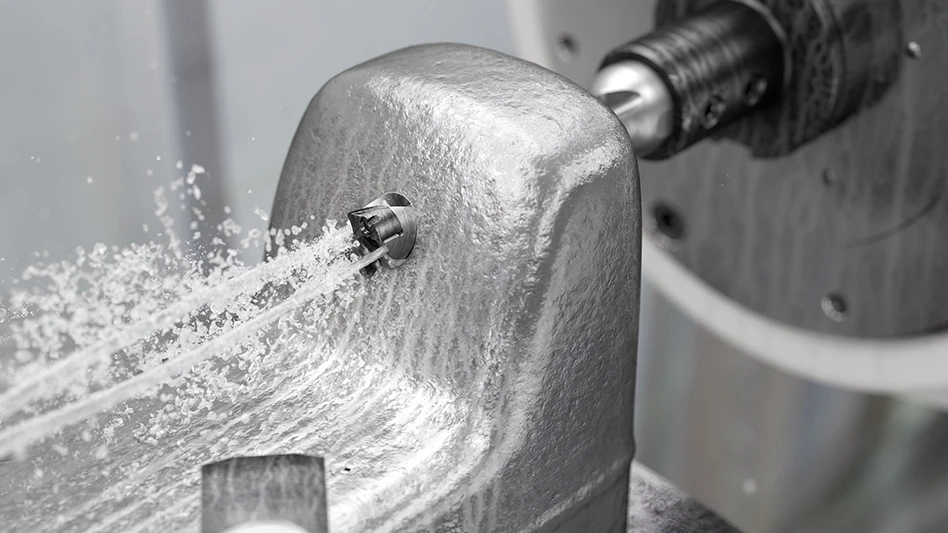
Deep hole drilling machines can achieve length to diameter (L:D) ratios of greater than 30. While this can be achieved on a traditional machining center with a twist drill, it typically requires a spot or pilot hole to prevent drill wander and a peck drilling cycle to clear chips from the hole. A deep hole drilling machine, however, uses whip guides and bushings to keep the drill perfectly aligned as it enters the work piece. In addition, the design of the drill and the high-pressure coolant flow effectively breaks up chips as it works. These features result in much higher productivity when drilling longer L:D parts.

If you’re manufacturing thousands of cannulated bone screws per year, those productivity gains really add up. Furthermore, Bourn & Koch offers Mollart deep hole drilling machines with up to eight spindles (in its pellet die series – other machines offer up to four) so multiple components can be drilled at once.
Custom machines for any application
Bourn & Koch joined forces with Mollart Machinery after both companies were acquired by the InCompass group of machine tool manufacturers within days of each other. Mollart, a UK-based company in business since 1929, has been designing and manufacturing deep hole drilling machines for more than three decades. Some of those machines, particularly the company’s massive pellet die machines, presented some logistical challenges due to their large size vs. Mollart’s relatively small manufacturing facility.
Bourn & Koch’s expansive Rockford, Illinois facility proved to be just the solution. At the start of 2024, Mollart began transferring the production of its machine tools, as well as field service and support, to its new sister company’s 130,000ft2 manufacturing space. Bourn & Koch reorganized its shop layout to accommodate the new machinery, which includes gundrilling, BTA drilling, and micro-drilling equipment among others.

Editor's Note: This article originally appeared in the January/February 2026 print edition of Today's Medical Developments under the headline “Deep hole drilling for critical precision in medical components”.
The VDM micro-drilling machine stands out in particular when it comes to medical manufacturing. The single-axis CNC machine is configured with four vertical spindles capable of drilling holes up to 300mm deep. The machine can also be fitted with optional X & Y axes for positioning pallets for larger production runs or off-center drilling of smaller parts. The spindles are positioned at the bottom, so they drill upward. Each machine is customized to the required application, and it offers multiple automation options.
“We’re working on some pretty neat projects right now for drilling very tough materials in very high volume,” Goral says. “It’ll all be done with automation. I see the possibilities for drilling cannulated bone screws in very high volume with that machine to be extremely high. And looking at how we can automate it and make it so it’s lights-out production is 100% a possibility.”
According to Goral, the VDM is one of the machines most commonly used for medical applications, alongside the Drillsprint series of single-axis gundrilling machines. It, too, offers several options for customization, including a counter rotation function for applications requiring especially straight holes, such as IM nails.
Additional customization options for Mollart machines include number of spindles and whip guides (which can be auto-latching or manual), types of coolant and filtration systems, peripheral equipment add-ons such as mist collectors, and, of course, different levels of automation all the way up to fully automated machines.

“We’re a custom machine tool builder. That’s one of Bourn & Koch’s big benefits – we’ll build a machine that doesn’t exist for varied niche processes,” Goral continues. “And Mollart had that in their DNA, too. The engineering expertise we have in making custom machines, and the fact that we’ve retained Mollart’s engineers, is really beneficial when we do get something that’s a bit out of the ordinary. We tend to get the really tough stuff. We don’t tend to get the easy things. And that seems very much what was in Mollart’s wheelhouse, too. So when custom challenges come up, we say bring them on, because we’re very well poised to handle them.”

Putting customers first
The addition of Mollart’s machine tools brings Bourn & Koch’s total machine tool line offering up to 29. To keep up, the company is continually adding to its field service team, ensuring they can respond quickly to even the most urgent customer needs. (Mollart’s UK headquarters continues to provide support, as well.) It also maintains strong relationships with suppliers for deep hole drilling tools including Star SU and Botek. Bourn & Koch maintains a highly partnership-focused business model, as does Mollart – another element making their own partnership work so well.
Bourn & Koch recognizes the importance of user-friendliness in all of its machines, which includes grinding, gear hobbing, and gear shaping equipment in addition to the Mollart deep hole drilling line. The company developed its own human machine interface (HMI) for its products so operators don’t have to be CNC programmers to be able to run them, even for the more complex operations.
Bourn & Koch’s customers span many different industries, and the company works hard to keep up with the rapid changes in each of them. The addition of Mollart’s products has been beneficial to Bourn & Koch’s medical manufacturing capabilities, Goral says, particularly the VDM, which is so well-suited to small components requiring deep, precise holes – again, cannulated bone screws, but also parts for robot-assisted surgeries and other advanced applications. When it comes to miniaturization, Mollart was ahead of the curve with the VDM, he continues, but Bourn & Koch will likely begin looking more closely at smaller machines to accommodate the trend of increasingly diminutive, high-precision medical components.
“At the end of the day, we have a good product line right now that’s well accepted by medical manufacturers,” Goral concludes. “As those things continue to evolve and develop, we’ll be able to adapt to those trends too.”
Bourn & Koch
https://www.bourn-koch.com

Explore the January/February 2026 Issue
Check out more from this issue and find your next story to read.
Latest from Today's Medical Developments
- Case study: Precision in confined spaces
- The importance of a fully integrated value chain
- Renishaw highlights high-productivity metal AM solutions
- Trice Medical launches platform for minimally invasive tendon treatment
- AI solution for autonomous bin picking
- Norman Noble opens rapid prototyping lab, invites medtech OEMs to open house
- DMG MORI, University of Tokyo establish Machining Transformation Research Center
- Platinum Tooling announces new product catalog