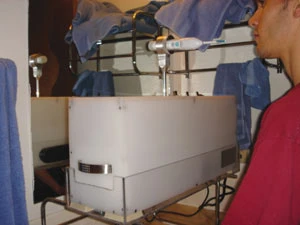
Technology is meant to make life simpler. That is why a group of engineering seniors tackled a unique design challenge. Their goal was to help people with Cerebral Palsy save time while preparing for the day.
David Moran has Cerebral Palsy (CP). This means that during repetitive motion he gets spasms. After starting and stopping the repetition numerous times he becomes exhausted from the intensity of the activity. Where this occurs most often in Moran's life is while he is brushing his teeth. In fact, the activity typically takes him about an hour every time he performs it. That is two hours a day that he spends on this one activity essential to his health and hygiene.
Cara Macrory, a mechanical engineering student at the University of Oklahoma (OU), along with a group of other engineering seniors, challenged themselves to find a solution to Moran's unique problem. Macrory's teammates were Mike Byers, Mike Walters, Randall Warren, David Monroe and Michael Fozdar. Together, they decided to design an Assistive Toothbrush Device as their senior design practicum. Dr. David Miller was their faculty sponsor and Dr. Robert Rennaker was their faculty sponsor/advisor.
Brushing teeth is a repetitive motion problem, and that is why it is difficult for Moran in the first place. For the Assistive Toothbrush Device, the team created a list of requirements which included that the device be safe to use, that it significantly reduced the time Moran spent brushing his teeth, and that it would be durable, functional and versatile. They also hoped to make the device portable and comfortable.
The Assistive Toothbrush Device design team chose to incorporate an EZ Limo linear slide system into their design to mimic a brush stroke. The EZ Limo is a series of products designed and manufactured by Oriental Motors.
When asked for a list of major advantages or features the EZ Limo components provided to the end system, the team indicated overall ease of system integration. They needed to incorporate the slide system with a controller and teaching pendant so that the device could essentially be taught the particular motions necessary for Moran's tooth brushing activity.

The EZ Limo, from Oriental Motor, is a critical device in the final production and internal workings of the Assistive Toothbrush Device.
The EZ Limo system was chosen partially because the team was made up of six mechanical engineering students with limited exposure to computer programming languages. The learning curve had to be short. Even without prior experience with the installation and programming of electromechanical components like the EZ Limo, the team found that the documentation and teaching pendant provided the information and capabilities necessary to facilitate much of the work needed for the design.
According to the documentation, a user is supposed to be able to create motion in minutes by using the system.

Oriental Motor's EZ Limo is a complete system approach to linear actuation and motion control. The system performs complex or simple tasks through the use of minimal programming and a teaching pendant.
In fact, the original concept of a linear device, like the EZ Limo, was to create a simple, yet fully capable package - one that could be bought, installed and operated in the least amount of time. "Although some technical knowledge is necessary," Macrory explains, "You do not have to be an engineer to apply the system." The added bonus is that the system is designed for advanced functionality and motion control. Oriental Motor's aim was to save linear motion system designers the time and expense of having to do everything in-house from design through build. To fit a variety of application characteristics, the specifications for the device had to fit a broad number of uses. Features of the system include maximum speeds to 800mm/sec, strokes to 50mm, and resolutions to 0.01mm.
Although some of these specifications were over and above those needed for the particular tooth-brushing application, the capabilities of the device helped assure the design team that it would last for a long time to come. The teaching pendant in particular was much easier to code than other systems they had considered for the project. Besides that, the teaching pendant was easier to reprogram as the testing sessions progressed. This made changes to the operation of the Assistive Toothbrush Device a quickchange operation.
Adapting the system to perform similar to what a person does, meant that a variety of speeds, motion paths, and ranges of overall motion were necessary.
The primary motion characteristics for the final device consisted of X-Y rotational motion, Y-Z rotational motion, and X-Y linear motion. The complexity of these operations and how they interacted became more apparent as the design work progressed.
After testing the Assistive Toothbrush Device, detailed concerns from the subject were discussed and additional rounds of adjustments were performed. Through it all, the team found that the EZ Limo System performed very well during each of the adjustments.
All parties involved with the design were helpful and prompt including the engineering team members, the OU faculty advisors, and sales engineers from Oriental Motor. For example, some capabilities of the system were overlooked due to the difficulties the team had wiring some of the switches with the I/O cable. Macrory states, "What was easy about the IO cable problem was the diagram in the user's manual explaining which ports on the connector would perform which tasks.
An electrical engineer at the OU campus quickly came to our assistance." The final prototype required limited interaction and provided 14 independent operational procedures.
For budget reasons, and due to time constraints, the final design used acrylic support panels instead of the proposed lightweight extruded aluminum frame and a handsome acrylic enclosure. Through several redesigns the team achieved a reduction of the system dimensions, and a reduction in assembly hardware and system positioning apparatus.
The end result of the project was an Assistive Toothbrush Device that Moran could use every day with ease.
Brushing his teeth could be accomplished in minutes instead of hours.
The components used are expected to last a long time, need minimal maintenance, and provide a solid solution to Moran's daily challenges. The product also has the capability to be adapted for use by many people with CP or similar conditions where they have limited arm control.
Oriental Motor
Torrance, CA
OrientalMotor.com

Explore the October 2009 Issue
Check out more from this issue and find your next story to read.
Latest from Today's Medical Developments
- NextDent 300 MultiJet printer delivers a “Coming of Age for Digital Dentistry” at Evolution Dental Solutions
- Get recognized for bringing manufacturing back to North America
- Adaptive Coolant Flow improves energy efficiency
- VOLTAS opens coworking space for medical device manufacturers
- MEMS accelerometer for medical implants, wearables
- The compact, complex capabilities of photochemical etching
- Moticont introduces compact, linear voice coil motor
- Manufacturing technology orders reach record high in December 2025