Though it may sometimes be overlooked, tubing represents one of the most critical components of many medical devices and healthcare applications. From IV lines and surgical drains to laboratory transfer systems, elastomeric and latex tubing often represent critical connections many medical applications rely on for effective performance.
And because of the high-stakes nature of many of these applications, said tubing must perform flawlessly and often under strict regulatory and performance demands. For medical device manufacturers and designers, knowing what to look for when sourcing tubing can be key to more effective, efficient device design and functionality.
With this in mind, it’s worth considering the particulars of medical-grade elastomeric tubing – its characteristics and performance requirements, different material options and their advantages, and how manufacturers can best deploy them to suit patient needs. Let’s explore.
Identifying key performance properties for medical tubing

Identifying the optimal tubing for any given medical application first starts with properly identifying its intended function, and how it’ll serve the overall needs of the application.
To start, you might ask yourself: Does the tubing need to flex repeatedly without kinking? Will it be exposed to skin or internal tissues? Will it carry reactive drugs or other fluids? Does the tubing need to be regularly sterilized, or will it serve as a single-use component?
In identifying these needs, it can be helpful to consider an example. Tubing used in chest drainage systems, for instance, should exhibit several critical functions:
- It should remain flexible for mobility.
- It should maintain a seal under varying pressures.
- It should resist chemical degradation.
Comparatively, other tubing may be required to exhibit differing functionality. Portable infusion pump tubing should combine softness for comfort with structural integrity to resist collapse under pressure. Similarly, tubing for blood pressure monitors requires specific elasticity, texture, smoothness, and longevity characteristics to perform reliably. Elsewhere, for drug or biopharmaceutical production, tubing should exhibit excellent leachables and extractables performance, so as not to leave trace elements of materials within sensitive final products.
Medical tubing also must generally meet various strict performance and safety standards. Good biocompatibility is a common requirement, helping the tubing to prevent unwanted reactions. Elsewhere, chemical compatibility is important if the tubing has to transport delicate drug formulations. If the tubing is reusable, it must resist breaking down with exposure to cleaning agents.
Material selection: Matching material with function

Determining which performance characteristics your application requires is key to identifying the best materials for the job. For medical grade tubing, some of the most common materials include polyvinyl chloride (PVC), thermoplastic elastomers (TPE), and latex. Each have their strengths and drawbacks in meeting end use intended functionality – let’s examine each a bit more in depth:
PVC is a popular tubing material choice due to its cost-effectiveness and versatility across applications. It’s lightweight and can be manufactured with varying degrees of flexibility, making it ideal for general fluid transfer applications including oxygen and respiratory tubing, IV tubing, and more. PVC is easy to work with as well, lending itself to solvent bonding for easier assembly or manufacture. It’s a strong choice for applications demanding resistance to tearing, corrosion, chemicals, and electricity.
Certain characteristics of PVC make it inappropriate for some applications. PVC requires plasticizers – some of which are classified as carcinogens – to soften the material, limiting its applicability for products that may closely interact with patients. If the tubing is to be implanted in a patient, for example, PVC is not an option.
TPE tubing is often used as an alternative to PVC in applications where flexibility and chemical resistance are necessary, such as catheters and IV tubing. Because TPE is easy to sterilize, tubing made from this material generally offers optimal cleanliness and good biocompatibility. Without needing plasticizers like PVC, TPE tubing represents a good choice for many general medical applications.
TPE has flexibility and a soft feel, mimicking many of rubber’s most desirable properties. Additionally, high-quality, specialized TPE can deliver greater resistance to heat or chemicals than latex while demonstrating excellent elasticity, flexibility, and elongation performance. Depending on the compound, TPE products can also offer good tensile strength and tear resistance.
Latex has been used in the medical industry for many years, and for good reason: Latex offers excellent flexibility and elasticity for applications requiring such properties above all.
While latex allergies have become a more common concern over the years, medical-grade latex is generally safe for skin contact and for applications where it may come into prolonged contact with the body. Latex is resistant to tearing and puncturing, making it suitable for applications requiring reliable, durable parts such as catheter balloons and tourniquets.
Importantly, not all PVC, TPE, or latex materials are the same. Medical device manufacturers should seek out medical-grade materials from their tubing suppliers, especially for more sensitive or demanding applications. A supplier should also be able to help identify the material best suiting the needs of a specific application.
Meeting trends in medical manufacturing

Sourcing tubing from trusted suppliers is just one of many critical supply chain decisions medical manufacturers must make in a challenging supply environment. Fortunately, tubing doesn’t have to be complicated.
Working with domestic, U.S.-based suppliers can make a real difference for medical device manufacturers and designers. Not only can global supply chain woes and associated high costs be avoided, but local suppliers may expedite necessary product orders to best enable efficient production and customer satisfaction.
Meanwhile, medical technology companies continue to seek cost efficiencies when developing new and innovative products. Tubing offers one potential area of opportunity – silicone tubing has remained the default choice in a range of drug production applications for many years, but in some other use cases may represent a case of over-engineering. Instead, TPE options may be worth consideration in many general applications to reduce overall production costs without sacrificing processing performance.
Tubing components are essential in a range of modern medical equipment, and, ultimately, working with the right supply partner to specify optimal materials not only helps ensure desired performance, but can influence market success. For medical technology professionals, their material choices and supplier partnerships are worth careful consideration.
Kent Elastomer Products
https://www.kentelastomer.com
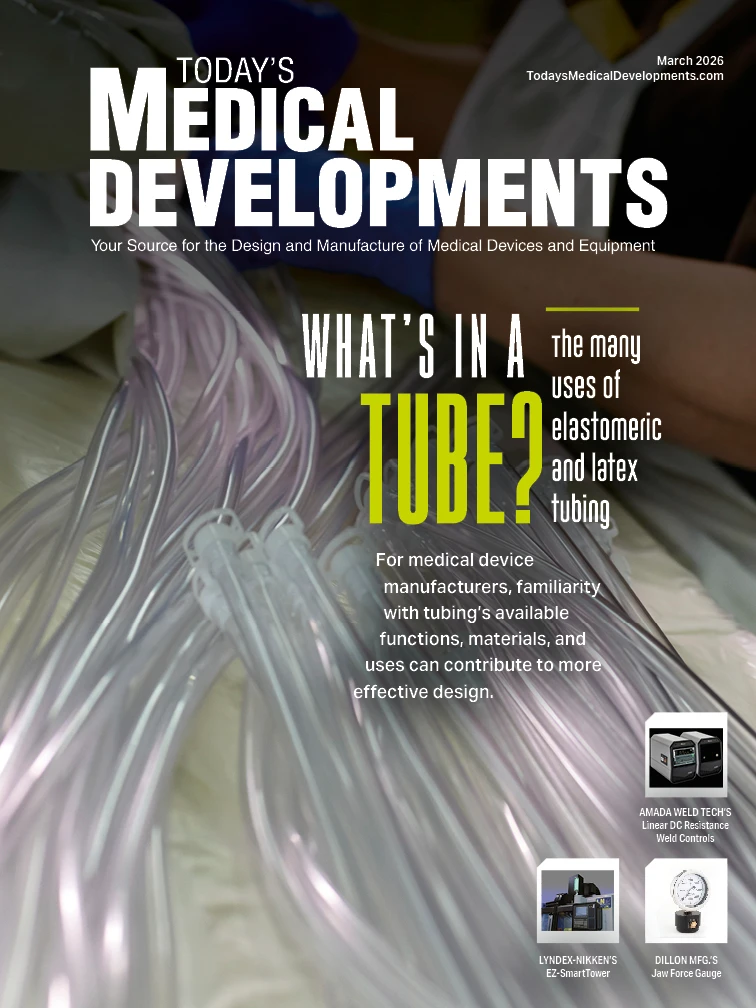
Explore the March 2026 Issue
Check out more from this issue and find your next story to read.
Latest from Today's Medical Developments
- Manufacturing technology orders reach record high in December 2025
- Kennametal introduces Machinist of the Year program
- User-friendly, automated AM post-processing systems
- Tools for Schools program invests in future of manufacturing
- How should you approach automation?
- US Paralympian partners with Autodesk to advance high-performance prosthetics
- Take a break and learn something new about manufacturing over lunch
- DMG MORI to invest more than $40.5 million in Illinois expansion