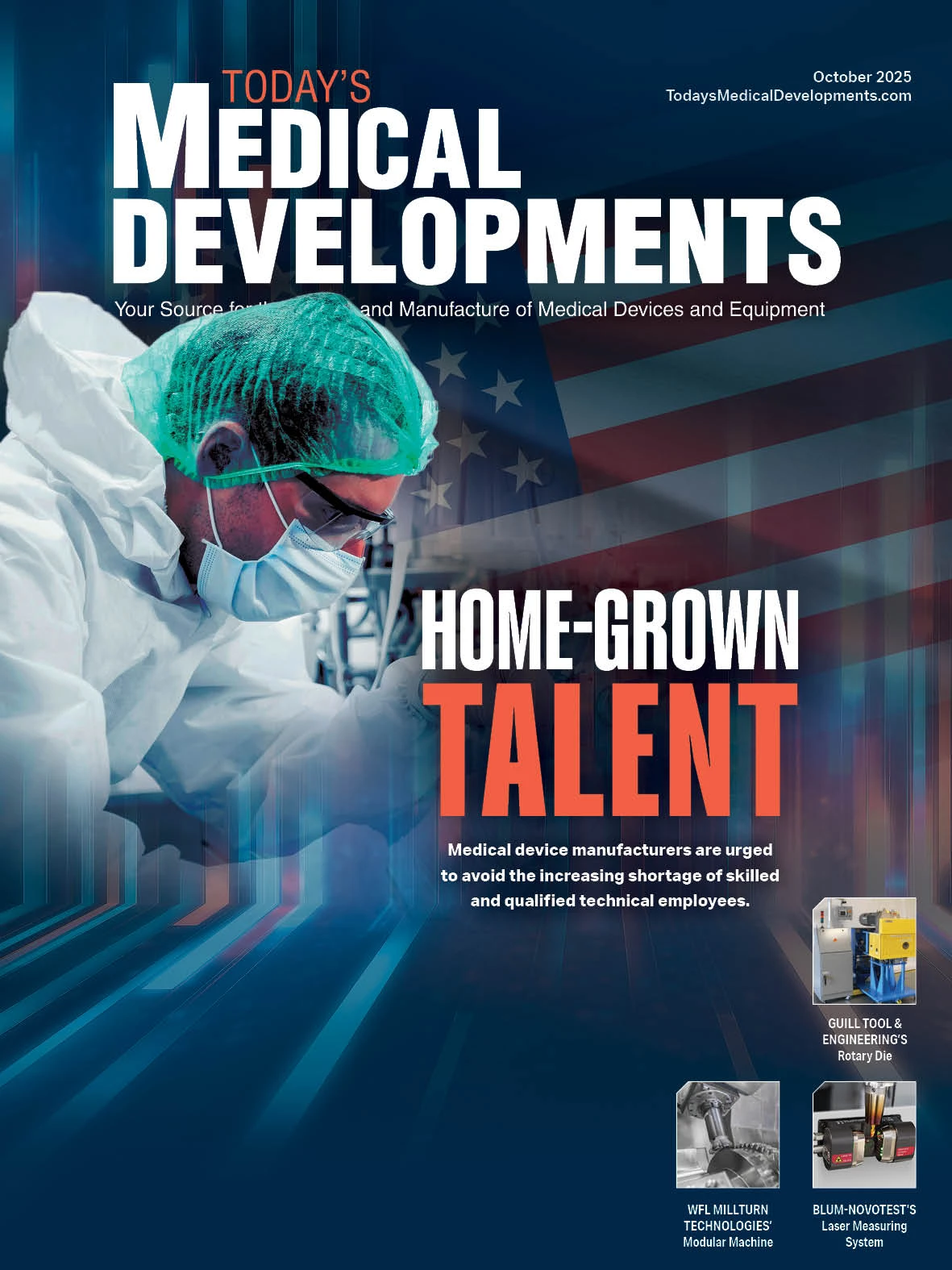
Editor's Note: This article originally appeared in the October 2025 print edition of Today's Medical Developments under the headline “Home-grown talent”.
A recent study cited in the May 2025 issue of Today’s Medical Developments (TMD) magazine indicates 75% of medtechs say they’ll shift their supply chain strategy in the next three years. Of those, 63% say they will decrease their dependence on China.
In the 2024 study, 24% said they’d move their footprint to the U.S. or Canada. But considering the U.S. import tariff announcements were released in April 2025, it’s likely a much larger percentage would now move operations to the U.S.
“One purpose of another current survey is to determine the impact of proposed policy changes, (e.g. tariffs, taxes, and deportation) and the U.S. need for a greatly enhanced skilled workforce and training system,” says Harry Moser, founder of the Reshoring Initiative. “Reshoring has surged from 11,000 jobs announced/year in 2010 to 270,000/year in 2023. Our economy and national defense need much more reshoring and workforce to thrive and survive.”
The U.S. trade deficit has risen from -$578.50 billion in 2019 to $971.12 billion in 2022 according to the U.S. Department of Labor. The increasing deficits, year-to-year, have shown no sign of moderation until the Trump administration announced new import tariffs in April 2025. The uncertainty the tariffs have caused may initially cause a pause or softening, but the deep supply chain dependence on China and other top trading partners such as Mexico, Vietnam, Ireland, and others, will likely keep the imbalance going for several years. However, the reshoring movement is already underway and will likely increase for several years until a balance is reached.
The Reshoring Initiative, founded in 2010, assists companies in accurately assessing their total cost of offshoring. The Initiative’s mission is to balance the $1.2 trillion goods trade deficit. Notably, due to more reshoring and less offshoring, U.S. manufacturing employment has risen throughout the past 14 years, the best record in the past 45 years.
“The pandemic was an eye-opener, showing us what’s at risk when supply chains are disrupted. Ever since, most of our clients have been reshaping their supply chain procurement strategies – and the teams that execute them – to focus on resiliency and guard against potential geopolitical risks, climate risks, and more,” says Kathy Nunnally, managing partner at Regions Recruiting.
In early May 2025, because of the temporary pause in the tariff confrontation between the U.S. and China, some may have guessed the tariffs might be eliminated since they were reduced to 30% for China imports into the U.S., and 10% for U.S. imports into China. However, as U.S. Treasury Secretary Scott Bessent pointed out “the largest (U.S.) bilateral trade imbalance is with China.”

The total U.S. trade imbalance reached $1.2 billion in 2024. Since U.S. Trade Representative Jameson Greer called the $1.2 billion imbalance a “national emergency,” it’s quite unlikely the tariffs will go away soon since the trade imbalance is a major contributor to the “out of control national debt.”
Building a talent pool
All the aforementioned, unpredictable variables, and the resulting increase in reshoring of manufacturing, underscores the need for companies to protect themselves from a coming, predictable, increased shortage of skilled and qualified technical employees.
Plas-Tech Engineering Inc., a Lake Geneva, Wisconsin-based manufacturer of injection molded medical devices, has been experiencing the difficulty of finding qualified, skilled talent in the areas of automation and mold-making and repair for many years.

To address this problem, “we started an apprenticeship program several years back,” says Aaron Hirschmann, president and chief technical officer. “Our first experience involved an existing employee who wanted to move into a more technical area of our business.”
To facilitate that move, Plas-Tech Engineering provided the trainee with formal training at a local technical college. That was followed with hands-on training under a supervisor as on-the-job training.
“Now, we’ve formalized our programs to provide the formal training first or concurrent with the on-the-job training. So, it has become, as intended, a win-win for both Plas-Tech Engineering and the trainee,” Hirschmann explains.
Plas-Tech Engineering is a leader in the custom injection molding of a variety of medical devices and parts for diverse industry applications. The company was recognized by the Wisconsin Manufacturers and Commerce Association (WMC) as the Manufacturer of the Year award winner among Medium Category Nominees (100 to 249 employees) in February 2025. The award recognizes Plas-Tech Engineering’s superiority in financial growth, technological advances, product development, and sustainability. It also highlights Plas-Tech Engineering’s need to recruit more skilled workers to add to its workforce.
“The medical injection molding business is a very different and difficult world with all the clean-room requirements, presses operating at their required temperatures, and moving robotic equipment, so we want to provide a safe training environment for our apprentices to learn and grow. If you take care of your people, they stay with you. We believe that more than 85% of apprentices are staying with the company after their training is completed,” says Madlynne Neuls, manufacturing manager.

“We coach our trainers to have the attitude that the apprentice should want to do our job when we retire or leave. We feel this puts everyone in the right frame of mind whether it’s the trainer or the apprentice,” she adds.
And, in one unusual case, Plas-Tech Engineering experienced a huge windfall from their apprenticeship program. According to the company’s Tool Room Lead, Dan Wojick, “because of the updated tech school training, our tool room apprentice caught an error on a drawing that saved the company about $80,000. I hope everyone that starts an apprenticeship program gets that kind of payback!”
When you consider the potential increase in business reshoring activity will likely create if it continues to increase at or greater than the record shows from these past several years, medical device manufacturers who don’t want to find themselves falling behind would be well advised to begin their own apprentice training program. Of course, it requires an investment of time and money, but the payback can be great, even without the windfall Plas-Tech Engineering experienced.
“When our tool room apprentice started, I felt as though I didn’t know how to talk to him at the beginner level, he needed time and training to allow him to understand. But now that he’s had hands-on experience, and knows most of the machine terms and jargon, it’s much easier to talk with him. That’s precisely the progress and benefit of the program that it’s intended to deliver,” Wojcik adds.

Training programs
Most companies will appreciate the efficiency and effectiveness they realize from home-grown technical talent. The apprentices trained within your own operation begin their careers as journeymen, having already been trained in your specific equipment, procedures, and policies and therefore very likely to reach peak production very quickly.
There are also resources companies can access for information and help in determining their need for an apprenticeship program. In some states, employers are eligible for grants on an annual basis to help cover or reduce the costs of hiring the apprentice. ApprenticeshipUSA’s (https://www.apprenticeship.gov) website states that: “all states have apprenticeships; however, at least 24 have coordinated, centralized apprenticeship programs. Often the coordinating agency is a division of the department of labor or an entity within the postsecondary education system.”
Registered Apprenticeship is an industry-driven, high-quality career pathway where employers can develop and prepare their future workforce, and individuals can obtain paid work experience with a mentor and receive progressive wage increases; classroom instruction; and a portable, nationally recognized credential. Registered Apprenticeships are industry-vetted and are approved and validated by the U.S. Department of Labor or a state apprenticeship agency.
According to ApprenticeshipUSA, 94% of apprentices who complete a Registered Apprenticeship retain employment with their host company, with an average annual salary of $84,000.
The training apprentices receive goes beyond classroom education by combining hands-on learning and practical experience. They acquire technical skills and soft skills such as communication, problem-solving, teamwork, and the host company’s specific policies and procedures. These internally trained and fully functional individuals are better equipped to excel in the dynamic demands of the host company’s workplace, making them valuable assets to their employer.

Skill-building through apprenticeships fosters a culture of continuous improvement, helping ensure employees are always current and relevant in an ever-changing manufacturing landscape. In addition, apprenticeship host companies realize increasing credibility in their surrounding community as the word spreads about their apprentice program. It’s truly a win-win for everyone.
Plas-Tech Engineering Inc.
https://plastechengineering.com
Explore the October 2025 Issue
Check out more from this issue and find your next story to read.
Latest from Today's Medical Developments
- Case study: Transforming CNC machining through smart lubrication strategies
- Join the automation conversation
- Medtronic expands neurovascular portfolio with Scientia acquisition
- Enhanced visitor experience highlighted at TMTS 2026
- This week: Tube bending and workholding solutions to implement now
- Highly reliable electronic components drive medical innovations
- Compact centrifugal barrel tumbler finishing machine
- Medical device manufacturer affected by major cyberattack