Odyssey Medical, a market leader in microsurgical implants, partnered with Tsugami/Rem Sales to penetrate the orthopedic component market. In doing so, they have diversified their business, significantly increased profitability, and given the company a solid platform for continued growth into new markets.
Founded in 1995, in Memphis, Tenn., by Gary and Barbara Tatge as a manufacturer of microsurgical components, Odyssey received their first patent in 1997 for the Parasol Punctal Occluder; the first product marketed under the Odyssey name.
The Parasol represented a significant breakthrough in the treatment of dry eye syndrome, a condition occurring in patients with abnormally low tear production or retention caused by normal aging, contact lens wear, surgery, and a host of other environmental factors. Punctal occluders work by blocking the punctum, or tear duct, to prevent malfunctioning ducts from carrying away tears too quickly.
The company quickly took the lion share of the punctum plug market, reaching the number one slot in 2002. In an effort to grow through diversification, the company began searching for opportunities in other emerging medical device markets. By early 2004 Odyssey Medical and its Director of Technical Services, Tim Gooch, began to look at penetrating the larger orthopedic component market. More specifically they planned to become a primary supplier of spinal components. "We were attracted to spinal components because they represent the fastest growing segment of the orthopedic market," explained Mr. Gooch. Odyssey's prior experience with its own branded product allowed them to more effectively navigate the traditional barriers of entry to the orthopedic market. 

First and foremost are FDA stringent Quality Systems Regulations, a segment of federal law that governs the practices of medical device manufacturers. These quality standards require, among other things, that manufacturers making medical devices document every action taken on a part while the manufacturer has its custodial possession. Odyssey, who had just received ISO 13485 2003 certification, was able to identify and implement the necessary quality procedures quickly because their core manufacturing business was already FDA compliant.
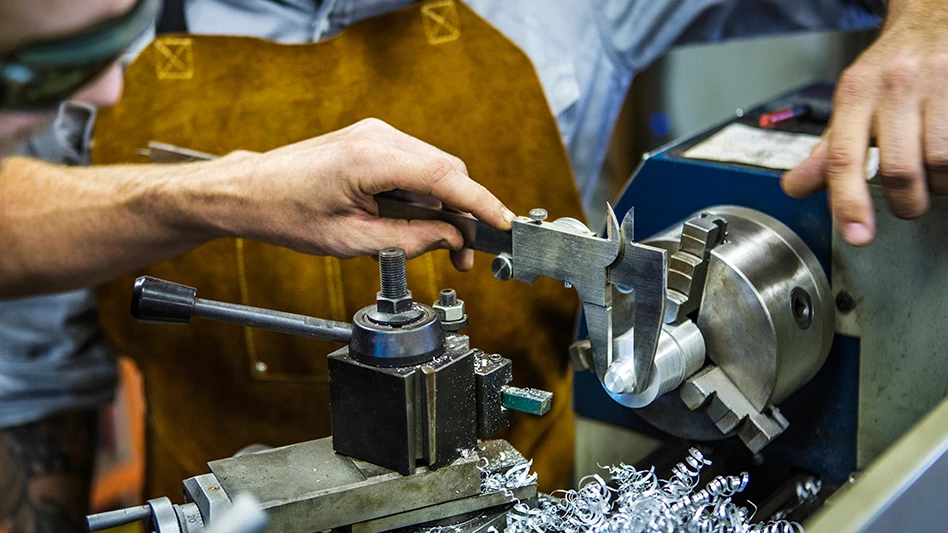
The ability to achieve and maintain extremely tight tolerances represents the other significant barrier, and requires many manufacturers to make a sizeable investment in manufacturing technology. This was no different for Odyssey who found the perfect partner in Rem Sales of East Granby, Connecticut, the United States importer of Tsugami Swiss Turns since 1978.
In March 2004, Odyssey purchased their first Tsugami, a BF 20 Swiss Turn. While impressed with its rigidity, accuracy and repeatability, Mr. Gooch wanted to add thread whirling capability. This led to a May 2005 purchase of a Tsugami BS20 Swiss Turn with Rem Sales' patented thread whirling system, and represented a vast improvement over the segmented threading on the BF20.
The two Tsugami machines have allowed Odyssey to reach and maintain extremely tight tolerances. For instance, Odyssey manufactures an implant assembly requiring an interference fit of 0.001". The BS20's capabilities are such that Odyssey can produce the assembly to the necessary tolerances in two parts rather than the three parts used by other manufacturers, and well within required tolerances.
To maximize the abilities of their machine tools, Odyssey has implemented stringent controls for process prove-out and an in-process technique called Precontrol. Precontrol augments standard practices of control charts by triggering the operator to make adjustments to machine offsets well in advance of trouble. Mr. Gooch explains, "The part specifications control the acceptability of the part, but Precontrol controls the actions of the operator." The technique divides the tolerance band into green, yellow and red areas with the middle 50% of the tolerance band being the operator's target operating zone. Any two consecutive parts that exceed this tighter tolerance trigger the operator to adjust the machine offsets. Consecutive parts that are off on opposite sides of the tolerance indicate the process is unstable resulting in adjustments to the process. Parts outside the tolerance zone are, of course, scrapped.
Odyssey implements several levels of inspection including receiving, in-process and final. All operators are considered to be a part of quality Control. The quality Assurance department then acts as a watchdog to monitor the quality of the processes through part sampling and accepted inspectional techniques. "All of the employees from management to final inspection are responsible for the quality of the product," notes Mr. Gooch. "With that in mind, we can consider our quality assurance department as process auditors. Inspecting quality into a device is a bad way of doing business. Building a robust process has a better smell of success."
On a corporate level Odyssey's quality team focuses on validating and improving processes. Each process used must pass a rigorous process prove-out prior to commissioning production. After implementation, any process or part found to be non-conforming is written up and brought before a material review board. That board can then determine the disposition of the part. Additionally, an authorized individual is appointed to prescribe corrective and preventive action (CAPA) to prevent recurrence.
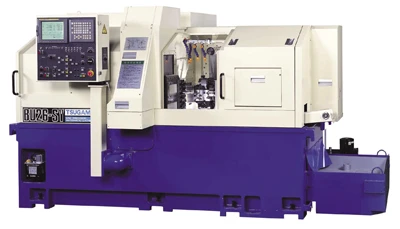
To more efficiently fill customer orders for small diameter screws with relatively large heads, Odyssey recently added a Tsugami BU26SY combination gang slide / turret Swiss Turn machine. As a solution for bulk metal removal on screws requiring 1" stock the BU26SY is ideally suited and gives Odyssey the ability to expand into additional market segments.
In the end analysis, intricate knowledge of the market, a motivated and effective manufacturing team, and Tsugami Precision Swiss Turns have made Odyssey's initial foray into orthopedic component manufacturing a remarkable success. Their commitment to process improvement and part quality is the keystone that future success will be built around. "Process validation is a walk down the aisle with manufacturing and quality," concluded Mr. Gooch. "The tool is using statistical techniques to determine process capability. If you don't have the tools that are capable, like Tsugami Swiss Turns, then you may as well go on to something else." TMD

Explore the January February 2006 Issue
Check out more from this issue and find your next story to read.
Latest from Today's Medical Developments
- NextDent 300 MultiJet printer delivers a “Coming of Age for Digital Dentistry” at Evolution Dental Solutions
- Get recognized for bringing manufacturing back to North America
- Adaptive Coolant Flow improves energy efficiency
- VOLTAS opens coworking space for medical device manufacturers
- MEMS accelerometer for medical implants, wearables
- The compact, complex capabilities of photochemical etching
- Moticont introduces compact, linear voice coil motor
- Manufacturing technology orders reach record high in December 2025