Today's implants provide more comfort, longer service life and better functional performance that is more attuned to natural body parts - so long as no impingements, nicks, mars, scratches or indentations occur from manufacturing through the actual implant surgery.
For one manufacturer of medical components, that is exactly what was happening to many of its hip stem implant pieces - accidental dings and part-to-part contact during various stages of transportation - creating problems significant enough to cause rejections and the higher need for repairs or outright scrapping of the parts. The high cost of the parts to manufacture in addition to the titanium material expenses, combined with the chance that a rejected piece could mistakenly be implanted into a patient, was an absolutely unacceptable proposition.
The cause? In the past, the manufacturer had inexplicably used a series of haphazard methods and materials for its handling operations.
The solution? One quick phone call and initial consultations with the applications specialist at PolyFlex Products.
PolyFlex is a company that provides custom thermoplastic injection molding services, low-pressure foam urethane, cast solid elastomers and thermoset components, and develops cartons and totes, dunnage specialty items, and engineered handling/logistic products for a variety of industries and markets.
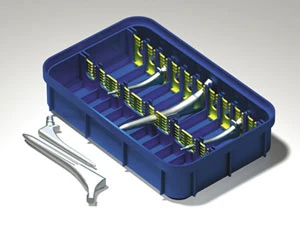
The results? A series of tote trays developed by PolyFlex in concert with the implant manufacturer that handles the hip stems during in-process manufacturing stages, in packaging, from shipping to clinics and hospitals, and, since the trays are made from thermoplastic urethane (TPU), for return to the manufacturing facility for sanitization and reuse.
A key design element of the new tote packaging is in the fact that a common tray configuration is adaptable utilizing TPU inserts to accommodate up to 21 different hip stem products, varying in size and/or length. This helps to minimize inventory costs and storage needs for the trays, and minimizes initial tooling investment required for producing the trays. The TPU inserts create a movement restricting nest that eliminates part-to-part contact and therefore protects the implants from any dents, scratches and mars that could otherwise damage the parts.
Since implementing the new tote trays, the manufacturer has been able to standardize his packaging and protective processes, significantly reducing repair and scrap volumes.
Additional features of the new tote tray series include a single, dedicated lid size and shape, meaning that one lid configuration is common to all totes - and, importantly, an economic advantage in tooling costs. The tote trays are designed to be easily stackable, with or without the lid in place, thus a single lid could be used on the top tray of a stack to protect its contents while the remaining trays' contents would be shielded by the tray above. Heights of the trays and inserts were specifically developed to assure that all the weight of a stack of trays and parts is borne by the trays themselves - no weight that might deform the parts is transferred into or through the implants. Therefore, the number of trays included in a stack is optional and need only a plastic banding for secure shipping.
Besides the flexibility of the tote trays to accommodate varying part configurations, the mold tooling design is flexible enough to offer versatility and economics to accept future parts and additional designs. For example, the basic tote tray mold uses inserts to establish its internal depth. If future parts require a deeper tray, the inclusion of different inserts could be used to alter the tooling for the new dimensions - at costs of approximately one half the investment of the initial tooling.
In addition, a tool design that is used to produce a snap-in wear pad can also be easily and quickly modified for use with different parts that may require altered nesting profiles. This tool design allows for simple tool modification at only onefifth of the original tooling costs.
PolyFlex Products
Livonia, MI
polyflexpro.com

Explore the March 2009 Issue
Check out more from this issue and find your next story to read.
Latest from Today's Medical Developments
- NextDent 300 MultiJet printer delivers a “Coming of Age for Digital Dentistry” at Evolution Dental Solutions
- Get recognized for bringing manufacturing back to North America
- Adaptive Coolant Flow improves energy efficiency
- VOLTAS opens coworking space for medical device manufacturers
- MEMS accelerometer for medical implants, wearables
- The compact, complex capabilities of photochemical etching
- Moticont introduces compact, linear voice coil motor
- Manufacturing technology orders reach record high in December 2025