Managing Editor, CScott@gie.net
A recent episode of “60 Minutes” told the stories of three patients paralyzed after accidents. Until recently, the severity of their spinal injuries would have left them without hope of regaining mobility.
However, these patients participated in a clinical trial, run by French neuroscientist Gregoire Courtine and Swiss neurosurgeon Dr. Jocelyne Bloch, allowing them to move again. What makes this treatment different from anything that’s come before is the patients can control their limbs using only their thoughts.
Courtine and Bloch’s lab, NeuroRestore, developed a device stimulating the spinal cords of paralyzed patients, allowing them to stand, take steps, and in some cases, even climb stairs, using a button to activate the device. Recently, Courtine and Block took the technology further with their digital bridge – a skull implant wirelessly connecting the spinal cord stimulator directly to the patient’s brain.
As the researchers explain, a spinal cord injury interrupts the signal between the brain and spinal cord directing movement. The digital bridge restores that signal.
The small titanium device, implanted into the patient’s skull directly above the brain’s motor cortex, features electrodes recording neurons correlating to the movement of various areas of the limbs. When a patient thinks about moving a limb, the electrodes record the brain activity, which is then translated via artificial intelligence (AI) into instructions for the spinal cord stimulator. The stimulator sends electrical pulses activating muscles in the limb, allowing the patient to move it less than a second after thinking about it.
Many people are wary of AI, and there’s been plenty of evidence demonstrating caution is warranted. That’s another column altogether, but in the medtech field, AI, automation, and robotics have already achieved remarkable things. We’ve been following the progress of robotically powered exoskeletons, such as Ekso Bionics’ (formerly Parker Hannifin’s) Indego, helping patients with impaired mobility to stand, walk, and otherwise move their limbs, for more than 10 years. Whether internal or external, AI- and robotics-based technology allows paralyzed patients to move again – and what’s really intriguing is the patients may not be dependent on the technology for life.
The rehabilitative use of the Indego strengthens patients’ muscles and helps them gain neuroplasticity, sometimes leading to the ability to move unassisted. And while NeuroRestore’s digital bridge is still in clinical trials, Courtine and Bloch discovered something unexpected: some of the patients regained the ability to move their limbs without the device’s assistance. Using it had enabled the growth of new nerve connections, specifically on a neuron capable of repairing the central nervous system.
Courtine and Bloch have co-founded Onward Medical to further develop the digital bridge and their full ARCBCI System, including the spinal stimulation device.
We’ve explored automation and AI frequently in recent issues – with the impact it’s having in manufacturing facilities and direct patient care, it’s impossible to disregard. Yes, it’s important to proceed with caution – but we are proceeding, and the results can be astonishing.
“It’s giving me my perspective back,” said Marta Carsteanu-Dombi, one of the clinical trial patients, in the “60 Minutes” interview. “Standing up again and looking people in the eye, that’s different.”
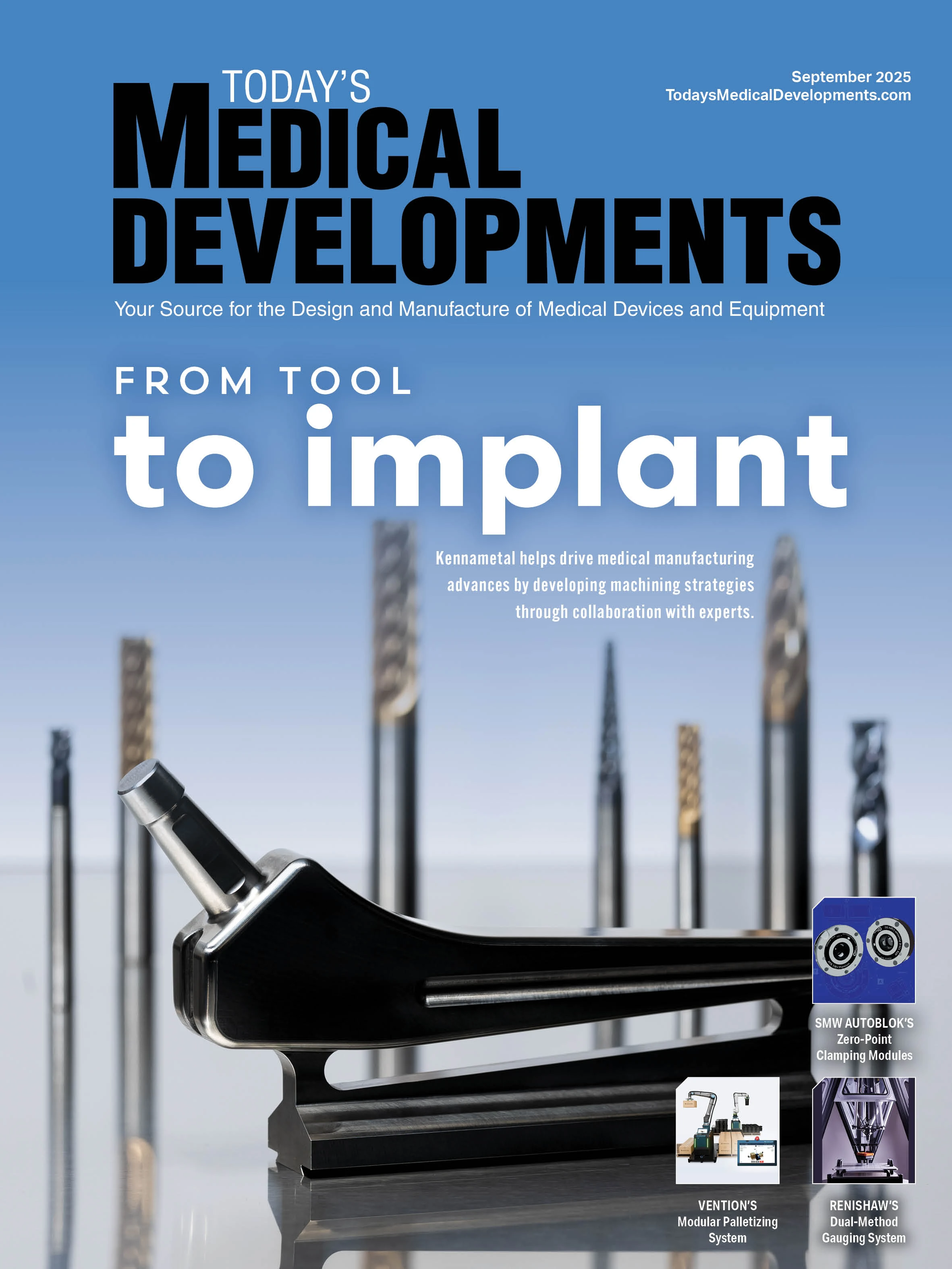
Explore the September 2025 Issue
Check out more from this issue and find your next story to read.
Latest from Today's Medical Developments
- NextDent 300 MultiJet printer delivers a “Coming of Age for Digital Dentistry” at Evolution Dental Solutions
- Get recognized for bringing manufacturing back to North America
- Adaptive Coolant Flow improves energy efficiency
- VOLTAS opens coworking space for medical device manufacturers
- MEMS accelerometer for medical implants, wearables
- The compact, complex capabilities of photochemical etching
- Moticont introduces compact, linear voice coil motor
- Manufacturing technology orders reach record high in December 2025