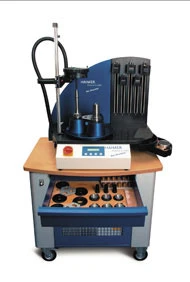
The High Accuracy Toolholder of Choice for the Medical Industry Requirements in the medical industry are much more precise than general machining, so more attention must be made toward the selection of the appropriate toolholder in regard to its features and benefits.
Within the last 10 years, the acceptance and integration of shrink-fit toolholders has continued in aiding in the advancement of the machining capabilities in the North American-based medical industry.
Toolholding for milling machines in general had been often overlooked by most manufacturing facilities throughout North America. The medical industry, however, often has been the first segment of the manufacturing market to look for more precise toolholder options. Due to numerous inherent benefits, shrinkfit toolholders have predominately become the high-accuracy toolholder of choice for the medical market.
The medical industry faces many challenges in which shrink-fit toolholders have proven to provide benefits. Small cutting tool diameters, deep reach needs for clearances on 5-axis machining centers, fine finish requirements, and tough materials to be machined create great obstacles for many medical manufacturers.
In order to address this challenge, the medical industry have been forced to look at their entire process and decide on the appropriate machine control, CAD/CAM software package, toolholders and cutting tools in order to most efficiently complete the job.
FINDING A SOLUTION
When looking for toolholder solutions for any type of machining, it is always good to first focus on three main features that a toolholder must bring you:
Rigidity - Rigidity comes from sufficient taper contact and proper clamping of the toolholder in the machine tool spindle.
Accuracy - Accuracy comes from minimal runout at the cutting edge of the cutting tool.
Balance - Balance comes from a balanced assembly of the toolholder -including all accessories such as pullstuds - and cutting tool combination.
SHRINK-FIT ADVANTAGES
There are 10 inherent benefits that a good shrink-fit chuck can offer a medical manufacturer:
- Unsurpassed accuracy - A properly produced shrink-fit chuck should be able to guarantee 0.00012" (3µm) maximum runout at three times the cutting tool diameter.
- Availability of slim profiles - Shrinkfit chucks are available with 3° draft angles and very slim profiles. They can also be modified to be straight walled in order to prevent toolholder collision with the workpiece.
- Gripping torque - A shrink-fit chuck grips the cutting tool 360° around the shank. This leads to a high gripping torque that prevents the cutting tool from moving during roughing or finishing operations.
- Extended reach options - Shrink-fit chucks can utilize shrink-fit extensions, which provide the user with many options with standard products. This is beneficial for 5-axis machining as well.
- Balance repeatability and balanceable options - Shrink-fit chucks offer significant balance repeatability because there are no moving parts.
- Reduction of toolchanging time / less toolholder accessory inventory - Tool changes can be consistently done in five to 10 seconds. This allows the toolholder assembly to be in the machine making chips more of the time.
- Cleanliness of setup - A shrink-fit chuck is typically a sealed system by design. Therefore, the introduction of contaminates in the bore are minimized. If contaminates are introduced to the bore of a toolholder, often times runout accuracy is compromised.
- Coolant options - Shrink-fit chucks often have clever methods (such as the "Cool-Jet" offering) to deliver coolant or air/oil mist down to the cutting edge of the cutting tool.
This helps with the proper removal of chips and can also aid in providing better finishes. In addition, if a medical manufacturer does high precision drilling, a shrinkchuck makes an excellent holder for coolant-through drills, since no accessories or special collets are needed - the sealed design of the toolholder simply allows the coolant to flow through the cutting tool. - Consistency of setup - Shrink-fit holders provide repeatability from toolholder setup to toolholder setup.
This is especially beneficial for those shops running lights-out. For example, all toolholder setup operators set the toolholders the same with shrink-fit holders. There are no variables - such as over-tightening or under-tightening a collet nut or not cleaning out a chuck sufficiently. - Availability of shrink-chucks - Most of the major toolholder builders in the world now offer shrink-fit chucks as a standard. Therefore, medical manufacturers are not roped into proprietary high-precision collets or pressfit systems that sometimes are only available from one manufacturer.
SELECTION
While there are many suppliers of shrinkfit chucks available, there are good and bad shrink-fit chucks. It is important to do research related to the selection of a toolholder for your particular application.
Typically, the initial purchase of your toolholders will last the life of your machine tool. Studies have found that the overall expense of toolholders equals less than 0.5% of the overall machining process during the life of the machine tool.
The relationship between the bore of the holder and the taper is what leads to the accuracy of the chuck. It is important to choose a company that truly makes their own product and specializes only in the production of toolholders. This guarantees you the most consistent and accurate toolholder available for your job. The material of the shrink-fit chucks is also a key element in making the correct selection. If a substandard material is used, one might shorten the life of the shrink-fit chuck based on limited heating cycles. A shrink-fit toolholder, made of the correct material, should remain effective indefinitely. Also, it is important that the chucks subscribe to the DIN standards on the nose dimensions so that all cooling options from the shrink-fit machine side can be utilized.
In general, it is recommended to purchase chucks with many "options" builtin - such as balanced so that there is under 1gmm of unbalance in the chuck, balanceable design, bore for the data chip, form "DIN B" coolant delivery option, etc. - so that you are not limited in the future as your operation evolves.
Finally, the company making the chucks should be an industry leader, constantly putting further efforts into research and development for new toolholding concepts that can further strengthen the role of shrink-fit toolholders. For example, the recent development of a shrink-fit chuck that provides an anti-vibration feature in a shrink-chuck helps dampen the vibration during roughing operations.
SUMMARY
It is often stated by shop owners and plant managers that shrink-fit tooling has been the best investment they have made in the past five years. Acceptance of the use of shrinking technology in the medical market has played a vital role in strengthening North American manufacturing capabilities and preparing it for continued growth.
Haimer U.S.A.
Villa Park, IL
haimer-usa.com

Explore the March 2009 Issue
Check out more from this issue and find your next story to read.
Latest from Today's Medical Developments
- Exchangeable-head solid carbide cutting tools
- NextDent 300 MultiJet printer delivers a “Coming of Age for Digital Dentistry” at Evolution Dental Solutions
- Get recognized for bringing manufacturing back to North America
- Adaptive Coolant Flow improves energy efficiency
- VOLTAS opens coworking space for medical device manufacturers
- MEMS accelerometer for medical implants, wearables
- The compact, complex capabilities of photochemical etching
- Moticont introduces compact, linear voice coil motor