Subfractional horsepower motors can be found used in applications touching every facet of our lives.
AC motors are used in equipment that copies keys, slices meats, fills the bottles that hold shampoo, count coins, stir frozen slushy drinks, moves photos through a film processor and industrial chicken rotisseries, to name just a few uses.
Stepping motors print lottery tickets, airline boarding passes, turn slot machine wheels, rotate surveillance cameras, position IC chips on circuit boards, analyze blood samples, help in the search for new drugs, control the amount of medicine administered to patients, emboss credit cards and do much, much more.
Brushless DC motors spin laser scanners at the grocery store, pump liquid fertilizer on to golf courses, power glass inspection systems for flat panel televisions, move conveyor belts to sort bad fruit from good, drive orthopedic rehabilitation equipment and treadmills, as well as aiding in the growth of silicon crystals. These are among the thousands of brushless DC motor applications.
A bedside medical pump is an application where hybrid stepping motors are commonly used in the medical industry. These peristaltic type pumps are used to accurately and repeatably inject medicines into patients, in the right dosage, at the right rate. Stepping motor are ideal for this application since it is easy to control how far and how fast the motor will move, so regulating both the amount and rate of flow.
Major requirements for a bedside peristaltic pump application:
- It should be easy to set and adjust the amount and rate of fluid flow;
- The motor must be compact;
- The Motor must be quiet;
- The motor and the related driver must draw low power for battery backup purposes;
- The motor should be able to run with a very wide speed range. Low speeds for administering drugs and high speeds for priming and/or cleaning the pump.
Since a stepping motor moves in a fixed increment for every step requested, the number of requested steps determines the distance that a motor will move. In addition, a properly sized stepping motor will not need the use of any type of feedback device to ensure it has moved the proper distance. A typical 5-phase step motor has a basic full step angle of 0.72°/step. In order to make the motor move 1 complete revolution, 360° divided by 0.72°/step would mean that 500 steps would need to be requested. If the pump mechanism were set to deliver 0.01cc of fluid per step, 1 rotation of the motor would deliver 5cc of the fluid. If these 5cc of fluid needs to be delivered in 2 minutes, then the 500 steps would need to be requested at a rate of 4.12 steps/sec.
In the real world, step angles of around 5000 steps/revolution are used in the pumps to increase the resolution of the motor. The benefits of increasing the step resolution are that the amount of the fluid to be moved per step of the motor will be lower and that the step motor will run smoother and more quietly.
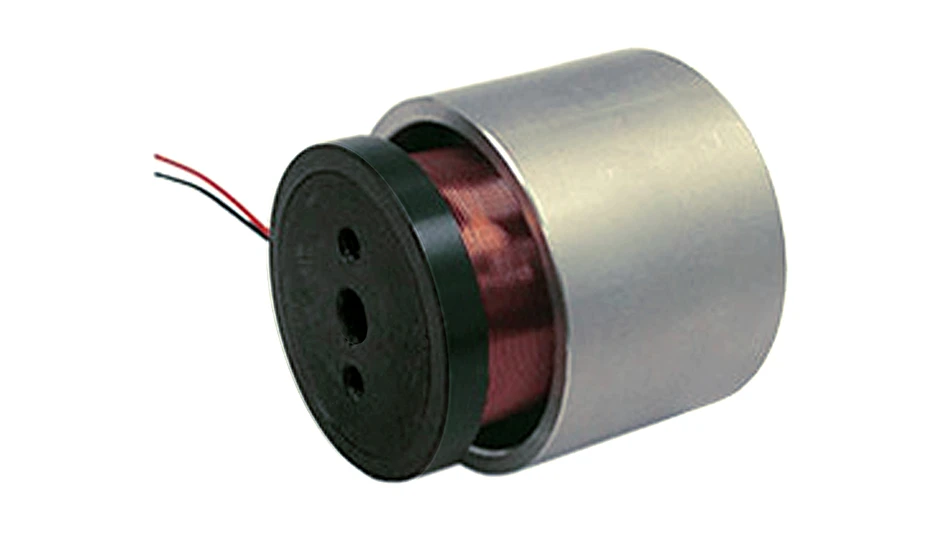
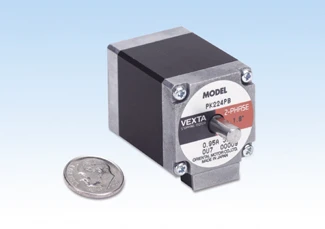
Hybrid stepping motors are available in many sizes, including mounting sizes as small as 20mm-sq. (0.78in-sq.). These compact mounting sizes allow medical equipment designers to create smaller and less obtrusive pump designs. Although these motors are small, they can deliver torques up to 3.2 oz-in without gearheads.
Since these pumps are generally in close proximity to the patient, any noise generated by them can be disconcerting. As a result, the motor must rotate smoothly and quietly in order not to disturb the patient. In general, the best way to reduce the amount of vibration and noise generated by vibration of a step motor is to reduce the step angle. This can be done either mechanically or electronically. A typical 2-phase hybrid step motor has a basic step angle of 1.8°, while the 5-phase step motor has a step angle of 0.72°. The step angle can be reduced electronically by using a microstepping driver. A microstep driver reduces the step angle of the motor by controlling the phase currents in a manner that causes the rotor to move in very small increments. A combination of a 5-phase step motor and a 5-phase microstepping driver leads to the best possible motor vibration performance.
In emergency situations, AC power may not be available for the bedside pump. Since DC voltages and currents run a stepping motor, it is possible to use battery backup in emergencies. Stepping motor have high output torque to input power ratio, which means that battery life can be extended. Another power saving feature of a stepping motor is that the current to the motor can be reduced when the motor is not being requested to move. This can further extend the battery life in the pump.
By simply increasing the frequency of step requests, the motor will run at higher speeds. Of course, there are limits as to how fast a motor will rotate, but real world speeds tend to be well within the capabilities of a stepping motor.
Both 2-phase and 5-phase stepping motors are widely used in peristaltic medical pumps used by hospitals and urgent care clinics around the world. Their small size, ease-of-use and ability to quietly, precisely and accurately deliver fluids make them ideal for ensuring the comfort and improved health for a variety patients. TMD

Explore the January February 2006 Issue
Check out more from this issue and find your next story to read.
Latest from Today's Medical Developments
- Stryker’s flexible syndesmotic fixation device stabilizes ankle injuries
- Mergers & acquisitions news: MGS, Quantum Surgical bolster medtech portfolios
- Exchangeable-head solid carbide cutting tools
- NextDent 300 MultiJet printer delivers a “Coming of Age for Digital Dentistry” at Evolution Dental Solutions
- Get recognized for bringing manufacturing back to North America
- Adaptive Coolant Flow improves energy efficiency
- VOLTAS opens coworking space for medical device manufacturers
- MEMS accelerometer for medical implants, wearables