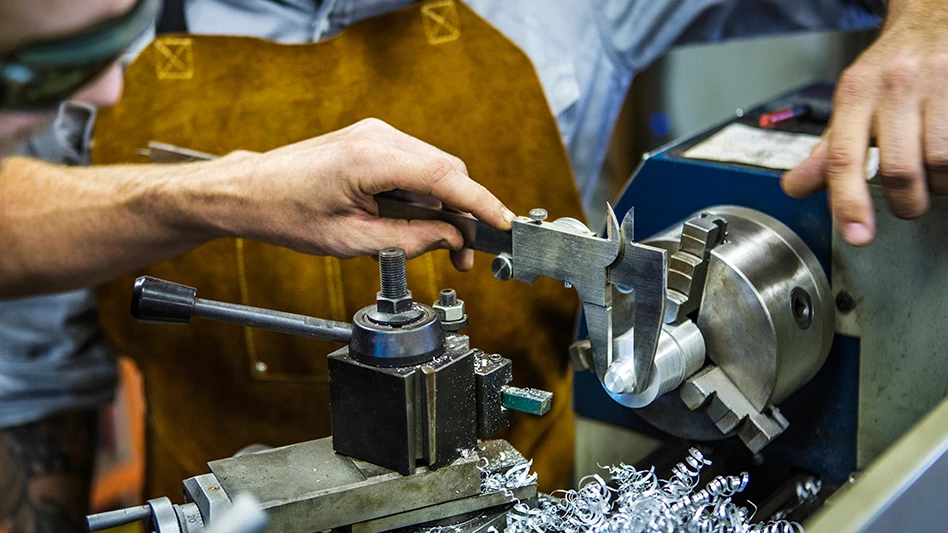
The Formula Plastics facility includes a Class 100,000 cleanroom, 60 injection molding machines ranging from 30 tons to 550 tons, in six plants covering 140,000ft2, and an advanced metrology lab.In the price-driven and competitive business of injection molding, one usually conjures up an image of a no-frills facility in a far-off land where the decision to do business is dictated mainly on price. However, one facility is proving to U.S. manufacturers that they do not have to compromise on cost to get outstanding quality along with conveniences and efficiencies they never thought possible.
This ISO-certified injection molding facility includes a Class 100,000 cleanroom, 60 injection molding machines ranging from 30 tons to 550 tons located in six different plants covering 140,000ft2, and an advanced metrology lab – on a sprawling 10-acre campus.
Every month, auditors employed by a veritable Who’s Who list of Fortune 500 U.S. manufacturers regularly arrive to tour the facility and perform detailed inspections, which the facility passes with excellence. Day after day, the company churns out hundreds of thousands of plastic injection molded parts, which are loaded onto the company’s own truck fleet and shipped to manufacturers throughout North America with names like Sunstar Butler, Covidien, and Scantibodies.
What is so unusual about this picture? This see-it-to-believe-it facility owned and operated by Formula Plastics is located in Tecate, Mexico. By operating just south of the border, the injection molder is strategically located to acquire the latest in technology and provide JIT deliveries to customers located throughout Northern Mexico and the United States.
“Every time I visit Formula Plastics, I see something new,” says Michael Parks, manager of supply chain planning and logistics for Scantibodies Laboratory Inc., Santee, CA.
Parks’ supervisor, who was doing business in Tecate, CA, introduced Parks to Formula Plastics. When the companies’ Chief Operating Officer, John Van Duzer, stopped by for lunch, he suggested that Parks should take a look at the company. Based upon Van Duzer’s recommendation, Parks decided to take a tour of the production facility – a tour that Formula Plastics regularly provides for all interested parties on a regular basis.
“I had sourced injection molded components in many parts of the world, but this kind of quality and involvement was new to me, and I was impressed,” Parks says. “I needed a source for our medical diagnostic pregnancy test devices and decided to look into the Formula Plastics injection molding operations. I was equally impressed with the factory environment and the attention to detail that was evident in the company’s production processes.”
Scantibodies is an international manufacturer and marketer of more than 1,500 diagnostic products used by clinical laboratories throughout the world. These products are used in medical diagnostics to calibrate and monitor the accuracy of clinical tests and prevent drift of test values, which ultimately guide a patient’s doctor to prescribe the correct therapy.
“We did a quality audit to make sure that they could meet our stringent standards for the injection molded products we needed,” Parks explains.
The Scantibodies audit team was indeed satisfied that the injection molder possessed the production equipment and quality processes necessary to produce the items wanted. Also important, the molding facility was relatively close to the Scantibodies Baja, CA, plant, making JIT deliveries possible.
“Given their capabilities, the injection molder’s proximity was an added advantage,” Parks explains. “We have purchased plastics from as far away as China, but the logistics and shipping costs make a significant difference when you consider the weight involved. We are producing literally millions of parts each month, and I have to keep the optimum inventory levels, which are constantly revolving.”
Parks says that with the injection molder nearby, they are more than able to meet his demands without having a huge warehouse full of plastic. In addition, because this supplier has its own truck fleet, they are able to make deliveries whenever required.
Raising the Bar
Formula Plastics prides itself in being able to meet the most sophisticated and challenging injection molding requirements, regardless of size, materials, processes, or turnaround times.
The firm has 60 molding machines, ranging from 30 tons to 550 tons, located in five different plants. This not only includes the most modern molding equipment, but also high-level inspections with an on-site metrology lab employing laser-tracking CMM and RAM Optical vision instrumentation. Comprehensive data collection and management of customer specifications and inspection records is also provided.
The injection molder’s client list is equally impressive with customers including Robert Bosch, Sunstar Butler, Leviton, Yakima, Phillips, Covidien, Square-D, Rockwell, and Scantibodies, representing a diverse range of industries including agriculture, electronics, tools, recreational and business equipment, healthcare, and others.
However, producing components for Scantibodies introduced a new requirement: a cleanroom that met the standards of manufactured medical devices.To satisfy that need and meet even higher requirements, the injection molder built a large Class 100,000 particle cleanroom that is suitable for producing items for the medical, high-tech, and other industries that demand high cleanroom standards.
Plant 6 currently houses the Class 100,000 particle cleanroom and the building is capable of adding capacity with another cleanroom to accommodate additional medical molding demands.
Another area of importance to Scantibodies and other high-volume product manufacturers is the ability to produce, maintain, and repair molds.
“In the past I have had some problems where the tooling was not maintained well, or there was damage to tooling,” Parks says. “That can result in quality problems. Because Formula Plastics performs inspections throughout production, we do not have those problems. But equally important, they take very good care of our molds, and see to it that they are repaired whenever necessary.”
“Tooling is a big investment for the customers,” agrees Alex Mora, Formula Plastics’ president. “Molds break when you are running production, therefore, the ability to quickly accommodate mold repairs means we are in control of our customers’ delivery demands. Therefore, having the ability to repair molds quickly and expertly is very important in terms of our customers’ delivery and quality standards. We pride ourselves on being able to do that well.”
Parks adds that Formula’s inspection capabilities also contribute to their overall quality. “Quality problems due to tooling wear must be found during inspections,” he says. “We still do inspections, but they are at the lower AQL level, which is less time consuming. And that is made possible because we require that our suppliers perform high-level inspections of all parts all the way through their processes.”
Formula Plastics
Tecate, CA
formulaplastics.com

Explore the November December 2010 Issue
Check out more from this issue and find your next story to read.
Latest from Today's Medical Developments
- NextDent 300 MultiJet printer delivers a “Coming of Age for Digital Dentistry” at Evolution Dental Solutions
- Get recognized for bringing manufacturing back to North America
- Adaptive Coolant Flow improves energy efficiency
- VOLTAS opens coworking space for medical device manufacturers
- MEMS accelerometer for medical implants, wearables
- The compact, complex capabilities of photochemical etching
- Moticont introduces compact, linear voice coil motor
- Manufacturing technology orders reach record high in December 2025