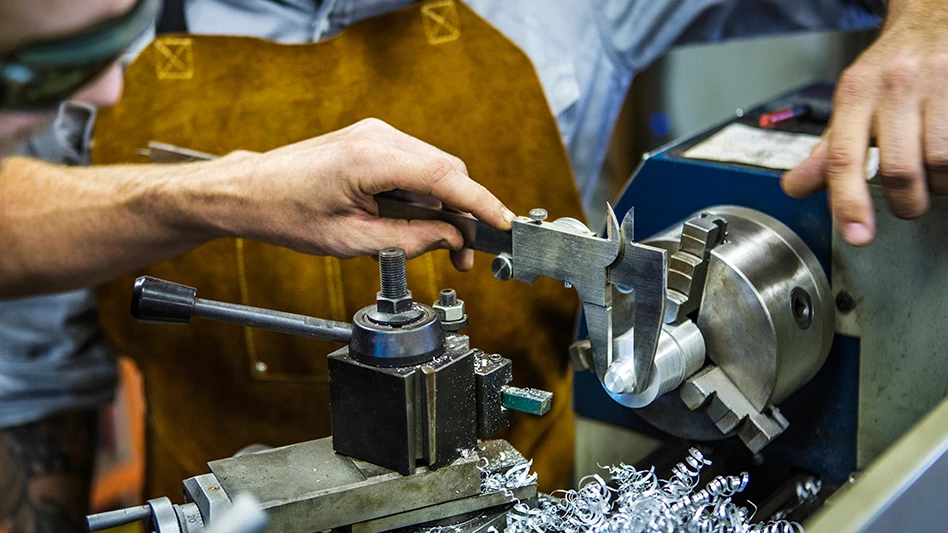
Iscar has steadily expanded its capacity of inserts, including the smaller ones needed for implant and prosthesis work. Iscar has steadily expanded its capacity of inserts, including the smaller ones needed for implant and prosthesis work. |
Worldwide demand for precision-turned medical parts is definitely on the rise, especially for orthopedic and dental implants. This is partly due to the aging population; the longer we mortals live, the more spare parts we will need.
So as demand increases, so will the competition for this high-end work. also increases. The business will go to providers that deliver not only extreme accuracy and efficiency in difficult-to-machine metals, but to those that also provide prototyping capability, quick turnaround, and the willingness to deliver in small quantities. Working with such expensive and difficult material, and short runs, leaves little room for error.
The good news is that advanced tooling is now available specifically to help those demanding medical fabrication jobs run faster and better. Proper choice of tooling – even drop-in replacements – can often double machining rates or edge life, improve chip control, and eliminate part distortion on thin-walled or difficult-to-grip workpieces.
For example, while producing a small part at a Swiss dental product manufacturer, inserts were failing prematurely and unpredictably, often by chipping and edge breakage. Edge life averaged 90 pieces, but the range varied so widely as to render meaningless the term average.
With the drop-in switch to an Iscar PVD-coated Pentacut insert in a very rigid screw lock toolholder, edge life more than doubled to 250 pieces per edge, with an improved surface finish. The failure mode was gradual, predictable edge wear as indicated by deterioration of surface finish. The operation could run unattended as a result. Key to the improvement was the greater clamping rigidity that held the insert in place.
Three Common Denominators
In this case, machining away more than half of the original metal weight illustrates an often-overlooked aspect in medical component turning. Though the parts may be small, the volume of metal removal is relatively large. Whether on miniature Swiss automatics or small turning centers, turning medical components often involves extreme stepped diameters machined from solid bar stock. The finished part may weigh much less than before machining.
 The other common denominator of medical part turning is that the material will likely be difficult to machine. The main diet is gummy stainless steel and other nicke-based alloys, long-chipping titanium, high-temperature alloys, and hardened steels. In material selection, biocompatibility, corrosion resistance, and extreme high strength will necessarily take precedence over machinability.
Workpiece geometry can add to the challenge. Thin-walled tubing, especially aluminum on other non-typical medical parts, are prone to distortion unless the cutting edges are extremely sharp. Many workpieces will be asymmetrical, with complex curves interfering with fixturing and support. This places a premium on minimizing cutting forces, so the cutting and not distortion of the actual workpiece occurs. In particular, there must be adjustments of rpms in order to maintain proper surface speeds as the part diameter shrinks in unforgiving materials.
Fortunately, significant advances in tooling for difficult materials in larger-scale applications are now available in the smaller sizes you need for medical component work. Advanced coatings reduce friction, machining heat, and microscopic stress raisers that can lead to sudden edge failure. Improved carbide grades stand up reliably to the punishing materials, even with interrupted cuts. More aggressive chipbreakers and through-the-tool coolant delivery improve chip control and evacuation while reducing re-cutting even in the deepest bores. More secure clamping systems keep the insert in position and eliminates the micro-vibrations associated with insert movement in the seat pocket.
Coatings Breakthrough
Three years ago, Iscar introduced the Sumo Tec post-coating treatment, designed to make the insert coatings smoother and more lubricious, thereby mitigating the three key enemies of insert life: friction, heat, and stress raisers. At the time, offering of this technology was for a limited number of milling and turning inserts. Field experience demonstrated that the Sumo Tec treatment improved efficiency an average of 35%, taking into account both throughput and edge life. Today, more than 40% of Iscar carbide inserts come with the Sumo Tec treatment as standard.
Matching Grades to Applications
Here is a closer look at the carbide grades that are improving medical turning.
Grade IC 807, a submicron grade with a TiAN PVD coating and Sumo Tec treatment, is well suited for medium speed machining in austenitic stainless steel, heat resistant alloys, and hardened steel. The Sumo Tec post-coating treatment demonstrates excellent resistance to built-up edge in stainless work.
Grade IC 808, with a hard, fine-grain substrate and the same coating and treatment as IC 807, delivers high resistance to wear and chipping on a wide variety of materials and for interrupted cut applications.
Extra-tough Grade IC 328, with TiCN coating and the new IC830 with the Sumo Tec treatment, has proven itself even in milling, parting, grooving, and unstable turning applications in plain, alloy, and stainless steels.
Grade IC 928 performs well in heavy roughing work and interrupted cuts in all the common metals used in implants. It features a tough substrate with a PVD TiAlN coating.
 Iscar offers inserts specifically designed for medical machining successes. Iscar offers inserts specifically designed for medical machining successes. |
Chipbreakers
Choice of chipbreaking geometries can also make a big difference on small medical parts in difficult materials. Iscar features these chipbreakers:
- For general turning and good finish in all metals including aluminum, the sharp edges, high rake angles, and polished top of the AS-type chipbreaker.
- For more severe applications such as parting and grooving, thin wall tubing in softer, gummy materials, the more aggressive J, JS, and JT chipbreaker geometries may be necessary. They feature sharper cutting edges along with the high rake for better chipbreaking.
In internal turning, chip control and evacuation has been a chronic problem, especially for gummy, long-chipping metals. A complete line of Iscar Mincut grooving tools alleviates this with through-tool coolant delivery. The toolbars feature a very rigid clamping system, prolonging edge life and improves process security.
Available for bore diameters down to 8mm, they have proven safe for grooving, undercutting, threading, and channeling in very deep holes. The Mincut range is capable also of face grooving depths up to 5.5mm.
Protecting Slender Parts
For threading on slender parts, a multi-tool process called whirling can do the job without deforming the workpiece. Multiple tools, symmetrically spaced, balance the cutting forces as no single point tool possibly can.
Now Iscar offers inserts specifically designed for this process as special tooling. Typical successes have included thread whirling titanium bone screws.
Better Solutions Sooner
It is clear that medical component machining will remain a growth industry for the near future. Like other high-end manufacturing sectors, it will remain very competitive. Advanced tooling, now more widely available in the required smaller sizes, can make a big difference in efficiency and profitability. Often all it takes is a drop-in replacement.
Iscar Metals Inc.
Arlington, TX
iscarmetals.com

Explore the April 2012 Issue
Check out more from this issue and find your next story to read.
Latest from Today's Medical Developments
- NextDent 300 MultiJet printer delivers a “Coming of Age for Digital Dentistry” at Evolution Dental Solutions
- Get recognized for bringing manufacturing back to North America
- Adaptive Coolant Flow improves energy efficiency
- VOLTAS opens coworking space for medical device manufacturers
- MEMS accelerometer for medical implants, wearables
- The compact, complex capabilities of photochemical etching
- Moticont introduces compact, linear voice coil motor
- Manufacturing technology orders reach record high in December 2025