Each year, the manufacturing and technology trade show season kicks off with CES, the Consumer Technology Association’s massive tech showcase. It’s a good opportunity to gauge where tech is heading, and while we weren’t there in person, we’ve been following the reports coming out of the show, especially those pertaining directly to manufacturing. It likely won’t be a surprise to anyone that CES 2026 was heavy on artificial intelligence (AI) and robotics.
Technology developer RealSense evaluated some of the major robotics trends apparent from the show, and one in particular stood out: visual perception.
“We’re moving from isolated automation to shared autonomy,” says Nadav Orbach, CEO of RealSense. “Robots are no longer executing scripts; instead, they’re being asked to understand intent, navigate uncertainty, and collaborate. That only works if they can see and perceive the world with confidence."
According to RealSense, smarter robots are trained through experience. Rather than simply executing instructions, robots are shifting to carrying out assigned goals through vision-language-action (VLA) models. Developers will define intent – for example, moving a pallet or inspecting a facility – and the robots must infer context, plan routes, identify objects, and adapt in real time.
RealSense also notes the increasing prevalence of humanoid robots, which we’ve been seeing over the past year with introductions of humanoids from companies such as Hexagon, Techman Robot, and others. As with other robots, the success of humanoids comes down to perception – reliable vision allows them to safely, autonomously work alongside humans and integrate into larger robotic systems.
Integration is key, RealSense adds – robotics are moving away from siloed machines toward interoperable ecosystems including sensing, compute, and AI across platforms plus workflows connecting perception data, simulation, and deployment. Finally, the company concludes, the success of robotics in manufacturing, healthcare, and other environments depends on trust, safety, and real-world reliability.
It’s interesting to contrast the emphasis on safety and trust in physical robotics with other AI applications, particularly generative AI. This month’s infographic examines the top 10 healthcare technology hazards of 2026 according to ECRI, a nonprofit dedicated to evaluating safety and quality in healthcare tech. The greatest technology-based threat to human health, ECRI concludes, is an excess of trust in chatbots such as ChatGPT for advice on health conditions. While these bots can offer valid advice, they’re not regulated and can also provide false or misleading information resulting in patient harm.
It’s understandable, with the high cost and long waiting times involved in the healthcare system, that people seek readily available online solutions. However, as Marcus Schabacker, M.D., Ph.D., president and CEO of ECRI comments, “Medicine is a fundamentally human endeavor. While chatbots are powerful tools, the algorithms cannot replace the expertise, education, and experience of medical professionals. Realizing AI’s promise while protecting people requires disciplined oversight, detailed guidelines, and a clear-eyed understanding of AI’s limitations.”
Finding a balance between human and artificial intelligence has been a concern for years, if not decades, and will continue for the foreseeable future. Whether online or on the shop floor, safety is paramount – and that starts with humans.
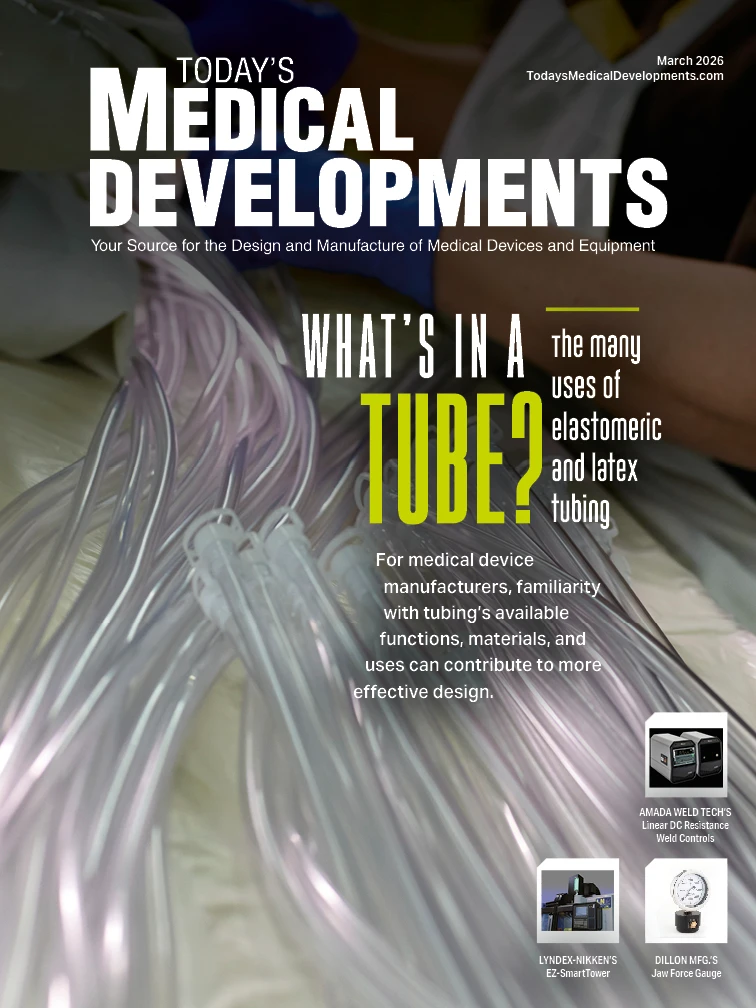
Explore the March 2026 Issue
Check out more from this issue and find your next story to read.
Latest from Today's Medical Developments
- Manufacturing technology orders reach record high in December 2025
- Kennametal introduces Machinist of the Year program
- User-friendly, automated AM post-processing systems
- Tools for Schools program invests in future of manufacturing
- How should you approach automation?
- US Paralympian partners with Autodesk to advance high-performance prosthetics
- Take a break and learn something new about manufacturing over lunch
- DMG MORI to invest more than $40.5 million in Illinois expansion