CREDIT: Auburn University
Students from Auburn University's Mechanical Engineering and Industrial Design programs recently witnessed something pretty special: the public unveiling of a surgical device prototype they helped to develop.
"When it came time to boot up the device at the convention and we saw it worked flawlessly, I felt myself breathe a sigh of relief," says alumna Haley Duncan, who graduated in the spring. "And when the manufacturers and nurses had positive reactions, it definitely put a smile on my face."
Duncan and her fellow mechanical engineering classmates Savannah Anderson, Joseph Freeman, and Jake Garza, as well as Master of Industrial Design student Sheridan Kromann, were part of a research team that worked with KYRA Medical Inc., a global manufacturer of medical equipment, to create a new surgical device. As KYRA's special guests at the Association of Perioperative Registered Nurses' (AORN) annual conference in Boston earlier this year, they witnessed the premiere of their design in front of industry professionals.
A much-needed solution
When performing arthroscopic procedures, surgeons use a small camera to view and repair joints throughout the body, including hips, knees, wrists, and shoulders. While these are minimally invasive surgeries, they require a great deal of saline fluid pumped from IV bags to keep surgical sites clean.
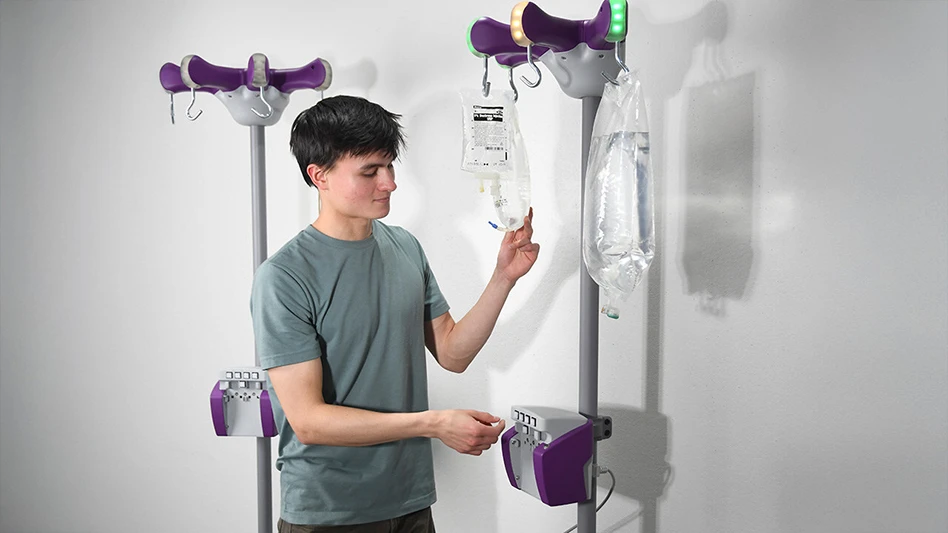
Currently, nurses must change the IV bags quickly every time an alarm goes off – a hectic event that can distract the surgeon and even interrupt the surgery. But the Auburn team's prototype eliminates that rushed response.
"This device automatically switches over to a new bag as each one empties," says Shea Tillman, the Bauhaus Professor in the College of Architecture, Design and Construction. "It provides a non-disruptive means of managing and monitoring the fluid for surgical procedures."
In constant communication
This past year, KYRA staff members held weekly video chats and visited campus several times to collaborate with students and faculty, which included Chad Rose and Michael Zabala from the Samuel Ginn College of Engineering and Tillman.
"KYRA is an established and well-respected medical startup, and the energy their tightly knit team brings to a project like this quickly transferred to our team at Auburn," Tillman says. "They are a very hands-on 'prototype-fast-and-early' group that is excited about sharing what they know about product development with our students."
Over the course of the project, the students built half a dozen mockups and 3D printed more than 100 iterations of component parts before finally creating the final two prototypes displayed at AORN. Unveiling the final product was the ultimate reward for engineering student Anderson.
"When we finally took the packaging off the device and set it up in the booth, all I felt was relief and pride in our device," she says. "When we saw how seamlessly it blended into the KYRA brand and the other devices around it, it was a 'we made it' moment."
The Auburn connection
The collaboration with KYRA came about when Steve Taylor, Auburn's senior vice president for research and development, had a chance encounter with Howard Miller, KYRA's president, CEO and co-founder. Miller, an Auburn alumnus who has worked in the medical device industry for 30 years, proposed a partnership with the university and a collaboration between engineering and industrial design.
"As an Auburn Engineering alumnus, it was incredibly rewarding to see the next generation of engineers bringing a real-world medical device all the way from concept to professional unveiling, and it was great to have industrial design included as well," he says. "The students and faculty truly embodied the values of the Auburn Creed – hard work and integrity."
Engineering student Freeman was grateful for the opportunity to work on a new product with an interdisciplinary team.
"Working alongside industrial designers from day one was a great learning experience, and I truly believe our success wouldn't have been possible without that integrated approach," he says. "They showed me that usability and ergonomics are just as critical as functionality for a device like this."
Latest from Today's Medical Developments
- Teleflex sells acute care and urology businesses for $2.03 billion
- HANNOVER MESSE: Where research and manufacturing meet
- What’s next for the design and manufacturing industry in 2026?
- Arcline to sell Medical Manufacturing Technologies to Perimeter Solutions
- Decline in German machine tool orders bottoming out
- Analysis, trends, and forecasts for the future of additive manufacturing
- BlueForge Alliance Webinar Series Part III: Integrate Nationally, Catalyze Locally
- Robot orders accelerate in Q3