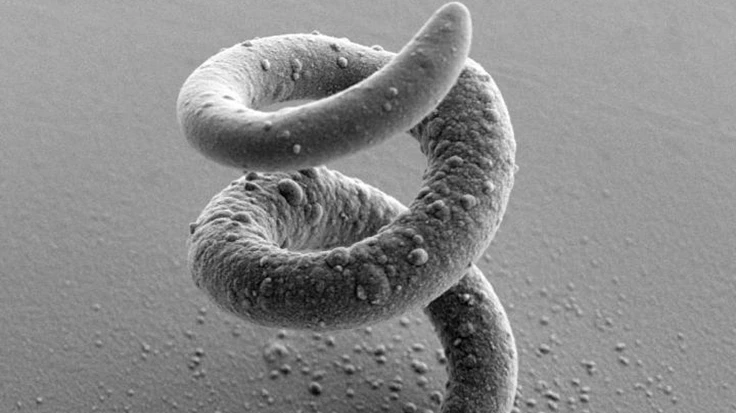
Zurich, Switzerland – Scientists at ETH Zurich have developed a new method of 3D micro-printing. This can be used to manufacture even tiny, partly overhanging structures easily and in a single step. One day, this could pave the way for the manufacture of complex watch components or micro-tools for keyhole surgery, for example.
Tiny pipette
The new technique is a refinement of the FluidFM system developed at ETH Zurich several years ago. At the heart of this system is a moveable micropipette mounted on a leaf spring, which can be positioned extremely precisely. Nowadays, FluidFM is used primarily in biological research and medicine; for example, to sort and analyze cells and to inject substances into individual cells. For three years now, the system has been sold commercially by the ETH spin-off Cytosurge.
Electrochemical reactions at the tip
The system now developed works as follows: a droplet of liquid is placed on a base plate made of gold. The tip of the micropipette penetrates the droplet and acts as a print head. A copper sulphate solution flows slowly and steadily through the pipette. Using an electrode, the scientists apply a voltage between the droplet and the substrate, causing a chemical reaction under the pipette aperture. The copper sulphate emerging from the pipette reacts to form solid copper, which is deposited on the base plate as a tiny 3D pixel.
"This method can be used to print not only copper but also other metals," says Tomaso Zambelli, associate lecturer and group leader at the Laboratory of Biosensors and Bioelectronics at ETH Zurich. And FluidFM may even be suitable for 3D printing with polymers and composite materials, he says.
An advantage of the new method over other 3D microprinting processes is that the forces acting on the tip of the pipette can be measured via the deflection of the leaf spring on which the micropipette is mounted. "We can use this signal as feedback. Unlike other 3D printing systems, ours can detect which areas of the object have already been printed," says Hirt. This will make it easier to automate the printing process.
Successful collaboration with a spin-off
The scientists have submitted a patent application for the method. The scientists have submitted a patent application for the method. The ETH spin-off Cytosurge has now licensed the method from ETH Zurich. Pascal Behr played a key role in developing FluidFM at ETH several years ago. Today, he is CEO of Cytosurge. "We see big market potential in the printing process and an opportunity to further diversify our company," he says. "We are convinced of the idea of using FluidFM in 3D micro-printing. Now, the task is to optimize this application in collaboration with interested researchers at universities and in industry -- for example, in the watchmaking, medical technology and automotive sectors." Behr sees an initial application in the field of rapid prototyping, where microscopic components can be manufactured quickly and easily using 3D printing.
Latest from Today's Medical Developments
- NextDent 300 MultiJet printer delivers a “Coming of Age for Digital Dentistry” at Evolution Dental Solutions
- Get recognized for bringing manufacturing back to North America
- Adaptive Coolant Flow improves energy efficiency
- VOLTAS opens coworking space for medical device manufacturers
- MEMS accelerometer for medical implants, wearables
- The compact, complex capabilities of photochemical etching
- Moticont introduces compact, linear voice coil motor
- Manufacturing technology orders reach record high in December 2025