CREDIT: PARASOFT | PARASOFT.COM
Artificial intelligence (AI) and machine learning (ML) are revolutionizing healthcare, extending their impact beyond hospitals and diagnostic labs to patients' wrists, chests, and even bloodstreams. As medical wearables transition from basic fitness trackers to advanced diagnostic tools, AI is emerging as the central intelligence behind biosensors, interpreting signals, identifying anomalies, and even predicting life-threatening conditions before they arise.
For example, take the Embrace2 smartwatch by Empatica. Using AI-enabled forecasting through machine learning algorithms and electrodermal activity sensors, potential convulsive seizures in epilepsy patients can be detected in time to alert caregivers. This smartwatch uses sensors to monitor physiological signals and movements. If it detects patterns associated with generalized tonic-clonic seizures, caregivers are automatically signaled via a phone call or SMS that includes the user’s GPS location.
Embrace2 is the first to receive FDA approval for neurology use (in people six years old and older), achieving 100 percent detection accuracy in clinical trials. While this is exciting news for the healthcare community and patients alike, integrating AI and ML into these compact, safety-critical devices presents significant challenges along with the exciting, lifesavings opportunities.
From passive data collection to active decision-making
Today's leading-edge medical wearables are not merely health monitors; they function as around-the-clock health assistants. For instance, Nanowear’s SimpleSense-BP employs cloth-based sensors and AI algorithms to monitor blood pressure without the need for the traditional inflatable cuff. In addition, smartwatches that can identify atrial fibrillation and glucose sensors that provide real-time insulin needs demonstrate how AI and ML are transforming passive data collection into active, intelligent decision-making.
By interpreting galvanic skin response, ECG patterns, monitoring oxygen saturation, and analyzing sleep cycles, AI enables these devices to deliver real-time insights and alerts that can potentially save lives. Operating 24/7, wearables are uniquely equipped to detect subtle physiological changes that routine hospital visits might overlook.
Medical-grade wearables produce a continuous flow of physiological data, but this raw data is only valuable if it can be interpreted quickly, accurately, and contextually. This is where AI excels.
Imagine a wearable that notices a sudden drop in blood oxygen levels. AI can immediately assess whether it signifies harmless fluctuation or respiratory distress, considering factors such as the wearer’s age, activity, and medical history. The goal is not just to gather data but to understand and act upon it in real time.
AI also allows for adaptive personalization. A heart rate pattern that is normal for a marathon runner might be alarming for a sedentary individual. AI models can learn from each user's baseline to provide more accurate alerts and reduce false positives.
Embedded intelligence, embedded challenges
Integrating AI into medical wearables is not as simple as adding an app. These devices must adhere to strict medical standards and function reliably under varying conditions while always safeguarding sensitive personal data.
In medical contexts, an unpredictable AI model poses more than an inconvenience – it becomes a life-threatening liability. While ML models can adapt, this adaptability complicates their verification process using traditional testing methods. For critical functions, such as fall detection or heartbeat irregularity monitoring, AI must repeatedly exhibit deterministic and auditable behaviors.
Medical wearables often need to operate for days or weeks on a single battery charge. Running a neural network on low-power hardware presents significant challenges. Therefore, AI models must be efficient, compact, low-latency, and power-conscious.
Smarter AI for safer health monitoring
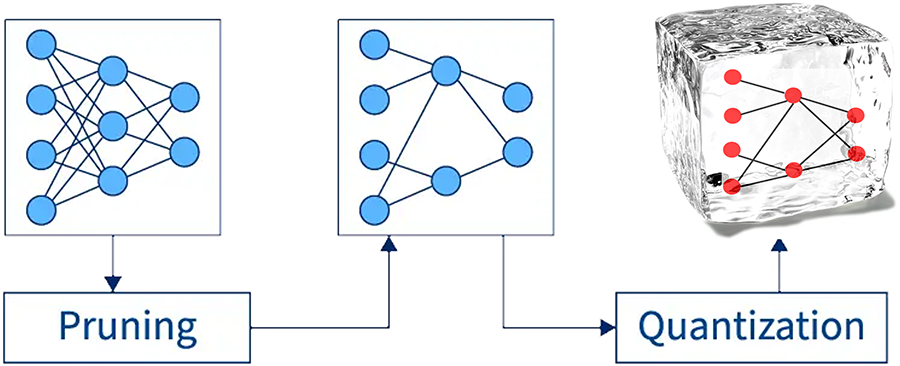
To address these constraints, engineers are employing the following optimization strategies:
- Model Pruning: Removing nonessential components of a neural network, thereby reducing memory and processing requirements while maintaining accuracy.
- Quantization: Utilizing lower-precision arithmetic, such as 8-bit models instead of 32-bit, accelerates computation and minimizes energy consumption.
- Edge AI Hardware: Leveraging dedicated chips like NPUs or AI accelerators integrated into wearables' microcontrollers.
Manufacturers also implement “frozen” AI models – versions that cannot be altered after deployment – to ensure consistent and testable behavior in the field. Some devices incorporate fail-safe logic: basic, rule-based overrides that take precedence over AI decisions in critical situations.
Making AI explainable and verifiable
For regulatory approval, AI in medical wearables must be explainable. Regulators and clinicians need clarity on how models reach their conclusions. Techniques from explainable AI (XAI) assist developers in visualizing which signals triggered alerts or how confidence thresholds were determined.
Before deployment, these systems undergo extensive testing, including simulated patient scenarios and long-term reliability assessments. Redundant systems, like dual-model validation, enhance trust and reliability. Advanced wearable systems, such as epilepsy monitors or continuous cardiac devices, may utilize multiple AI algorithms in parallel to improve detection accuracy and minimize false alarms. As AI becomes integrated into these systems, redundancy will be essential for safety and FDA approval.
Saving lives and more ahead
AI-powered wearables already are making significant impacts in our daily lives. Examples such as the Apple Watch and Fitbit utilize FDA-cleared algorithms to detect atrial fibrillation and abnormal heart rhythms.
Abbott’s FreeStyle Libre system connects with insulin delivery systems like CamAPS FX, employing adaptive and predictive algorithms – principles consistent with AI/ML – to optimize insulin delivery in real time. Using a small sensor placed under the skin, the product measures glucose in the wearer’s interstitial fluid.
As miniaturized sensors and edge AI continue to evolve, expect the next generation of wearables to extend well beyond fitness and chronic condition management. AI will lead the way in identifying the early warning signs of depression, dehydration, infection, or even signal emerging diseases before symptoms manifest.
Additional good news is on tap as increasing levels of integration with various clinical systems will result in wearables being able to transmit real-time data to telehealth dashboards, empowering increasingly proactive and continuous care models.
Regulatory bodies recognize the importance and are doing their best to adapt as well. New frameworks such as the FDA’s Software as a Medical Device (SaMD) guidelines and IEC 62304, an international standard that defines software lifecycle processes specifically for medical devices, are leading the way toward safer, AI-integrated health technologies.
These regulatory frameworks implicitly require traceability practices, irrespective of AI involvement. To effectively manage traditional software risks, such as memory leaks, as well as AI-specific issues like bias detection, a hybrid approach that combines classical verification with AI-specific methods is essential.
From passive to proactive
AI is transforming medical wearables from passive trackers into proactive, intelligent partners for the next chapter of health management. Embedding AI into these small, critical systems, however, requires rigorous engineering and careful optimization as well as an unrelenting commitment to safety and security.
As technology continues to advance at progressively faster speeds, AI will not only enhance healthcare, but it will also make processes more personalized, predictive, and preventative than ever before. Embracing smart devices represents a giant leap forward for the entire healthcare community, whether it is enhancing diagnostic accuracy and speeding up drug discovery or boosting patient care and administrative efficiency.
Latest from Today's Medical Developments
- Gore completes acquisition of Conformal Medical
- Medical textiles designed for cardiovascular, orthopedic, dental prosthetic applications
- Micro-precision 3D printing: Trends and breakthroughs in medical device manufacturing
- One-component, dual-cure adhesive system for medical device assembly
- #82 Manufacturing Matters - Forecasting 2026 with GIE Media's Manufacturing Group
- Flexing prosthetic finger offers lifelike appearance and movement
- How the fast-evolving defense market impacts suppliers
- Medtronic’s Hugo robotic-assisted surgery system makes US debut