We all know companies starts with an idea – that’s what you need to found a company. And typically, a company will evolve, adding more product, more services, etc. This is the nature of business and I’m not telling you anything you don’t already know if you are in the business world. However, what caught my attention was the direction one company has headed – taking precision engineering technology from the shop floor to apply to medical devices.
Renishaw began with the development of touch-trigger probes in 1973. Its founder, Sir David McMurty, developed it to solve a specific inspection requirement for the Olympus engines used on the supersonic Concorde aircraft. This innovative product led to a revolution in three-dimensional coordinate measurement, enabling the accurate measurement of machined components and finished assemblies.
Since then, Renishaw has grown and taken its core skills in measurement, motion control, spectroscopy, and precision machining and applied them to many areas – machine tool automation, coordinate measurement, additive manufacturing, gaging, Raman spectroscopy, machine calibration, position feedback, CAD/CAM dentistry, shape memory alloys, large-scale surveying, stereotactic neurosurgery, and medical diagnostics.
So, what caught my attention is their recent involvement in medical devices. Just a quick visit to their website shows they offer advanced engineering solutions for stereotactic neurosurgery, neuroinspire surgical planning software, and research & development for implantable therapeutic delivery devices.
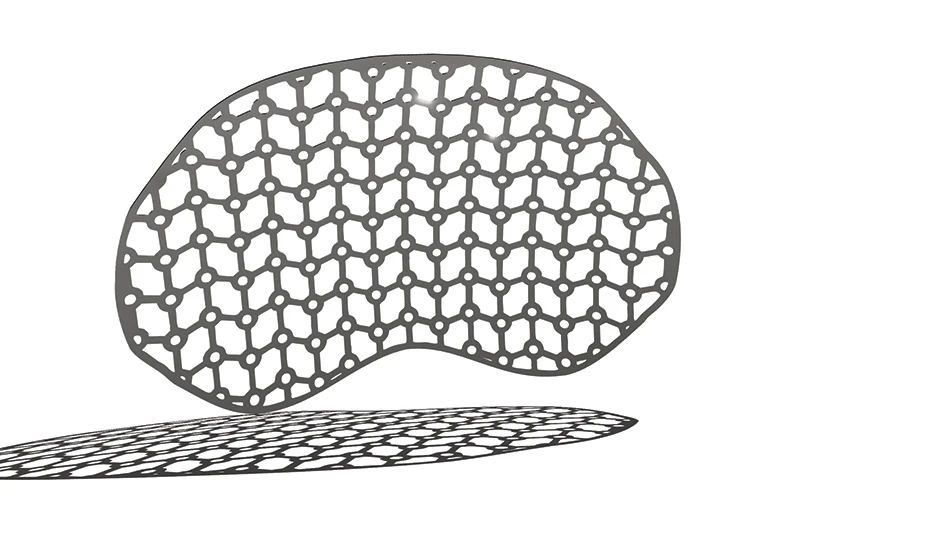
But, it doesn’t stop there. Most recently, when McMurty was contacted about how deep brain stimulation (DBS) rods might be improved, he took interest and saw this is a new area to explore. Bone-anchored hearing aids inspired the design for this neurological implant, Renishaw’s expertise in 3D was able to personalize the device, and today, its undergoing trials for Parkinson’s disease and cancer treatment.
Not what you might have expected from a company that started with touch-trigger probes.
Latest from Today's Medical Developments
- Stryker’s flexible syndesmotic fixation device stabilizes ankle injuries
- Mergers & acquisitions news: MGS, Quantum Surgical bolster medtech portfolios
- Exchangeable-head solid carbide cutting tools
- NextDent 300 MultiJet printer delivers a “Coming of Age for Digital Dentistry” at Evolution Dental Solutions
- Get recognized for bringing manufacturing back to North America
- Adaptive Coolant Flow improves energy efficiency
- VOLTAS opens coworking space for medical device manufacturers
- MEMS accelerometer for medical implants, wearables