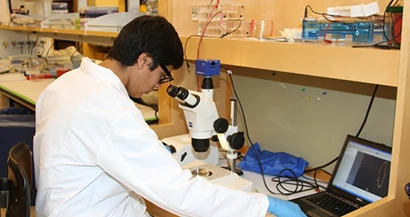
Officials from Carl Zeiss Microscopy LLC announce that it loaned high end research microscope instruments as part of an innovative training program at Children’s Hospital Los Angeles. The program brings minority Los Angeles area high school students into working laboratories, and entices them with the excitement of scientific discovery. Carl Zeiss, which has loaned research grade fluorescence, laser scanning, and laser dissection microscopes to Children’s Hospital for years, loaned a Stemi 2000C stereo microscope with an AxioCam ERc 5s camera, which can also work as a stand-alone imaging station.
The unique Latino & African American High School Internship Program (LA-HIP) is a biomedical summer research and college preparatory program for Latino and African American senior high school students who live or attend school in South or East Los Angeles. Interns work for six weeks in medical research labs performing hands-on experiments relevant to childhood diseases. LA-HIP was established by Emil Bogenmann, PhD, EdD, director for Research Education at The Saban Research Institute of Children’s Hospital Los Angeles.
“Students come here in the first week to learn laboratory fundamentals so they can learn how to isolate DNA and look at microscopic cells and tissue,” states Dr. Bogenmann. “The availability of the powerful microscope and digital camera hooked to a laptop enabled the students to take pictures and make observations on their own specimens.” The top-notch Zeiss stereomicroscopic equipment fosters excitement and helps teach students proper lab techniques at the same time.
Mark Mobilia, a sales representative for Carl Zeiss, worked to install the equipment and provide technical support during the course of the program. “I was a research scientist before joining Carl Zeiss, and I was gratified to be able to give back to the community, demonstrate that science is fun and exciting, and have a hand in training the next generation of American scientists,” Mobilia says. “Carl Zeiss is fully committed to helping recruit more minorities into science. We have already made plans to supply equipment for next year’s crop of interns, and even hope to increase our financial and technical support.”
Latest from Today's Medical Developments
- NextDent 300 MultiJet printer delivers a “Coming of Age for Digital Dentistry” at Evolution Dental Solutions
- Get recognized for bringing manufacturing back to North America
- Adaptive Coolant Flow improves energy efficiency
- VOLTAS opens coworking space for medical device manufacturers
- MEMS accelerometer for medical implants, wearables
- The compact, complex capabilities of photochemical etching
- Moticont introduces compact, linear voice coil motor
- Manufacturing technology orders reach record high in December 2025