As pharmaceuticals have become an extremely large and profitable business for legitimate drug companies, these same products have also become big business for the drug counterfeiters.
According to a number of recent reports, pre-filled syringes are particularly susceptible to counterfeiting. To foil pharmaceutical counterfeiters in pre-filled syringe products, a new solution is available that has proven effective in preventing counterfeit pharmaceuticals in prefilled syringes from reaching patients: in-mold labeling of pre-fillable syringe barrels. This advanced technology anti-counterfeiting solution will be available for demonstration in a high-speed, high-tech automated system at the National Plastics Exposition (NPE), April 1-5, 2012 in Orlando, FL, in Booth #3169, CBW Automation.
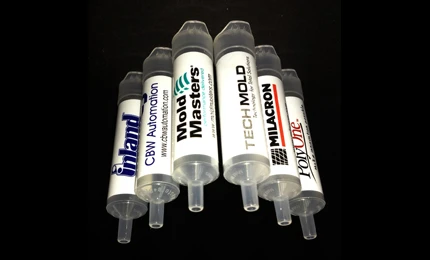
In-mold labeling technology offers a number of benefits to pharmaceutical brand owners interested in protecting their intellectual property including the ability to create a label with special inks that will only reveal under special black lights. The label can also be coded so that each syringe has its own identity to ensure it is the real deal. Additionally, the polymer label actually becomes a part of the syringe barrel, making it impossible to remove the label and replace it with a counterfeit one.
According to the February 16, 2012 issue of The Wall Street Journal, Europe has adopted legislation requiring each pack of drugs to carry its own unique serial number, which will become enforceable in 2016, when “. . . pharmacies, and hospitals will be required to scan the bar code to ensure the product is legitimate.”
Developing this innovative automated IML system for pre-fillable syringe barrels, Tech Mold Inc., a designer and manufacturer of high-cavitation molds for the medical, packaging and pharmaceutical markets, built a 16-cavity syringe barrel mold. This mold, demonstrated in a high-speed automated in-mold labeling (IML) cell, innovated, built, and integrated by CBW Automation, a leading innovator and manufacturer of automation solutions for the plastics, medical and packaging industries, will be a must see at the show.
Accurate label placement in the mold cavities is critical to the success of this application. Typically, the dosage markings on a syringe barrel are either pad or offset printed onto the barrel, or printed on the self-adhesive polymer labels and placed on the barrel as secondary operations. The small outer diameter of the barrel and the need to align the registration dosage markings created a challenge for the label placement. However, the companies collaborating on this project came up with creative and innovative ways to meet all of the challenges to this project.
Scott May, vice president sales & marketing for Inland Label (Booth #8939) which developed the labels for this IML cell, notes that this particular application “demands the most critical cut-to-print and label-to-label size tolerances.”
However, roll-fed labels which use the cut-in-place technology developed by CBW Automation, benefit from thinner gauge label materials – as thin as 45 microns, which was necessary in this application for the small-diameter syringe barrel – to ensure that the label is placed accurately – within +/- 0.010”.
Another challenge for this syringe barrel application was the requirement for a very small label, less than 2”x 2” – yet with the highest quality graphics achievable. Inland Labels’ expertise in the development of specialty inks meant the company was able to produce the high-end graphics required. One of the most important features for a pre-fillable syringe product is the ability to protect consumers/patients from counterfeiting. To show how anti-counterfeiting measures might work, for this demonstration Inland Label imprinted the label with an image using special inks that is only seen under certain lighting conditions, thus ensuring complete safety and reliability in the product.
“This IML cell requires unique label placement precision using a small diameter wrapping of the label onto the mandrel for accurate positioning,” explains Jim Overbeeke, vice president of sales for CBW. “Due to the registration markings on the labels for accurate dosage level, precision placement is critical. In fact, accurate placement of the label is what sets this product apart from ordinary syringes.”
Innovation and collaboration on the automation, mold and hot runner design ensures that labels are placed in an accurate position (to within +/- 0.010”) on all 16 parts for the quality required for this application, and then removes parts molded from the previous cycle, in an extremely short cycle time.
In-mold labeling to prevent counterfeit pharmaceuticals is a technologically advanced method that exceeds other methods such as lot traceability numbers on cartons or printed code numbers on packaging. It is even superior to peel-and-stick labels, even those with holograms or color-shifting inks or ultraviolet pigments, because once the label becomes one with the molded part, it is not removable without destroying the syringe.
To learn more about this high-speed, advanced technology that can ensure the safety and proprietary nature of your pharmaceuticals in pre-fillable syringes, stop by CBW’s Booth #3169, and talk to one of the representatives about your upcoming requirements for protecting your intellectual property.
Latest from Today's Medical Developments
- NextDent 300 MultiJet printer delivers a “Coming of Age for Digital Dentistry” at Evolution Dental Solutions
- Get recognized for bringing manufacturing back to North America
- Adaptive Coolant Flow improves energy efficiency
- VOLTAS opens coworking space for medical device manufacturers
- MEMS accelerometer for medical implants, wearables
- The compact, complex capabilities of photochemical etching
- Moticont introduces compact, linear voice coil motor
- Manufacturing technology orders reach record high in December 2025