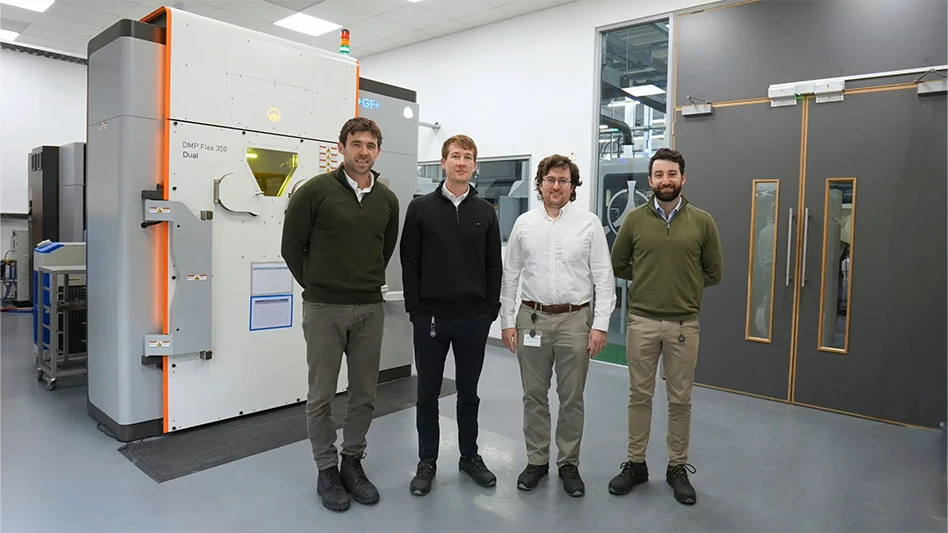
CREDIT: CROOM MEDICAL
Croom Medical, a CDMO specializing in orthopedic implant technology, announces the launch of Biofuse, a 3D-printed porous ingrowth platform produced with laser-powder-bed-fusion (L-PBF) technology.
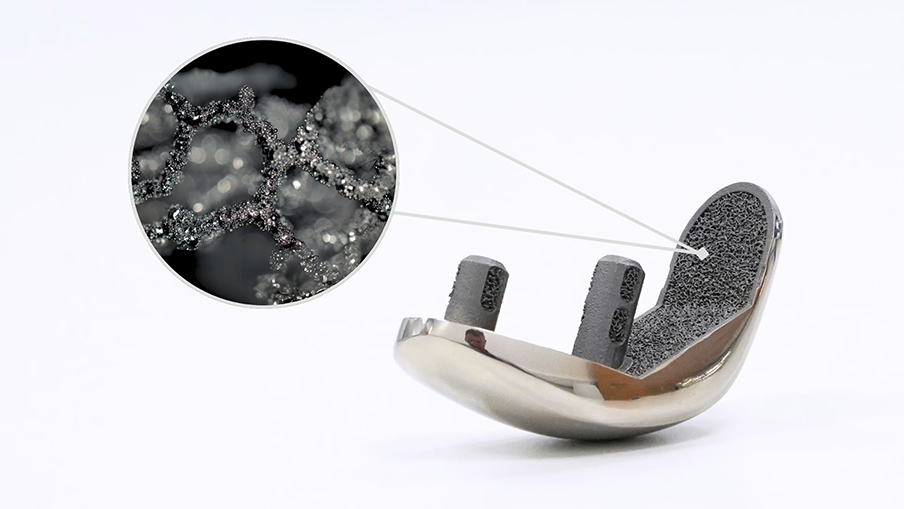
Biofuse integrates fully interconnected porous architectures directly into implant geometries, giving OEMs precise control over pore size, porosity, and lattice gradients. By combining dense and porous regions in a single build, it enables tailored ingrowth conditions while streamlining production and preserving feature fidelity.
Unlike traditional surface treatments such as spray coating or laser texturing, which provide only limited porosity, Biofuse forms its porous structures in-build across both surface and sub-surface regions. This eliminates delamination risks, removes coating and machining steps, and ensures structural integrity and consistent quality, even in complex geometries. The result is a more predictable path from design transfer through to validated production, helping OEMs accelerate development and deliver implants with enhanced performance.
“Biofuse draws on our additive experience, where we’ve seen firsthand how components can be both faster and more cost‑effective to print than to machine,” says Sean McConnell, engineering & NPI Manager at Croom Medical. “Embedding lattice structures directly into the build removes coating and machining steps. The result is a more predictable manufacturing process that consolidates production, preserves structural integrity, and helps OEMs bring implants to market faster.”
Backed by peer-reviewed studies, patents, and ongoing R&D, Biofuse is underpinned by Croom Medical’s expertise in lattice design and material behavior. OEMs can leverage this experience to replicate existing porous structures or explore new designs that improve fixation and manufacturability.
“With Biofuse, customers can design lattices to their exact requirements,” says Dr. Bryan Naab, additive lead at Croom Medical. “That might mean replicating a porous structure previously produced through coating methods or proposing lattice characteristics. The flexibility of the platform gives OEMs confidence that their design intent can be realized consistently and in line with regulatory expectations.”
Biofuse is now available through Croom Medical’s Additive Manufacturing offering, supporting projects from early design through to full-scale production. The launch highlights Croom Medical’s continued investment in additive manufacturing solutions for orthopedic applications.
Latest from Today's Medical Developments
- Fairlane Products offers variety of clutch bearing rollers
- OSSIO opens US headquarters in Florida
- Punch-laser combination machines enable precision cutting of sensitive materials
- Enlil, Interlynk to develop integrated cybersecurity solution for medical device manufacturers
- Mastercam releases second 2026 installment in new semi-annual software update cycle
- Medtronic plans to expand interventional cardiology portfolio with CathWorks acquisition
- Nikon releases latest update to dimensional measurement software
- US cutting tool orders reach $206.1 million in November 2025