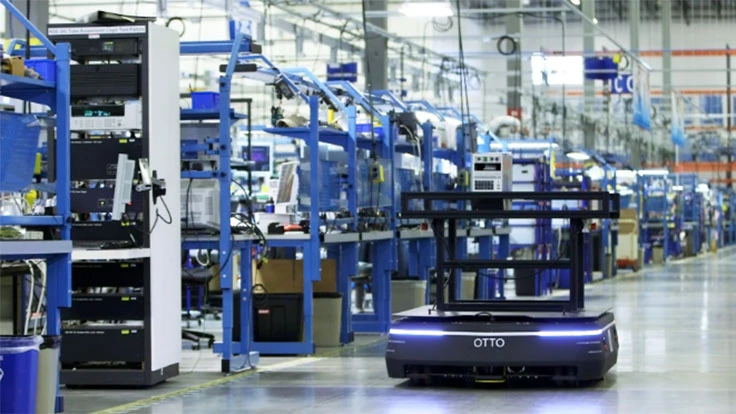
GE Healthcare’s 280,000ft2 facility in Milwaukee, Wisconsin is a mega center for medical equipment repairs. Multiple U.S.-based repair operations are consolidated into this site, which functions as a showcase for the use of advanced technology to improve process in material handling. The facility upholds lean manufacturing principles to achieve its mission: provide customers with reliable, consistent, fast, quality repairs so hospitals can restore operations quickly and focus on delivering the best patient care.
In previous repair centers technicians pushed carts to move equipment between repair cells, shipping, and other technicians. This manual process worked in batches, making material flow inefficient. Finished repairs would be added to other types of equipment on the nearest cart, which was pushed around to pick up other finished repairs before proceeding to shipping. The time taken for finished repairs to reach shipping was dependent on what other types of equipment were in for repair, which led to delays.
Additionally, other facilities suffered from wasted floor space due to the need for bulky carts and fixed infrastructure. This reduction of productive floorspace decreased the number of repair cells and limited throughput. GE needed a better material handling solution that fit the demands of their team.
“We needed to find an on-demand solution for moving materials throughout the facility,” says Patricio Espinosa, director, Americas Repair Operations, GE Healthcare. “OTTO Inventory Movement Platform is a perfect solution because it gets materials where they need to be, when they need to be there.”
Today, OTTO M software and OTTO 1500 self-driving vehicles are used to deliver parts for more than 2,000 medical equipment repairs per week.
Moving to lean manufacturing principles
Implementing the OTTO Inventory Movement Platform enabled the repair center to improve their material flow and find new efficiencies in the repair process. Instead of batching parts to travel in a variety of directions, the automated material handling solution enables pull-type supply chain management. Repairs are finished quickly, despite short lead times, because the automated material movement is based on actual demand. Instead of encumbering throughput by batching all material movement regardless of priority, OTTO delivers repairs to their destinations in an optimized workflow:
- When a technician is finished with repairing a part, they call an OTTO self-driving vehicle
- OTTO brings a new part to be repaired, and takes the finished part to shipping
GE Healthcare’s material handling is not easily standardized. The facility receives differently sized parts for repair every day, and many are non-conveyable. Additionally, different parts need to be delivered to different repair cells.
“The OTTO self-driving vehicle has the ability and flexibility to move without infrastructure like magnetic strips or conveyors,” Espinosa says. “The system can make a decision to turn and take different routes, which was essential for us. Our process changes every day depending on what parts come in for repair, but OTTO can accommodate all of them with its flexible attachments for different loads.”
Unlocking floor space and new metrics for improvement
GE’s Milwaukee facility is a human-dense environment with hundreds of repair technicians, but it didn’t take long for them to get used to working alongside OTTO.
“OTTO makes our jobs easier,” says Joe Germait, manufacturing technician at GE Healthcare. “Space is a shortage in our work areas, so it’s helpful that we call OTTO on demand and have it come pick up our parts. The pickup times are really quick, and it allows us to switch to the next part more quickly. Occasionally we meet up with OTTO in the aisle-ways and it goes right around us.”
Try the ROI calculator to discover what benefits your company can see: https://www.ottomotors.com/resources/roi-calculator.
Space is vital not just in repair work areas, but in the overall facility. Milwaukee center’s repair cells are 40% smaller since implementing OTTO because there was no need for extra physical infrastructure or large material movement equipment. This enabled GE to raise their throughput per square foot, and there has been a 66% increase in productive floor space.
OTTO’s software also provides Espinosa and his team with capabilities for process analytics. Kyle Smith, repair process engineer, GE Healthcare, explains, “We can analyze the habits of our employees with the data that’s provided by the OTTO platform. This is the kind of vital information that we need to help improve our operations to deliver repairs as quickly as possible.”
Last year our sister publication, Today's Motor Vehicles,covered a few companies working in the autonomous material handling arena. To learn more about these advancements, click here.
Latest from Today's Medical Developments
- NextDent 300 MultiJet printer delivers a “Coming of Age for Digital Dentistry” at Evolution Dental Solutions
- Get recognized for bringing manufacturing back to North America
- Adaptive Coolant Flow improves energy efficiency
- VOLTAS opens coworking space for medical device manufacturers
- MEMS accelerometer for medical implants, wearables
- The compact, complex capabilities of photochemical etching
- Moticont introduces compact, linear voice coil motor
- Manufacturing technology orders reach record high in December 2025