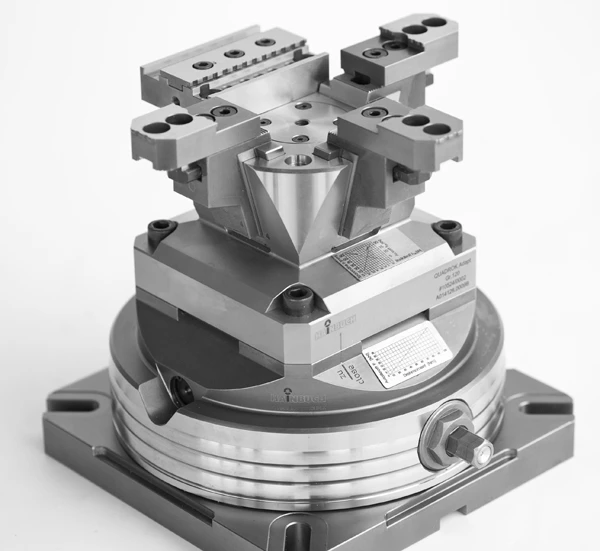
This clamping system can hardly be beat. Whether actuated manually or hydraulically the Quadrok really provides all possible clamping features. Special hallmarks are: easily approachable from all five sides, small and equal collision contour, ideal deployment of resources, just-in-time production due to short set-up and cutting times and an incredible versatility thanks to the Hainbuch modular system.
Systematical Quick Change Over
Design of the Quadrok, like many other Hainbuch systems, is simply by providing the utmost in performance. The jaws rest on the clamping unit, which are available in two different styles, operate manually or hydraulically. With just four screws and a 90-degree turn of the clamping unit, you can separate the upper from the lower units. Within a few minutes, there is creation of a new clamping device. If you set up jaws or segment bushings externally, you are saving time that is even more valuable. Meanwhile the actuation unit remains fastened on the machine table permanently. Depending on the application, the operator can choose different jaw packs or set up the unit for either ID or OD clamping by utilizing the available adaptations. There are no limitations for the flexibility. The system also ensures greater flexibility when it comes to clamping height: The lowest clamping base is at 195mm when using the Quadrok clamping units 120 and 200. Utilizing the mandrel adaptation for ID clamping brings it down to 115mm. Even on large machining tables, all five sides of a workpiece are thus easily accessible.
 Centric Four-Jaw Clamping
Tolerance compensation and high clamping force The Quadrok’s entire performance is played out by its clamping versatility. Whether simple steel or complex casting parts, thanks to an interface, attached to the base jaws with a pointed serration, everything clamps without problem. Depending on how the jaws are milled out makes it feasible to machine cubical or round parts. The inner components of the actuation unit are typical Hainbuch-like providing an active pullback effect. Therefore, compensation of material tolerances of ±1.0mm is possible because the raw material is always pulled to the clamping center by its four jaws. So, the user can utilize less expensive material with larger tolerances, while still being able to clamp workpieces securely and efficiently. Depending on the version, the clamping ranges are from zero to150mm for Quadrok 120 and 80mm to 250mm for Quadrok type 200. The jaw pairs of the Quadrok each provide 31KN while providing an actuation force of 97Nm at the manual jaw and 50 bars for the hydraulic clamping unit. Whether static or moveable jaws, it depends, entirely, on the clamping application. For instance, if replacing a moveable jaw with a static one, a clamping situation towards a static end-stop with three actively clamping jaws is established. This forces the workpiece into a corner. Of course, establishing a conventional vice clamping situation with two opposing jaws is easy. Additionally the jaws for the Quadrok are machineable to size for intricate workpiece contours as well.
Conclusion
The Quadrok four-sided clamping vice is ideal for everything in conjunction with a minimum of set-up time, high rigidity, and enormous clamping forces. With just one actuation unit and diverse adaptation possibilities, the Quadrok is able to tackle five-sided machining as well as clamping the ID of a bore.
Latest from Today's Medical Developments
- Stryker’s flexible syndesmotic fixation device stabilizes ankle injuries
- Mergers & acquisitions news: MGS, Quantum Surgical bolster medtech portfolios
- Exchangeable-head solid carbide cutting tools
- NextDent 300 MultiJet printer delivers a “Coming of Age for Digital Dentistry” at Evolution Dental Solutions
- Get recognized for bringing manufacturing back to North America
- Adaptive Coolant Flow improves energy efficiency
- VOLTAS opens coworking space for medical device manufacturers
- MEMS accelerometer for medical implants, wearables