CREDIT: JOHANSON TECHNOLOGY
Designing the next generation of wireless wearables, implantables, and real-time external or in-body monitoring devices is a complex challenge requiring highly reliable electronic components that greatly exceed the performance of standard commercial alternatives.
Meeting this objective requires passive electronic components that are precisely engineered to maintain accuracy and stability under demanding conditions. These components support essential functions such as reliable wireless communication, high resolution imaging, and consistent data transmission.
This includes capacitors, inductors, chip antennas, baluns, RF and EMI filters, and RF matching networks that are pre-matched to popular medical wireless chipsets to simplify layout design and reduce component count, as well as band pass, high pass, and low pass filters, and high Q capacitors and RF inductors.
High Q capacitors
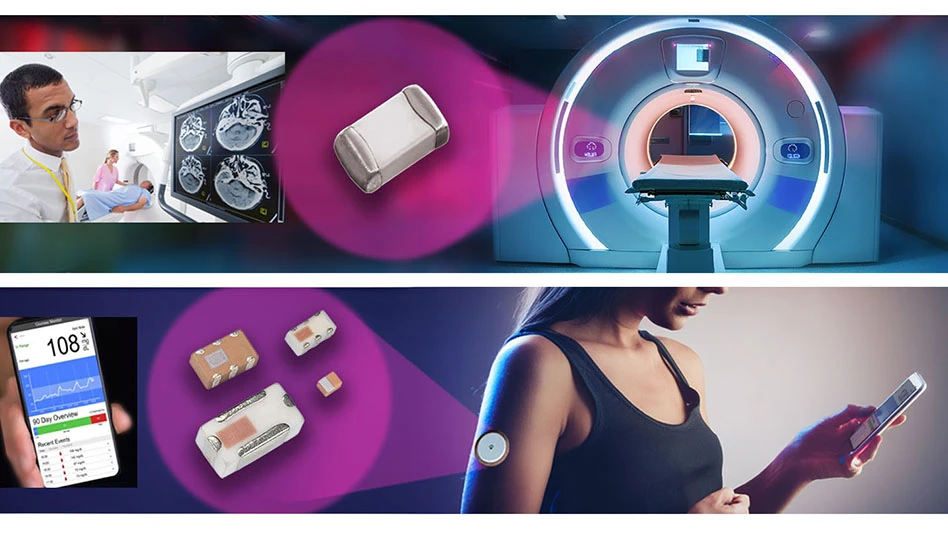
One example of this is found in magnetic resonance imaging (MRI) systems. To produce clean, reliable images, these systems rely on a wide range of passive electronic components that must function in extremely strong magnetic fields and high-frequency RF conditions. These passive elements must be non-magnetic, thermally stable, and engineered to withstand high voltages as well as rapid current transients.
Capacitors, specifically, must demonstrate outstanding reliability because they directly affect the safety, precision, and stability of both the imaging process and the high-power subsystems within the equipment. Even slight electrical variations can compromise safety, distort images, or cause system malfunctions.
To ensure long term reliability, capacitors must tolerate substantial dielectric stress, repeated cycles of charging and discharging, and sustained operation at elevated temperatures without performance degradation.
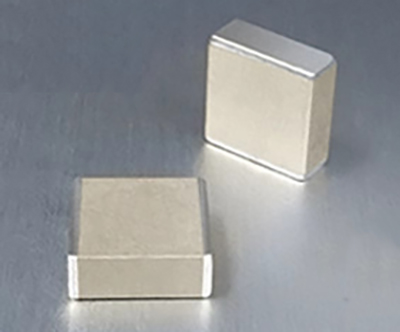
To meet these requirements in high-power RF sections such as coils, power supplies, and amplifiers, designers frequently use high-Q capacitors.
For many high-power RF applications, the Q factor of embedded capacitors is one of the most important characteristics in the design of circuits. In theory, a perfect capacitor would exhibit no loss and discharge a full energy transfer, but capacitors always exhibit some finite amount of loss. The Q factor represents the efficiency of the capacitor in terms of its rate of energy loss.
This factor is important because the higher the energy loss, the more heat is generated within the capacitor that must be dissipated or cooled. In high power applications, the heat can be substantial and if the temperature rises significantly, it can damage nearby components.
High-Q capacitors are characterized as having ultra-low equivalent series resistance (ESR). In addition to minimizing energy loss, High Q capacitors reduce thermal noise caused by ESR to assist in maintaining desired signal-to-noise ratios.
To achieve the lowest losses, certified suppliers such as Johanson Technology of Camarillo, California utilize the lowest loss dielectrics, inks, and electrode options in their high-Q designs. For more than 60 years, the company has designed and manufactured multi-layer ceramic capacitors, EMI filters, and other critical components for high reliability applications.
An example is the use of silver and copper electrodes, which outperform nickel in most high-Q applications. Nickel, which is commonly used in the lowest cost capacitors, is a poor conductor known for high loss at RF and microwave frequencies. Unlike silver and copper, nickel also creates a magnetic field that can interfere with devices such as MRI receiver coils.
Historically, Johanson Technology incorporates silver electrodes in its ultra-high Q (lowest ESR loss) offering, the E-Series multilayer RF capacitors in their high-power capacitors.
However, Johanson Technology has two new products designed for medical, and more specifically, MRI applications: the High-Q Copper Electrode C-Series Family and the P90 P-Series. The P-Series is designed for high-power RF applications, specifically at the low frequencies commonly used by MRI systems.
Preserving wireless connectivity
High reliability electronic devices also play a key role in wireless connectivity for patient monitoring, diagnostic processes, and effective therapy management across a broad spectrum of medical systems. This includes wearable and fitness tracking devices, implantable and in-body medical technologies, and platforms designed for remote monitoring and telemedicine applications.
These systems employ a variety of wireless protocols including Bluetooth Low Energy (BLE), Wi-Fi, sub-GHz Internet of Things (IoT), ultra-high frequency RFID, near-field communication (NFC), and cellular systems such as LTE and 5G. Specialized medical telemetry bands such as the Medical Implant Communication Service (MICS) and MedRadio bands provide secure and reliable links for implanted medical devices, including pacemakers and insulin pumps.
To achieve reliable and interference-free performance, medical devices integrate a complex set of RF front-end components and support electronics from chip antennas that transmit and receive RF wireless signals in the appropriate frequency range to baluns and matched baluns to simplify Bluetooth integration, and bandpass and low pass filters to improve signal coexistence and meet regulations.
The applications are diverse, extending across the full spectrum of medical use cases.
Biomedical monitoring technologies, including electrocardiogram (ECG) systems and glucose monitoring devices, capture essential physiological metrics continuously and in real time. Through wireless transmission, this data is delivered to mobile devices, remote care platforms, and hospital information systems, supporting ongoing surveillance and clinical assessment.
Several wireless communication protocols support these functions. BLE enables low power, short range connections for wearable sensors. Wi-Fi enables high-speed data transmission and supports teleconsultations, while LTE and 5G operate over cellular networks.
Implantable medical devices such as pacemakers, neurostimulators, and implantable drug delivery systems also exchange data wirelessly. In many designs, an external intermediary is used. A wearable patch or handheld reader is typical. Data is then forwarded to clinical systems or cloud platforms.
Proprietary wireless networks operating in the 2.4GHz and 5GHz frequency bands are commonly employed in robotic surgery systems, wireless endoscopic imaging platforms, and instrument telemetry interfaces. These specialized networks are chosen when ultra-low latency or elevated data security is required.
Wireless identification and tracking technologies are also present throughout clinical environments. NFC and RFID are used in hospitals for patient identification, instrument tracking, and management of mobile medical equipment. Wristbands and tagged devices are common examples.
No interference zones
With so many electronic systems operating at the same time within healthcare environments, electromagnetic interference becomes a concern as it can affect device operation and data integrity. To reduce this risk, medical systems are designed to operate within defined frequency ranges and comply with applicable regulatory and performance requirements.
Within MRI systems and other sensitive medical equipment, for example, electromagnetic interference mitigation is addressed through filtering and impedance-matching networks. Low-pass, high-pass, and band-pass filters built from combinations of resistors, capacitors, and inductors are used to control signal bandwidth and limit unwanted noise. Medical equipment operating in these environments is required to meet electromagnetic compatibility requirements defined under IEC 60601-1-2.
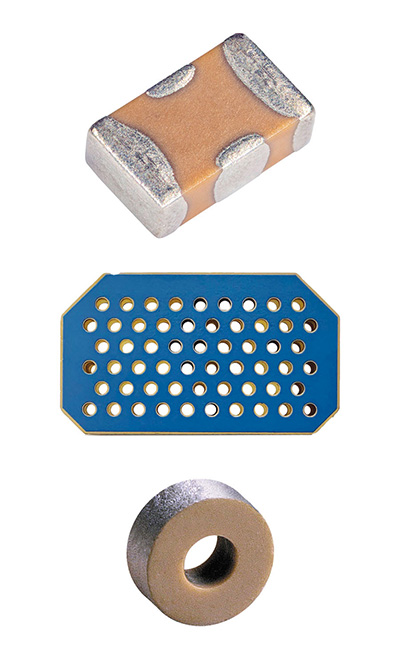
To meet the diverse requirements of medical applications, Johanson Technology offers EMI filters in a variety of configurations and form factors. Depending on the application, filters can employ differential-mode and common-mode elements, transient suppression, and shielding techniques.
To support scalable production, expedited lead times, and ITAR compliance, Johanson Technology manufactures its High-Q and EMI filters in North America. All high-reliability testing is conducted in the United States, and every product is subjected to complete visual and electrical inspection, with full traceability maintained for every material lot.
Miniaturized components
The accelerating evolution of medical technology is also driving electronic components toward increasing levels of miniaturization. As devices become smaller and more compact, engineers must reduce the size of passive components – such as filters, capacitors, and inductors – while preserving strict requirements for performance and long-term reliability.
Energy efficiency is also a critical design factor for power-sensitive medical systems. Extended battery life is particularly vital for implantable devices, where battery replacement procedures are complex and invasive.
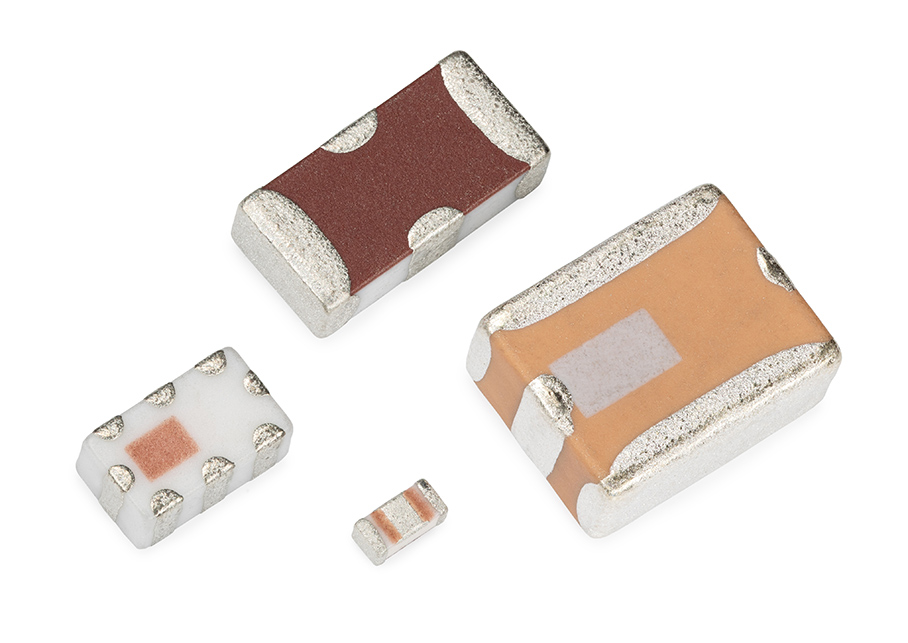
To meet this requirement, companies such as Johanson offer integrated passive components (IPCs) that are essentially electronic sub-systems combining multiple discrete passive components into a single surface mounted device.
Manufactured using low temperature cofired ceramic (LTCC) technology that allows the passive components to be layered three-dimensionally, IPCs deliver the same functionality as 10 to 40 individual components while dramatically reducing the board space required.
With this approach, the entire front-end between the RF chipset and the antenna can be manufactured in a single, ultra-low profile (0.35mm to 1mm total thickness) package less than 20% the total size of the same circuit comprised of discrete components.
IPCs also provide a high degree of reliability. Because they form a complete circuit within a compact LTCC package, they greatly reduce variability and eliminate many potential failure points found in assemblies using multiple discrete components. Combining matched elements into one integrated package further helps ensure consistent performance and facilitates compliance with FCC and ETSI regulatory standards.
As medical technology evolves toward more interconnected, compact, and highly integrated systems, the operational expectations placed on electronic components will continue to increase.
Selecting components engineered specifically for medical use enables manufacturers to mitigate risk, enhance long-term reliability, and streamline system integration.
About the author: Jeff Elliott is a Torrance, California-based technical writer. He has researched and written about industrial technologies and issues for the past 20 years.
Latest from Today's Medical Developments
- Compact centrifugal barrel tumbler finishing machine
- Medical device manufacturer affected by major cyberattack
- Defense Industry Trends webinar with Greenwich Capital Group
- Partnership to advance neuromuscular interface system for intuitive prosthetic control
- Easy-install Jaw Boring Rings
- Johnson & Johnson launches two new aspiration catheters for ischemic stroke treatment
- Mazak to showcase machining, automation technology at two upcoming events
- Materials, vapor smoothing capabilities developed for high-performance plastic parts