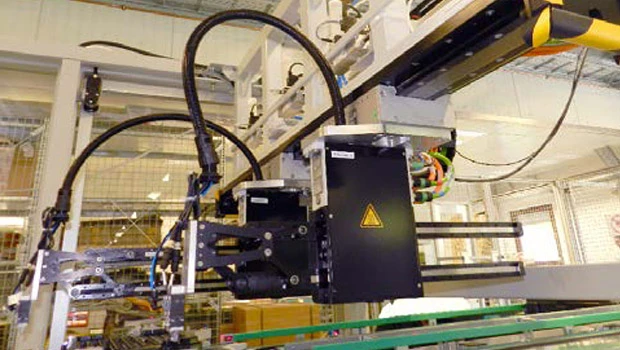
Industry leading specialist for rotary tables and automation, Weiss, based in Buchen, Germany, and its subsidiary Weiss North America Inc., based in Willoughby, Ohio, is a pioneer of direct-drive pick & place and multiple-axis modules. In an effort to advance palletizing applications that do not require the traditional selective compliance assemblyrobot arm (SCARA) system’s 4-axis design, Weiss has designed an economically advanced 3-axis design solution.
Figure 1
 Four axes are excessive
Tradtional, tried-and-true SCARA robots remain a very popular solution for palletizing and tray packing applications. However, their typical design configuration features four axes consisting of two rotary axes and one lifting swivel unit, which is generally not needed for most palletizing applications. The bottom line is, there’s no need to invest in 4 axes for the application.
In terms of figures, a SCARA robot costs on average around $13,000 − therefore the end-user pays roughly $3,250 per axis. On average, the Weiss handling axes cost the same − but only three are required. This results in a figure of approximately $9,750 for a handling system that covers a working space of 70mm x 225mm x 200mm. Additionally, the Weiss 3-axis solution allows for an additional modular swivel unit to be used where necessary.
Figure 1
 Ultimately, 4-axis SCARA robots typically have one axis too many for certain applications applications, can be costly, and take too long to program − especially when simpler and more economical alternatives like Weiss’ 3-axis intelligent system is available.
Furthermore, once pallets of different sizes come into play, the system has severe difficulties. A square pallet simply does not fit in with a curved robot action radius (see Figure II). As a result, manual intervention is often the only option, which may include relocating, rearranging, or completely exchanging the pallets.
One axis combo vs. two scara robots
When comparing the assembly and removal process, the difference between the two systems becomes even clearer as both stations are often positioned close together. In the SCARA scenario, there is usually only one response to this − using one robot for assembly and one for removal. This translates to a total of eight axes − with each axis costing roughly $3,250 per unit.
Given the sophisticated combination of various handling and axis units, the Weiss automated process is considerably more flexible. For example, two pick & place units can be positioned on a basic axis with a length of up to four meters and can work independently of each other (see Figure I & III). Instead of eight axes, only six are required. The customer effectively pays for six axes (basic axis with two carriages and two pick & place units) and utilizes the rail of the basic axis twofold − making cost advantages compared to the eight SCARA axes even more significant.
For processes where time is not a factor, the second pick & place module is not even needed. The remaining module on the long basic axis takes care of both assembly and removal.
Figure 2

 Axis of gearless direct-drive advantage
The design principle of a SCARA robot requires the use of different gears − whereas the handling solution from Weiss operates completely without gears, which is made possible by linear drives. This gearless design makes the handling system significantly more precise than the SCARA robot, which offers positioning with an accuracy of up to 0.01mm, whereas the conventional SCARA can only manage 0.05mm or more.
Eventually with age, the imprecision increases further due to wear on the gears. Of course, the smaller the parts, the more significant this becomes. Greater precision notably pays off even for parts with an edge length of under 100mm. The time-consuming processes required by the SCARA robot for its image processing system and position correction are no longer necessary.
In terms of productivity, the axis combination is in another league as the drives are screwed on directly − giving the overall system its enormous rigidity. This allows for faster acceleration and shorter cycle times.
Weiss 3-axis conclusion
Weiss’ 3-axis system provides a myriad of combinations that are more economical than SCARA robots for a multitude of handling tasks.
While ideal for palletizing and tray packing applications, the 3-axis system can also be leveraged for a wide range of associated applications including: automotive, medical, inspection, and electronics. In fact, the system is currently being used for the inspection of circuits in the production of electronic cigarettes.
Importantly, end-users can leverage the Weiss Application Software (WAS) to enable simple and intuitive commissioning of the system’s most important parameters. This makes life easier for smaller and medium-sized plant engineering companies in particular. In contrast, the programming process for the software of a SCARA robot is still a major barrier for these firms.
Finally, the axis combinations are not only easy to commission−the demounted individual modules can also be used in other automation processes at a later stage. This may take some time to pay off, but significant dividends are ultimately achieved.
Weiss North America Inc.
Latest from Today's Medical Developments
- Exchangeable-head solid carbide cutting tools
- NextDent 300 MultiJet printer delivers a “Coming of Age for Digital Dentistry” at Evolution Dental Solutions
- Get recognized for bringing manufacturing back to North America
- Adaptive Coolant Flow improves energy efficiency
- VOLTAS opens coworking space for medical device manufacturers
- MEMS accelerometer for medical implants, wearables
- The compact, complex capabilities of photochemical etching
- Moticont introduces compact, linear voice coil motor