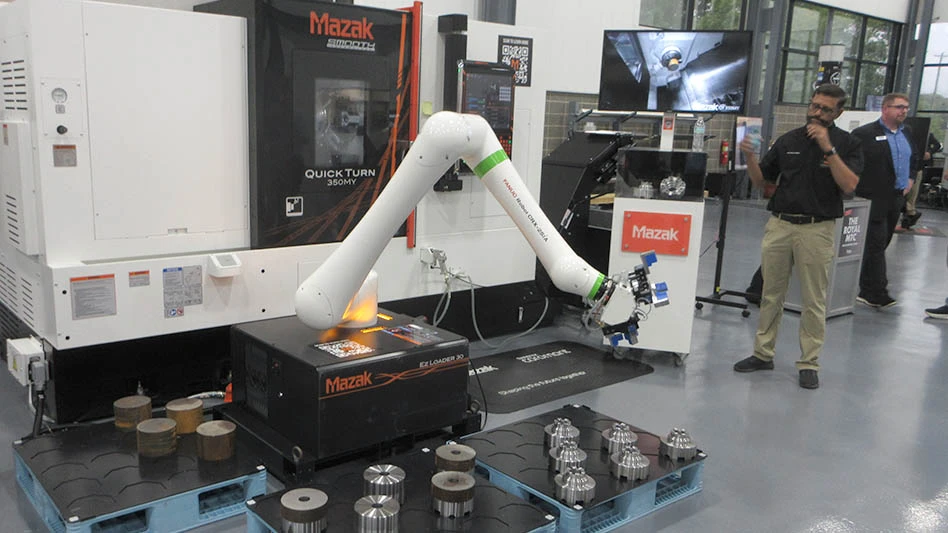
CREDIT: ERIC BROTHERS
Mazak Corp. welcomed attendees to its DISCOVER 2025 – A Technology and Education Event October 6-10 at the company's North American headquarters in Florence, Kentucky. The event, themed Drive Results with Innovation, showcased the latest advancements in machine tool technology and manufacturing solutions.
During the press appreciation breakfast October 7, Mazak President Dan Janka shared his optimistic outlook for U.S. manufacturing. He cited several positive indicators supporting his bullish perspective through 2026, including stable inflation and employment rates, increasing foreign investment and reshoring activities, supportive tax legislation, and projected rapid growth across key industry sectors.
"To remain competitive in this environment," Janka emphasized, "manufacturers of all sizes must focus on reducing overall production costs while simultaneously increasing output capacity."
The event was structured around four strategic focus areas designed to help manufacturers achieve these dual objectives:
- Advanced machining capabilities
- High-volume production solutions
- Multitasking technology integration
- Comprehensive shop solutions
A highlight of the event was a tour of Mazak's iSMART Factory, currently undergoing its 21st expansion since its original construction in 1974. The facility exemplifies vertical integration, using Mazak machines to manufacture components for other Mazak machines. This summer also marked a significant milestone when the company celebrated producing its 40,000th machine at the Kentucky facility on August 19.
Among the advanced machining solutions featured were the Ez Series machines, five levels of multi-tasking and DONE IN ONE part processing, additive manufacturing, and SYNCREX Swiss-type small part production turning.
Addressing the current business climate, Janka advised manufacturers to maintain focus despite external pressures. "In today's ever-changing political and economic landscape, it's crucial for manufacturers to move past distractions, filter out the noise, and stay committed to their strategic course," he concluded.
Tuesday keynote: Automation as a competitive necessity in modern manufacturing
In today's competitive landscape, robotics has become essential for maintaining productivity advantages. Mike Cicco, president and CEO of Rochester Hills, Michigan-based FANUC America Corp. explored this theme in his keynote Driving Results with Automation.
Key forces driving manufacturing automation
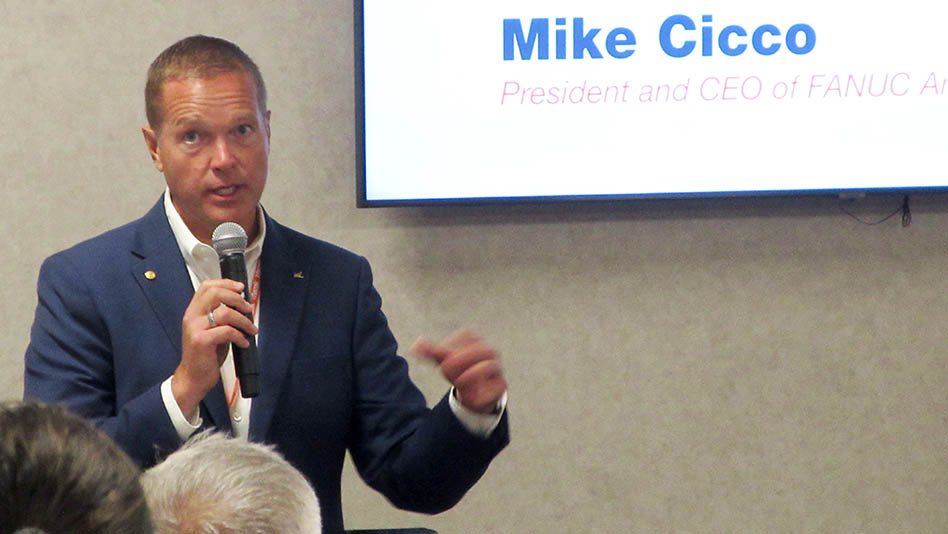
Cicco identified several converging factors pushing manufacturers toward automation:
- Labor market pressures: historically low unemployment coupled with more than 400,000 unfilled manufacturing positions
- High capacity utilization rates straining existing operations
- Growing emphasis on nearshoring and domestic production
- Increased government incentives supporting automation adoption
- Expanding educational programs for automation-skilled workers
- Development of more user-friendly automation technologies
Strategic implementation approach
For companies beginning their automation journey, Cicco advocates starting with easily achievable projects – the low-hanging fruit approach, allowing manufacturers to build confidence and expertise without requiring substantial upfront investments.
Global automation landscape
The data reveals significant regional variations in robot adoption. South Korea leads globally with approximately 1,100 robots per 10,000 workers, while the U.S. maintains about 300 robots per 10,000 workers. FANUC itself exemplifies heavy automation adoption, operating 3.5 robots for every human employee.
The future: AI-powered robotics
Next-generation robots will incorporate artificial intelligence engines, enabling self-learning capabilities. These advanced systems will combine visual sensors with autonomous decision-making, allowing robots to navigate and adapt to their environments independently.
Human-robot collaboration
Despite increasing automation, human workers remain crucial. Cicco stressed the importance of educational partnerships, highlighting FANUC's collaboration with more than 1,600 educational institutions to develop the necessary workforce. His message was clear: "Now is the time to do it."
Latest from Today's Medical Developments
- Gore completes acquisition of Conformal Medical
- Medical textiles designed for cardiovascular, orthopedic, dental prosthetic applications
- Micro-precision 3D printing: Trends and breakthroughs in medical device manufacturing
- One-component, dual-cure adhesive system for medical device assembly
- #82 Manufacturing Matters - Forecasting 2026 with GIE Media's Manufacturing Group
- Flexing prosthetic finger offers lifelike appearance and movement
- How the fast-evolving defense market impacts suppliers
- Medtronic’s Hugo robotic-assisted surgery system makes US debut