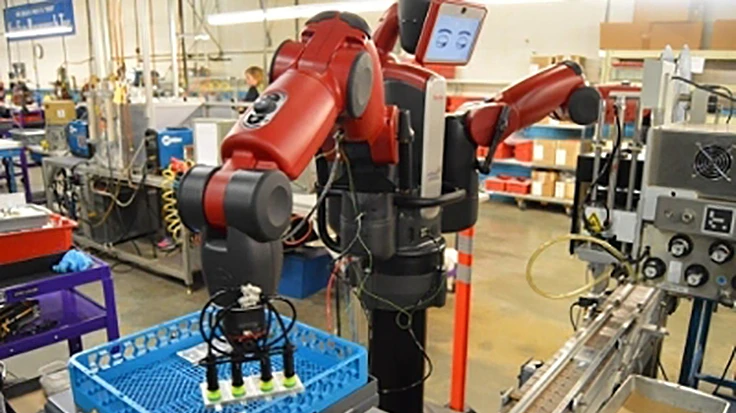
Boston, Massachusetts – Cornell Dubilier, the largest power capacitor company in North America, has deployed two Baxter robots within its manufacturing plant in Liberty, South Carolina, to streamline its capacitor labeling and inspection processes, fill gaps in production and increase flexibility.
Baxter is being deployed to complete two applications at Cornell Dubilier. In the first instance, Baxter works on the line to load and unload a conveyor that places a label on each capacitor. Previously, this was a tedious, manual process using a significant amount of the operator's time and effort. With Baxter, the human operator is free to complete more complicated tasks. A second Baxter is deployed in the inspection of new capacitor installations; the robot uses a vision system developed in a Cornell Dubilier research and development lab to load and unload parts for inspection.
"What's unique about our industry is that nearly everything needs to be customized or built in-house," said Daniel Brazinski, manufacturing manager at Cornell Dubilier. "When we've looked to automate our processes in the past, the price is well into six figures. Baxter allows us to significantly cut that price tag, while more effectively and flexibly achieving our automation goals."
Cornell Dubilier's roots can be traced back to 1909 when founder William Dubilier used the glass mineral mica to form a capacitor, revolutionizing radio broadcast communications and allowing for stronger signal transmission over longer distances. Today, Cornell Dubilier has more than 35,000 customers who use their capacitors for laser medical technology, aircrafts, alternative energy, welders, and generators.
"Implementing automation has traditionally been a very expensive and rigid process, but forward-thinking manufacturers like Cornell Dubilier are using Baxter to become far more agile," said Jim Lawton, chief product and marketing officer of Rethink Robotics. "Baxter provides the company with a level of flexibility and affordability that other automation simply cannot provide, and it's positively impacting the bottom line for both Cornell Dubilier and its customers."
Baxter has also become a litmus test of sorts for the Cornell Dubilier team, testing new equipment and process changes to see if employees can easily perform the task. The team is actively looking at more applications for the robot, and has already identified six more tasks in the Liberty facility alone where Baxter may be deployed.
Source: Rethink Robotics
Latest from Today's Medical Developments
- Exchangeable-head solid carbide cutting tools
- NextDent 300 MultiJet printer delivers a “Coming of Age for Digital Dentistry” at Evolution Dental Solutions
- Get recognized for bringing manufacturing back to North America
- Adaptive Coolant Flow improves energy efficiency
- VOLTAS opens coworking space for medical device manufacturers
- MEMS accelerometer for medical implants, wearables
- The compact, complex capabilities of photochemical etching
- Moticont introduces compact, linear voice coil motor