Newton, Massachusetts and Los Angeles – Barrett Technology has pioneered core technology underlying new levels of flexibility in articulated arms and hands. Barrett is the leader in advanced robotic manipulators, and its technology is featured by PBS's Miles O'Brien -- a reporter and amputee. O'Brien introduces this PBS NewsHour segment on advanced prosthetic hands by telling us "A hand without a sense of touch isn't really a hand at all." It's something that amputees and prosthetic hand researchers have been acutely aware of for a long time, but creating dexterous robotic hands with a sense of touch isn't trivial.
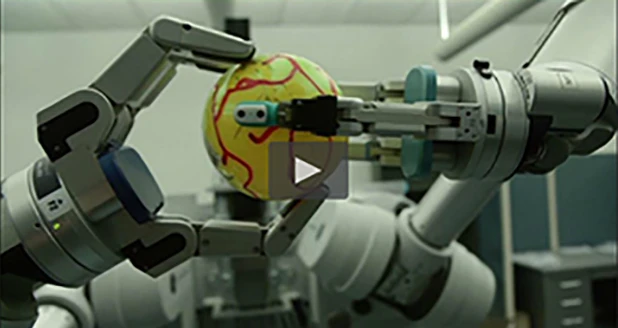
UCLA's Veronica Santos, PhD, is performing key research to advance prosthetic hands and arms and make them feel like your native limb. Santos is constructing a language of touch that a computer and a human can both understand by using SynTouch's BioTac sensors to explore objects of varied shapes, sizes and textures, and using BarrettHands on a pair of force-controlled WAM arms from Barrett Technology to control these explorations. The BioTac is the most human-like tactile sensor in the world, and the BarrettHand and WAM arm have long been the platform of choice for robotics researchers.
The video of bimanual operation using touch
and proprioception starts at 5:00 minutes.
Santos uses these advanced robotic technologies to enable her prosthetic-hand research, but technology isn't the ultimate objective. Santos envisions prosthetic arms and hands, which amputees use seamlessly. Her ideal outcome is that "All of the robotics, algorithms, and intelligence that we have built in at the very low level acts just like your spinal cord. You don't even know they're there." Seamlessly integrating this advanced technology into prosthetic limbs is an incredible challenge.
Meanwhile, Case Western Reserve University researcher Dustin Tyler, PhD is also working on technology to advance prosthetic hands. His research focuses on the seamless transmission of sensory data to amputees. By implanting electrodes that encircle nerves, data from sensors on prosthetic hands can be transmitted to the brain. Combining advanced tactile sensors and seamless transmission of sensory data won't give amputees their hands back, but "it will make you forget you don't have your hand" says Tyler. SynTouch is working with Dr. Tyler's group to provide custom NumaTac sensors to be used in his research.
Source: Barrett Technology Inc. and SynTouch
Latest from Today's Medical Developments
- NextDent 300 MultiJet printer delivers a “Coming of Age for Digital Dentistry” at Evolution Dental Solutions
- Get recognized for bringing manufacturing back to North America
- Adaptive Coolant Flow improves energy efficiency
- VOLTAS opens coworking space for medical device manufacturers
- MEMS accelerometer for medical implants, wearables
- The compact, complex capabilities of photochemical etching
- Moticont introduces compact, linear voice coil motor
- Manufacturing technology orders reach record high in December 2025