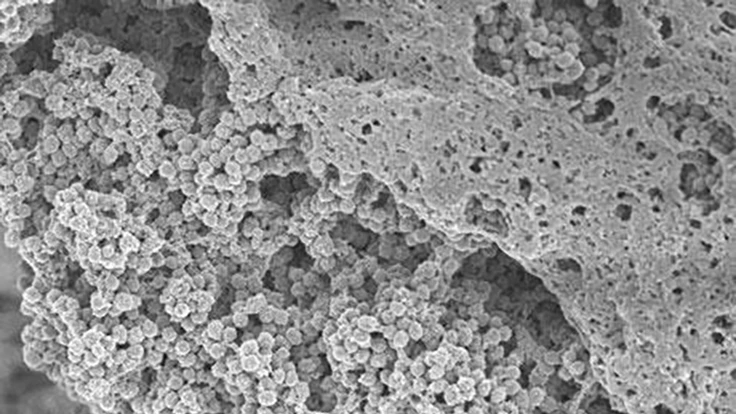
Gothenburg, Sweden – New research at the Sahlgrenska Academy show that coating implants with a certain "activator" can prevent Staphylococcus aureus, the leading cause of hospital-acquired infections, from forming biofilms.
Biofilms are mats of bacteria similar to the plaque that grows on teeth. Biofilms frequently coat the surfaces of catheters, and of various medical implants and prostheses, where they can threaten lives or lead to failure of the implants.
Antibiotics are impotent against biofilms. Now Gothenburg researchers Jakub Kwiecinski, Tao Jin and collaborators show that coating implants with "tissue plasminogen activator" can prevent Staphylococcus aureus, the leading cause of hospital-acquired infections, from forming biofilms.
Hijacks the system
A growing biofilm requires anchoring, and in earlier research, this team, led by Jin, an Associate Professor of Rheumatology and Inflammation Research at the University of Gothenburg, Sweden, had discovered that S. aureus hijacks the human clotting system to create a scaffold of micro-clots to support the growing biofilm.
"We hypothesized that if we forced the human body to start dissolving those clots, we could prevent the biofilm from developing," said Kwiecinski, a post-doctoral researcher in Jin's laboratory.
Clot-dissolving protein
To encouraging the clot-busting, the investigators coated the surfaces with tissue plasminogen activator (tPA), which activates the clot-dissolving protein, plasminogen.
"This deprives S. aureus of a scaffold for biofilm formation and prevents infection," said Kwiecinski. After performing the research under laboratory conditions, they confirmed that it works by coating catheters that they then implanted into laboratory mice.
Looking beyond bacteria
A key to the team's success was their decision to look beyond the bacteria, the stopping place for most previous research, to the human body's involvement in the infections, said Kwiecinski. The clot busting, he said, could be applied to biofilms of pathogens other than S. aureus.
Biofilm-related infections afflict around 1.7 million in the US alone, killing nearly 100,000 annually, according to the Center for Disease Control and Prevention. "With increasing numbers of prosthetic devices used in modern medicine, this number is only going to increase," said Kwiecinski. Thus, the research could lead to a major reduction in hospital-acquired disease and death.
Source: University of Gothenburg
Latest from Today's Medical Developments
- NextDent 300 MultiJet printer delivers a “Coming of Age for Digital Dentistry” at Evolution Dental Solutions
- Get recognized for bringing manufacturing back to North America
- Adaptive Coolant Flow improves energy efficiency
- VOLTAS opens coworking space for medical device manufacturers
- MEMS accelerometer for medical implants, wearables
- The compact, complex capabilities of photochemical etching
- Moticont introduces compact, linear voice coil motor
- Manufacturing technology orders reach record high in December 2025