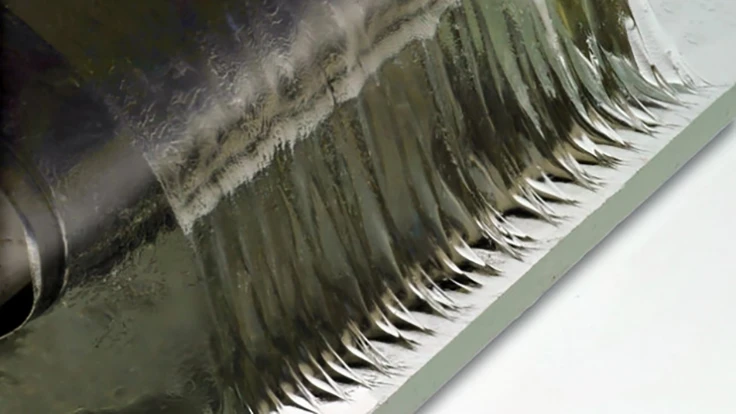
Engineered hydrogel being pulled away from a glass surface. The material shows a property called “tough wet adhesion” comparable to tendon and bone interface. The wavy edge instability at the interface is a hallmark of strongly adhered soft material on a rigid surface. Image: Felice Frankel
Nature has developed innovative ways to solve a sticky challenge: Mussels and barnacles stubbornly glue themselves to cliff faces, ship hulls, and even the skin of whales. Likewise, tendons and cartilage stick to bone with incredible robustness, giving animals flexibility and agility.
The natural adhesive in all these cases is hydrogel — a sticky mix of water and gummy material that creates a tough and durable bond.
Now engineers at MIT have developed a method to make synthetic, sticky hydrogel that is more than 90% water. The hydrogel, which is a transparent, rubber-like material, can adhere to surfaces such as glass, silicon, ceramics, aluminum, and titanium with a toughness comparable to the bond between tendon and cartilage on bone.
In experiments to demonstrate its robustness, the researchers applied a small square of their hydrogel between two plates of glass, from which they then suspended a 55-pound weight. They also glued the hydrogel to a silicon wafer, which they then smashed with a hammer. While the silicon shattered, its pieces remained stuck in place.
Such durability makes the hydrogel an ideal candidate for protective coatings on underwater surfaces such as boats and submarines. As the hydrogel is biocompatible, it may also be suitable for a range of health-related applications, such as biomedical coatings for catheters and sensors implanted in the body.
“You can imagine new applications with this very robust, adhesive, yet soft material,” says Xuanhe Zhao, the Robert N. Noyce Career Development Associate Professor in MIT’s Department of Mechanical Engineering. For example, Zhao’s group is currently exploring uses for the hydrogel in soft robotics, where the material may serve as synthetic tendon and cartilage, or in flexible joints.
“It’s a pretty tough and adhesive gel that’s mostly water,” Hyunwoo Yuk, a graduate student in mechanical engineering and the lead author of a paper on the work, says. “Basically, it’s tough, bonding water.”
Zhao and his students publish their results today in the journal Nature Materials.
Click here to read the full article by Jennifer Chu.
Source: MIT News
Latest from Today's Medical Developments
- NextDent 300 MultiJet printer delivers a “Coming of Age for Digital Dentistry” at Evolution Dental Solutions
- Get recognized for bringing manufacturing back to North America
- Adaptive Coolant Flow improves energy efficiency
- VOLTAS opens coworking space for medical device manufacturers
- MEMS accelerometer for medical implants, wearables
- The compact, complex capabilities of photochemical etching
- Moticont introduces compact, linear voice coil motor
- Manufacturing technology orders reach record high in December 2025