Medical devices used to prevent and treat illness and disease can be compromised when an accumulation of bacteria – biofilms – attach to the device surface after implantation. Communities of these bacteria – staphylococci – growing on catheters, heart valves, and artificial joints avoid being killed by antibiotics and the human immune system, typically requiring removal and replacement of the medical device. Each incident of biofilm infection can cost more than $50,000 to healthcare systems.
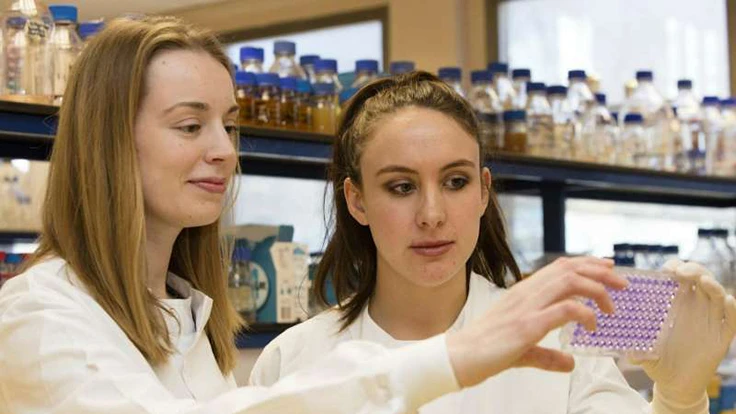
The research team led by Dr Joan Geoghegan, assistant professor of microbiology at Trinity's School of Genetics and Microbiology is studying new ways to prevent medical device-related infection. A recent breakthrough published in the Proceedings of the National Academy of Sciences shows that it is possible to prevent communities of staphylococci from forming by targeting the linkages that hold the bacteria together.
In collaboration with atomic force microscopy expert Professor Yves Dufrêne and his team at the Université Catholique de Louvain, Leanne Hays, PhD student in Trinity's Department of Microbiology, has found that it is possible to stop bacteria from attaching to surfaces and to each other using a small blocking molecule. The target of the molecule was a protein attached to the surface of the bacteria called SdrC. In laboratory experiments, the blocking molecule prevented the SdrC protein from recognizing other bacteria and stopped the staphylococci from growing as biofilm communities.
“These new findings show that it is possible to stop bacteria from building communities using molecules that specifically target proteins attached to the surface of the bacteria. This exciting breakthrough will inform the design of new, targeted approaches to prevent biofilm formation by staphylococci and reduce the incidence of medical device-related infection,” Geoghegan says.
Latest from Today's Medical Developments
- NextDent 300 MultiJet printer delivers a “Coming of Age for Digital Dentistry” at Evolution Dental Solutions
- Get recognized for bringing manufacturing back to North America
- Adaptive Coolant Flow improves energy efficiency
- VOLTAS opens coworking space for medical device manufacturers
- MEMS accelerometer for medical implants, wearables
- The compact, complex capabilities of photochemical etching
- Moticont introduces compact, linear voice coil motor
- Manufacturing technology orders reach record high in December 2025