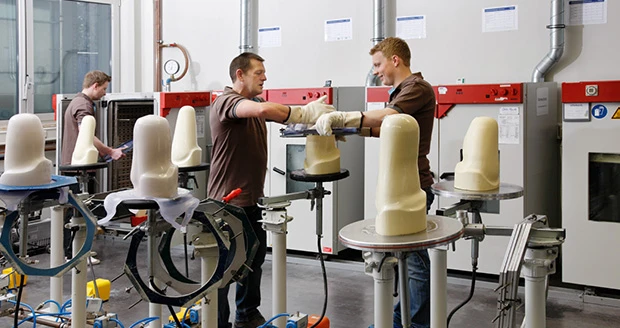
Liners made of silicone, polyurethane and other plastics enhance wearing comfort between the human body and the shaft of the prosthesis, Source: Otto Bock Health Care Deutschland GmbH, Duderstadt
Frankfurt am Main, Germany – Manufacturers of medical technology and production technology for medical products are equally called upon to put a continual series of innovations on the market, for the benefit of the patients. Orthopedic technology, for example: “Leg prostheses are tasked with giving the wearers their mobility back,” says Markus Rehm, a master mechanic for orthopedics, a top athlete, and wearer of a lower-thigh prosthesis. “In terms of functionality and safety, however, the optimum is still a very long way off.”
Jumping, dancing, jogging, swimming, climbing, or simply just walking – to enable all these movements to be optimally performed, this nowadays still requires several prostheses. Improving the wearing comfort even further, matching the prostheses more responsively to the movement sequences involved, rendering them more sensitive in regard to feeling heat or cold
“Here I would like to see quite a lot more improvements for the very near future,” says Rehm, a Paralympics winner and long-jump world champion.
Individuality is the trump card here. Companies like the Rahm Zentrum für Gesundheit (Rahm Health Centre) in Troisdorf, Markus Rehm’s own employer, purchase prefabricated prostheses from industrial suppliers, produce customized shafts as the link between the prosthetic and the human body, and modify them individually to the situation of their future wearers.
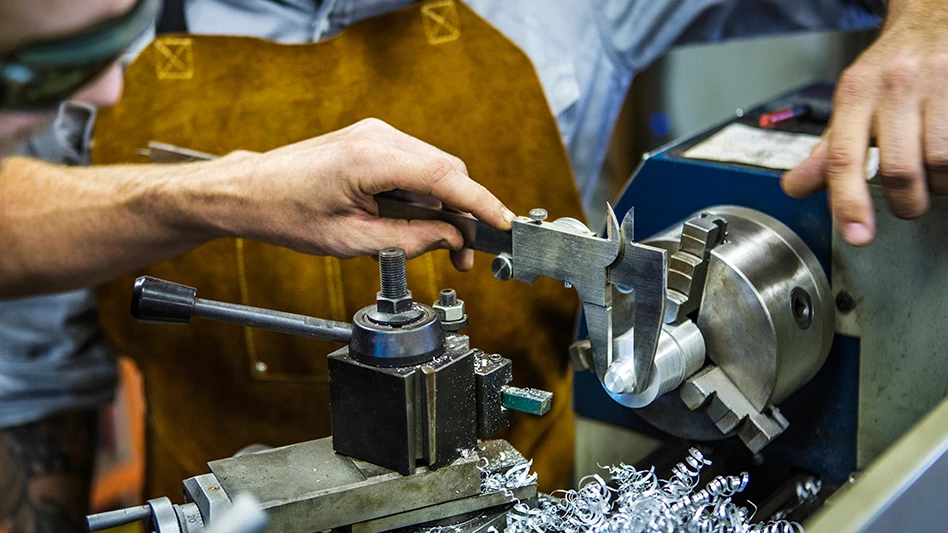
The materials used are lightweight ones like aluminum, carbon-fiber materials, titanium, silicone, etc. or material combinations. They are in many cases machined using conventional processes like milling, drilling or grinding. Also required are a goodly portion of skill and a steady hand. Furthermore, additive manufacturing is becoming progressively more important for customized medical technology.
New technologies, miniaturization, a paradigm shift away from an exclusively product-focused approach and towards complete-system and process solutions, the integration of ultra-modern information and communication technologies, personalization, and individualization are trends determining everyday reality in the field of medical technology. Every innovation in medical technology demands appropriate production technology for manufacturing it.
(Below) High-precision craftsmanship is essential for rendering high-tech usable. The shaft of the prosthesis is matched meticulously to the user concerned Source: Otto Bock Health Care Deutschland GmbH, Duderstadt

Medical technology increasingly in demand at the METAV
The interrelationship between medical and production technologies is the thematic focus of the Medical Area at the METAV 2016 in Düsseldorf from Feb. 23-27, 2016.
Medical technology is progressively evolving into a high-growth customer segment with ultra-rigorous stipulations in terms of quality, safety, and dependability. This demands machining technologies that supply precision and perfection in every phase of the manufacturing process, irrespective of whether customized or standard products are involved.
Starting life as a special show called “Metal meets Medical” at the METAV 2010, the subject has meanwhile gathered so much momentum that it has been anchored in the Medical Area as a fixed constituent of the METAV 2016. It will be spotlighting the entire spectrum available for production processes in the field of medical technology. New materials will be on show, as will surface treatment technology, product dimensioning and medical engineering, or the subjects of certification and production systems. For the premiere of the Medical Area at the METAV 2016, the existing exhibitor listing has been expanded to include a separate nomenclature with more than 30 entries for medical technology.
Four METAV areas invigorate the fair’s core section
With this profile, the Medical Area fits admirably into the METAV’s overall concept, which focuses on the entire value creation chain for metalworking applications. As from 2016, four areas will be appended, themed around Additive Manufacturing, Molding, Quality, and Medical, substantively conceived for mutual fructification. Manufacturers of medical technology, and of tools and molds, are all exacting purchasers of machine tools. Medical technology manufacturers use molds and tools for their production operations. Both sectors have ultra-rigorous stipulations for quality in their manufacturing processes. Solutions to this are offered by the Quality Area. Finally, visitors to the Medical Area can additionally familiarize themselves with the new options for additive manufacturing in the eponymous area. Inside an area, vendors showcase their corporate capabilities either as individual exhibitors or on shared stands. Each area features an integrated forum for presenting topical issues.
Ulrich Krenzer, managing director of Mapal Kompetenzzentrum VHM, Miller in Altenstadt, is fully persuaded of the new concept’s advantages. “Medical technology offers an enormous amount of potential, but also necessitates the development of concomitantly distinctive solutions. The requirements encountered in dental technology, for instance, are met by means of responsively adapted geometries and special cutting materials. We are delighted that the sector will be represented with an area of its own at the METAV 2016,” he says.
One of the Medical Area’s partners is the VDMA’s Medical Technology Working Group. Since being founded in March 2014, it has successfully positioned itself as a platform themed around issues of production equipment for medical technology. To quote Jürgen Lindenberg, managing director of Citizen Machinery Europe GmbH in Esslingen, a member of this Medical Technology Working Group and one of the METAV’s long-standing exhibitors: “The new areas at the METAV are a fine opportunity to purposefully target customers from the sectors concerned. We want to familiarize ourselves still more thoroughly with the requirements entailed by medical technology, and to further upgrade our high levels of competence in terms of micro-machining for this customer grouping. The METAV provides an ideal opportunity for this.”
Medical Technology Cluster North Rhine-Westphalia is one of the METAV’s partners
In regional terms, the Medical Area is supported by the Medical Technology Cluster North Rhine-Westphalia, headquartered in Düsseldorf. To quote its Executive Director Dr. Oliver Lehmkühler: “With the new Medical Area, the METAV is bringing together two vital sectors in North Rhine-Westphalia: metalworking and medical technology. This underlines the high quality of the technologies and products from North Rhine-Westphalia for the medical sector. As a partner of the Medical Area, we are delighted to be able to offer enhanced visibility for the highly innovative companies from North Rhine-Westphalia operating at this interface."
Source: METAV 2016
Latest from Today's Medical Developments
- Exchangeable-head solid carbide cutting tools
- NextDent 300 MultiJet printer delivers a “Coming of Age for Digital Dentistry” at Evolution Dental Solutions
- Get recognized for bringing manufacturing back to North America
- Adaptive Coolant Flow improves energy efficiency
- VOLTAS opens coworking space for medical device manufacturers
- MEMS accelerometer for medical implants, wearables
- The compact, complex capabilities of photochemical etching
- Moticont introduces compact, linear voice coil motor