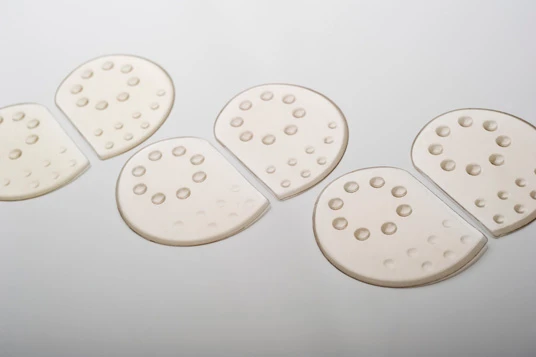
High-performance batteries enhance the quality of life of pacemaker patients substantially. Because of space restrictions in pacemakers, battery insulator must be precisely tailored and as thin-walled as possible. To produce this protective liner, Welch Fluorocarbon, a company based in Dover, NH, has now developed a unique process using a VESTAKEEP polyetheretherketone (PEEK) film from Evonik Industries.
Earlier generations of pacemakers were fitted with batteries that had to be recharged daily. Only with the advent of high-performance batteries, however, were patients relieved of this considerable burden. Following a period when even plutonium-based radionuclide batteries were used, pacemakers are now fitted almost exclusively with top-capacity lithium iodine batteries, which power the pacemaker for up to ten years. These must be accommodated in the confined spaced of the pacemaker. The space available for the insulation is also very limited, and wall thickness tolerances are low. For this reason, the batteries have so far been encapsulated manually with considerable effort using polyimide adhesive strips or parylene conformal coatings.
Custom-fit insulators are an alternative, but they usually cannot be produced by injection molding because of their thin wall thicknesses, low tolerances, and long flow paths. The company Welch Fluorocarbon has now developed a unique thermoforming process that makes it possible to manufacture such components. A plastic film is fixed in a frame, melted completely by heating to a tempe¬rature above the crystalline melt point of 340 °C, and then molded in vacuum. This molding from the melt produces particularly low-stress molded parts.
Because the insulator material must be chemically resistant to metallic lithium, the choice of suitable polymers is rather restricted. Welch decided on an amorphous VESTAKEEP PEEK film from Evonik, which both companies developed in close collaboration. The film is unusually low-stress and, in contrast to conventional extruded films, hardly flows
at all on melting. Only in this way is it possible to comply with the low thickness tolerances required. Using this film, Welch Fluorocarbon is now producing battery insulators with wall thicknesses of less than 25 microns and at extremely low tolerances.
VESTAKEEP film is highly resistant to chemicals and also features very high mechanical and flame resistance; it is stable even at high continuous working temperatures, and has excellent tribological and electrical properties. Evonik offers suitably adapted crystalline and amorphous VESTAKEEP films for all sectors of industry, including medical applications.
Latest from Today's Medical Developments
- NextDent 300 MultiJet printer delivers a “Coming of Age for Digital Dentistry” at Evolution Dental Solutions
- Get recognized for bringing manufacturing back to North America
- Adaptive Coolant Flow improves energy efficiency
- VOLTAS opens coworking space for medical device manufacturers
- MEMS accelerometer for medical implants, wearables
- The compact, complex capabilities of photochemical etching
- Moticont introduces compact, linear voice coil motor
- Manufacturing technology orders reach record high in December 2025