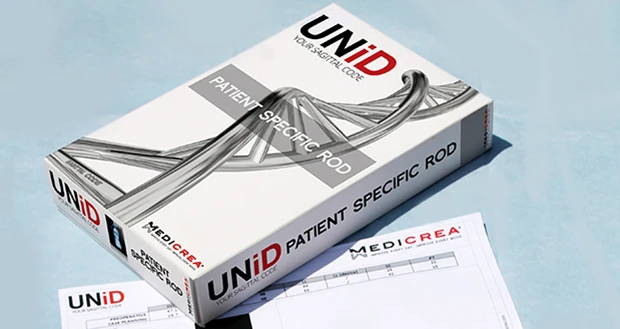
New York & Lyon, France – The MEDICREA Group officials announced the company has received 510(k) clearance from the U.S. Food and Drug Administration (FDA) for UNiD, the world’s first patient-specific spinal osteosynthesis rod.
The first U.S. patient underwent surgery to have personalized UNiD rods implanted last week in New York.
UNiD features a user-friendly software tool to help surgeons preoperatively plan their surgery and order customized, industrially produced rods to fit the specific spinal alignment needed for each individual patient. UNiD eliminates the need to manually contour a rod during surgery, providing surgeons with a precisely aligned rod prior to surgery and reducing the amount of time patients spend in the operating room, which directly impacts infection rate and quality of recovery.
“Understanding and restoring sagittal alignment is key towards providing better patient outcomes and preventing the need for reoperations, a major factor in rising health care costs. By providing rod customization, UNiD allows surgeons to precisely execute their preoperative plan and frees them from the antiquated technique of freehand bending, ensuring individual patients receive the most accurate and effective treatment. Having a more precise, personalized rod ready before even stepping foot in the operating room is a game-changer for spine surgery,” said Frank J. Schwab, MD, a renowned orthopedic surgeon and spinal deformity expert, who performed the first customized UNiD rod surgery in the U.S. today.
The UNiD rod system, which has been successfully implanted in over 100 patients in Europe offers a real-time support team, the UNiD Lab, that provides a seamless process by which surgeons preoperatively analyze, design and order the patient-specific rod. The UNiD plug in, proprietary to MEDICREA, is embedded into the Surgimap software, and provides surgeons a quick and efficient option for ordering patient-specific rods. After the planning process is complete, the order is transferred to the UNiD Lab, which processes the request and industrially produces and labels the rod specifically for the patient.
“When we created Surgimap in 2008 our primary goal was to provide a research tool for surgeons to plan, measure and review their results,” said Virginie Lafage, PhD, co-founder of NEMARIS. “As we collected data we noticed a startling trend: 62% of patient remained sagittally malaligned after surgery. This was occurring not because of a lack of skills, but because surgeons have not had the best tools at their disposal. Our collaboration with MEDICREA is an important step forward for spine surgery. Combining our core competency, our software platform, with MEDICREA’s hardware solution was necessary to bring a cutting-edge solution to surgeons and the patients they treat. It would not have been possible without such collaboration.”
The UNiD customized rod offers numerous benefits to surgeons and patients undergoing spine surgery.
The primary benefit of UNiD is it allows surgeons to plan and then execute their operating strategy without compromises or approximation errors.
Until now, surgeons had no alternative but to use a bending device, known as a French bender, supplied in all instrument kits to bend the rods manually. This manual rod-contouring process involves estimating the curve in a very empirical manner using pre-operative X-rays displayed on a wall in the operating room. Significant error and variability exist with that approach. With UNiD, surgeons can now be certain of implanting spinal fusion rods that are precisely adapted to the patient because UNiD rods are personalized and accurately curved using a design established by the surgeon during the pre-operative planning phase with the Surgimap / UNiD software.
Additional advantages of UNiD include:
- Surgeons can improve their success rate in terms of global sagittal patient alignment.
- With the free UNiD application in the Surgimap software, spine surgeons have access to the most recent scientific data available on the parameters necessary to determine and restore sagittal alignment for each patient.
- Surgeons can save time and be more efficient in the operating room.
- By eliminating the manual bending of rods during surgery, surgeons can significantly reduce operating time. This is an additional benefit, since infection rates and the quality of a patient’s recovery are directly linked to the duration of the surgical procedure. As soon as the surgeon validates the rod’s design in the UNiD application, MEDICREA precisely manufactures the implantable rod and delivers it within five working days.
- Surgeons can reduce the risk of spinal implant failure.
- The UNiD rods, customized for each patient, are pre-contoured using a controllable and reproducible industrial process. This eliminates the intraoperative use of a bending device, which creates indentations, or notches, in the rod. Such notches are an acknowledged cause of rods breaking postoperatively, which can occur in patients – especially adults with severe spinal deformities
“MEDICREA’s groundbreaking UNiD patient-specific rods include the most current clinical data and software development along with the latest in personalized production and industrialization to revolutionize how spine surgery is performed. UNiD rods provide surgeons a very precise surgical method, supporting better patient care and improved economic outcomes,” said Denys Sournac, founder, CEO and chairman of MEDICREA and added “FDA approval of UNiD is a major milestone for MEDICREA. We started working closely with the FDA nearly two years ago on that strategic approval and this newly obtained clearance marks the culmination of years of research and surgery planning to bring a patient-specific spine implant to market, as well as the beginning of a new exciting era in spine surgery.”
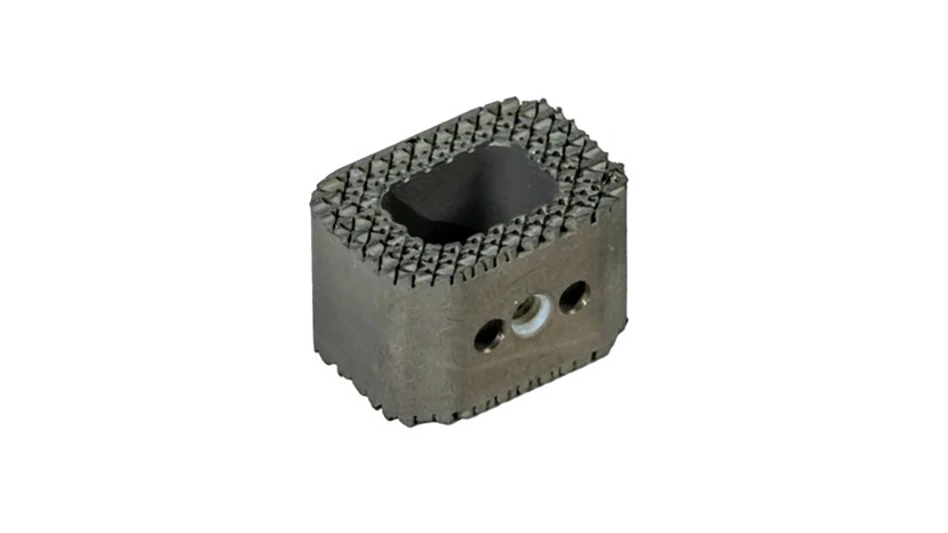
UNiD patient-specific rods are universal implants available in two alloys (Titanium TA6V ELI/Cobalt Chromium) and two diameters (5.5mm/6mm), that match global standards. UNiD naturally fits into the PASS LP thoraco-lumbar fixation system, present in a worldwide market segment estimated at $3.6 billion. The PASS LP system is already used by numerous spine surgeons in 35 countries, and notably in the United States where this product accounts for the majority of MEDICREA USA Corporation’s sales. MEDICREA’s customized spine implant platform also includes the UNiD anterior lumbar interbody fusion (ALIF) spine cages created with a 3D printer. With the support of specific software and advanced imaging, the UNiD ALIF customized cages made of Poly Ether Ketone Ketone (PEKK) exactly reproduce the anatomic details of a patient’s vertebral endplates. The world’s first spinal fusion surgery using the UNiD ALIF customized 3D printed spine cages was performed on May 28, 2014 in France.
UNiD is the first patient-specific device cleared to treat degenerative spine conditions including scoliosis and other type of deformities, which represent a $2 billion market opportunity in the U.S. alone. According to the National Scoliosis Foundation, an estimated six million people in the U.S. have scoliosis. Each year scoliosis patients make more than 600,000 visits to private physician offices, and an estimated 38,000 patients undergo spinal fusion surgery. Adult spinal deformity surgery is likely to increase in frequency with as much as 32% of the adult population suffering from scoliosis and a prevalence of 60% among the elderly. Hospital costs of adult spinal deformity surgery can exceed $100,000 per patient. Revisions and reoperations place a large financial burden on the health care system – increasing the average cost of adult spinal deformity surgery by more than 70%. The market for revision surgeries is growing at a significant rate because of the number of corrections performed with approximation errors and misalignment over the past 20 years.
Source: MEDICREA
Latest from Today's Medical Developments
- Gore completes acquisition of Conformal Medical
- Medical textiles designed for cardiovascular, orthopedic, dental prosthetic applications
- Micro-precision 3D printing: Trends and breakthroughs in medical device manufacturing
- One-component, dual-cure adhesive system for medical device assembly
- #82 Manufacturing Matters - Forecasting 2026 with GIE Media's Manufacturing Group
- Flexing prosthetic finger offers lifelike appearance and movement
- How the fast-evolving defense market impacts suppliers
- Medtronic’s Hugo robotic-assisted surgery system makes US debut