Globally
- 10+ million people living with limb loss
- $1.62 billion in 2015 value
- 5% CAGR through 2026
- ~1.5 per1,000 incidence of amputation
TYPES
LOWER EXTREMITY
- Foot & ankle prosthetics
- Knee prosthetics
- Hip prosthetics
UPPER EXTREMITY
- Hand prosthetics
- Elbow prosthetics
- Shoulder prosthetics
COMPONENTS
- Liners
- Sockets
- Modular
TECHNOLOGY
- Conventional
- Electric powered
- Hybrid
$731.1 million
- Electric-powered orthopedic prosthetics’ 2015 value
6% CAGR through 2026

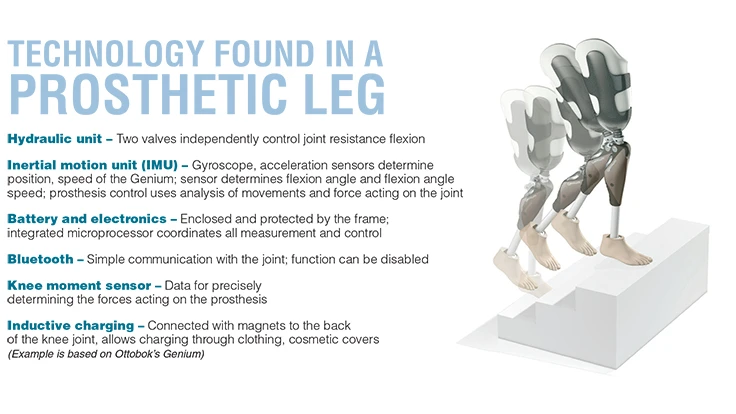
Technology found in a prosthetic leg
Hydraulic unit – Two valves independently control joint resistance flexion
Inertial motion unit (IMU) – Gyroscope, acceleration sensors determine position, speed of the Genium; sensor determines flexion angle and flexion angle speed; prosthesis control uses analysis of movements and force acting on the joint
Battery and electronics – Enclosed and protected by the frame; integrated microprocessor coordinates all measurement and control
Bluetooth – Simple communication with the joint; function can be disabled
Knee moment sensor – Data for precisely determining the forces acting on the prosthesis
Inductive charging – Connected with magnets to the back of the knee joint, allows charging through clothing, cosmetic covers
(Example is based on Ottobok’s Genium)
Latest from Today's Medical Developments
- NextDent 300 MultiJet printer delivers a “Coming of Age for Digital Dentistry” at Evolution Dental Solutions
- Get recognized for bringing manufacturing back to North America
- Adaptive Coolant Flow improves energy efficiency
- VOLTAS opens coworking space for medical device manufacturers
- MEMS accelerometer for medical implants, wearables
- The compact, complex capabilities of photochemical etching
- Moticont introduces compact, linear voice coil motor
- Manufacturing technology orders reach record high in December 2025