Cleveland, Ohio – Every three months, MAPI provides a detailed look at the health of the domestic manufacturing sector and reviews the performance of a selected group of its most important subsectors. This report covers the actual data available through July 2014 and provides our forecasts, completed in mid-August 2014.
Production declined very sharply in January (particularly because of weather) but rebounded dramatically in February, more than offsetting the January decline. Manufacturing industrial production increased at a 5% annual rate in the three months ending July 2014. Production activity from March through July was exceptionally strong in light of the sluggish GDP growth so far this year. For example, inflation-adjusted GDP increased at a 0.9% annual rate in the first half of 2014. Manufacturing production, however, grew at a 4% annual rate.
The manufacturing outlook for 2014 and 2015 calls for an acceleration in the growth rate each year. In addition, manufacturing will continue to grow faster than the overall economy. The proximate cause for faster industrial growth is that demand has shifted toward manufactured goods. Durable goods, equipment, and construction have long lives and therefore are temporarily postponable, especially during economic downturns and times of uncertainty. Consumers and firms sit on the sidelines until the goods wear out, growth necessitates additional capacity, and/or confidence returns. Motor vehicle sales and housing starts are traditional bellwethers for consumer durables–driven manufacturing. We expect auto sales to increase 5% in 2014 and 3% in 2015. Housing starts should grow 10% this year and 29% in 2015, and this growth will accelerate purchases of appliances and other household goods. The rebound in big-ticket consumer spending is supported by steady employment gains, households’ low debt burdens, and rising consumer wealth (a factor of higher stock and home prices).
Business investment responds to the ability to borrow and the need for capacity. Firms have lots of cash and are profitable, and falling unemployment indicates higher utilization rates. Further, several growth themes create an incentive for investment. The energy infrastructure for unconventional oil and natural gas has revived domestic drilling and the need for distribution pipelines and terminals. Residential and nonresidential construction are rebounding, and both have extended supply chains that include many manufactured goods.
The needs for new capacity and replacement cycles have converged for all types of transportation equipment – autos, trucks, airplanes, ships, and railroad. An aging population has accelerated the demand for medical care, including medical supplies and equipment. Furthermore, the manufacturing industry itself is attracting significant investment in machinery and structures thanks to the faster pace of growth and widening backlogs driven by the above themes. The acceleration in investment-driven and consumer-driven manufacturing will underpin an acceleration in material industries production.
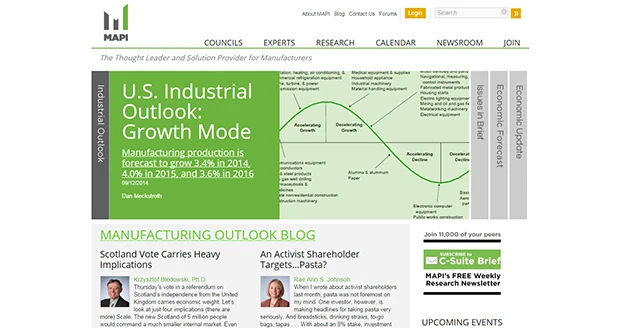
Manufacturing production is forecast to grow 3.4% in 2014, 4.0% in 2015, and 3.6% in 2016.
High-tech production (computers and electronic products) should grow 4.7% in 2014, 8.5% in 2015, and 10.4% in 2016. Non-high-tech or traditional manufacturing, which accounts for the vast bulk of value-added in the sector, will grow 3.2% in 2014, 3.8% in 2015, and 3.2% in 2016.
Get all the details from MAPI.
Source: MAPI
Latest from Today's Medical Developments
- NextDent 300 MultiJet printer delivers a “Coming of Age for Digital Dentistry” at Evolution Dental Solutions
- Get recognized for bringing manufacturing back to North America
- Adaptive Coolant Flow improves energy efficiency
- VOLTAS opens coworking space for medical device manufacturers
- MEMS accelerometer for medical implants, wearables
- The compact, complex capabilities of photochemical etching
- Moticont introduces compact, linear voice coil motor
- Manufacturing technology orders reach record high in December 2025