Purdue University
Anyone who has had a mammogram or magnetic resonance imaging (MRI) knows how uncomfortable and awkward the tests can be. One reason the tests are uncomfortable is they often use rigid radio-frequency (RF) coils to detect signals from the body.
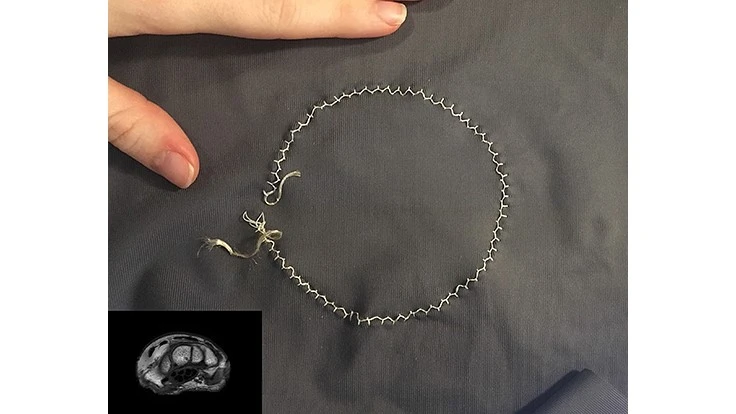
To address this, Purdue University researchers, using technology from the aerospace and defense industries, created a novel way of doing medical imaging; the team developed RF coils that are formable and stretchable.
“Imagine going for an imaging session and they strap on a comfortable fabric with the coils embedded inside,” says Joseph Rispoli, an assistant professor of biomedical engineering and electrical and computer engineering in Purdue’s College of Engineering. “We created an adaptable, wearable and stretchable fabric embroidered with conductive threads that provides excellent signal-to-noise ratio for enhanced MRI scanning.”
The Purdue team’s work appeared in the journal IEEE Transactions on Biomedical Engineering.
Current approaches to enhancing signal-to-noise ratio (SNR) include shaping receive coil arrays to encompass a generalized form of the body part of interest, but these are often rigid and require the patient be posed in a specific way. The Purdue flexible and stretchable coil could be placed close to the skin on an area or joint, regardless of its positioning.
The thread technology used in the Purdue innovation is similar to that found in applications for the aerospace and defense industries. Rispoli says the technology also is applicable to breast MRI and to enhancing medical device communication using wearable or implantable antennas.
“Our preliminary results show a full-scale device will be superior in all aspects of diagnostic testing, including increased sensitivity and fewer false positives,” Rispoli says.
The innovators are working with the Purdue Research Foundation Office of Technology Commercialization to patent the technology.
The National Institutes of Health funded some of the work on the technology. The Purdue innovators also presented the technology at the International Society for Magnetic Resonance in Medicine Annual Meeting and the IEEE International Engineering in Medicine and Biology Conference.
Rispoli also is a member of the drug delivery and molecular sensing program at the Purdue University Center for Cancer Research, where he works on technologies to diagnose and monitor brain, breast and other cancers.
Latest from Today's Medical Developments
- NextDent 300 MultiJet printer delivers a “Coming of Age for Digital Dentistry” at Evolution Dental Solutions
- Get recognized for bringing manufacturing back to North America
- Adaptive Coolant Flow improves energy efficiency
- VOLTAS opens coworking space for medical device manufacturers
- MEMS accelerometer for medical implants, wearables
- The compact, complex capabilities of photochemical etching
- Moticont introduces compact, linear voice coil motor
- Manufacturing technology orders reach record high in December 2025