On March 22, 2012, Chris James became the first patient in the United Kingdom to receive this groundbreaking surgery as part of a clinical trial being carried out at John Radcliffe Hospital and King's College Hospital in London.
James' operation took place at the Oxford Eye Hospital with the surgical team led by Professor Robert MacLaren.
Assisting MacLaren was Tim Jackson, a consultant ophthalmic surgeon at King's College Hospital in London. The following week, a second patient, Robin Millar, a 60-year-old music producer from London, received a retinal implant at King's College Hospital, with MacLaren assisting Jackson.
Both patients were able to detect light immediately after the electronic retinas switched on, and are now beginning to experience some restoration of useful vision. Further operations are in the planning stages for other suitable patients.
The retinal implants, developed by Retina Implant of Germany, look to restore some sight to people with retinitis pigmentosa, an inherited condition that affects around one in every 3,000 to 4,000 people in Europe.
Retinitis pigmentosa is a progressive disease that sees light-detecting cells in the retina deteriorating over time.
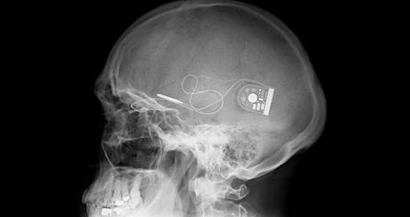
Design of the Retina Implant's devices is to replace the lost cells in the retina. Patients have a small microchip containing 1,500 tiny electronic light detectors implanted below the retina. The optic nerve is able to pick up electronic signals from the microchip and patients can begin to regain some sight once more.
MacLaren explains: "What makes this unique is that all functions of the retina are integrated into the chip. It has 1,500 light sensing diodes and small electrodes that stimulate the overlying nerves to create a pixellated image. Apart from a hearing aid-like device behind the ear, you would not know a patient had one implanted."
Chris James, 54, a council worker from Wiltshire, first began to experience night blindness in his mid-20s, later diagnosed with retinitis pigmentosa following a referral to Oxford Eye Hospital.
For a number of years, Chris' vision remained relatively stable. However, in 1990, a large dip in his vision left him legally blind. In 2003, another decrease in vision rendered Chris completely blind in his left eye and only able to distinguish lights in his right.
After having the artificial retina implanted in his left eye, Chris can now recognize a plate on a table and other basic shapes. In addition, his vision is continuing to improve as he learns to use the electronic chip in an eye that has been completely blind for over a decade.
The operation took eight hours and first required implantation of the power supply, which is buried under the skin behind the ear, similar to a cochlear implant. This part of the operation was by James Ramsden of Oxford University Hospitals assisted by Markus Groppe, an academic clinical lecturer at the University of Oxford.
The electronic retina was then inserted into the back of the eye and stitched into position before being connected to the power supply.
Three weeks after the operation, James’ electronic retina was switched on for the first time. After some initial tuning and testing, James was able to distinguish light against a black background.
"As soon as I had this flash in my eye, this confirmed that my optic nerves are functioning properly which is a really promising sign," James says. "It was like someone taking a photo with a flashbulb, a pulsating light, I recognized it instantly."
James continues to have monthly follow-up testing of his microchip. In the meantime, he is testing the microchip at home. "It is obviously early days but it is encouraging that I am already able to detect light where previously this would have not been possible for me. I am still getting used to the feedback the chip provides and it will take some time to make sense of this. Most of all, I am really excited to be part of this research."
MacLaren says, "We are all delighted with these initial results. The vision is different to normal ... and it requires a different type of brain processing. We hope, however, that the electronic chips will provide independence for many people who are blind from retinitis pigmentosa."
The U.K. part of the trial is coordinated by Oxford University and will see up to 12 blind patients receive the implant in operations at the Oxford University Hospitals NHS Trust and King's College Hospital in London.
The U.K. trial is funded by a grant from the National Institute of Health Research with extra support from the Oxford Biomedical Research Centre.
Anyone interested in finding out more information about the trial should email the research team at oehresearch@gmail.com or call the patient helpline on 01865 572900.
Latest from Today's Medical Developments
- Exchangeable-head solid carbide cutting tools
- NextDent 300 MultiJet printer delivers a “Coming of Age for Digital Dentistry” at Evolution Dental Solutions
- Get recognized for bringing manufacturing back to North America
- Adaptive Coolant Flow improves energy efficiency
- VOLTAS opens coworking space for medical device manufacturers
- MEMS accelerometer for medical implants, wearables
- The compact, complex capabilities of photochemical etching
- Moticont introduces compact, linear voice coil motor