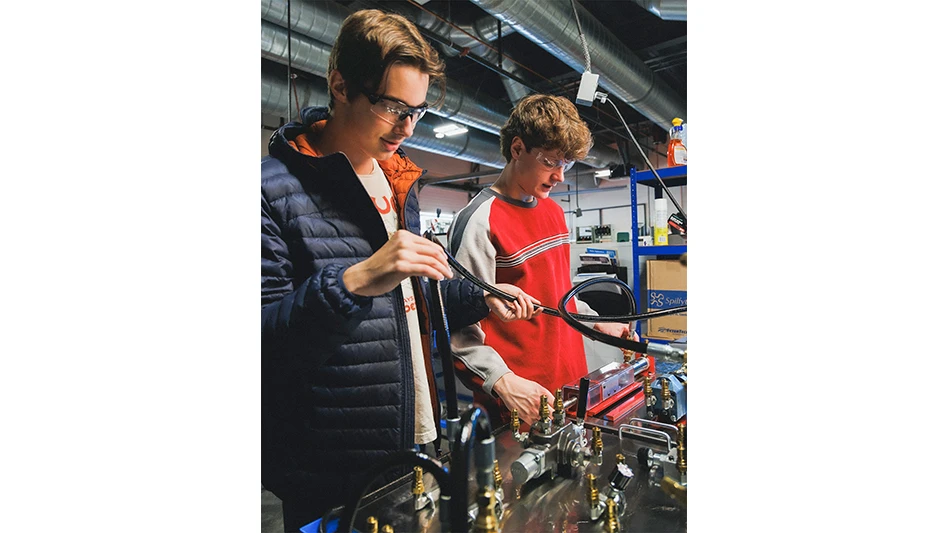
Boulder, Colorado – Officials from the International Titanium Association (ITA) are pleased to support of the International Tele-Mentoring Program (ITP). The ITP starts with schools comprised of students as young as 12 years old. Through their mentors, they are taught how to map out a STEM- related education and career path, guided by professional networks that help to implement and fine-tune these plans over time.
David Neils, executive director of ITP, said that professional mentors from more than 22 countries have supported more than 47,000 students during the last 20 years.
Tele-mentoring is a process that combines the proven practice of mentoring with the speed and ease of electronic communication, enabling busy professionals to make significant contributions to the academic lives of students. Through mentoring by industry professionals, a corporation helps students develop the skills and foundation to pursue their interests successfully and operate at their potential. “Although research shows that face-to-face mentoring programs can have a variety of positive impacts, many top professionals believe they simply don’t have the time to make that kind of commitment. By investing about 30 minutes per week, mentors can help students achieve academic excellence and explore their education and career futures.”
Guided by their mentors, students document the quality of various project outcomes against a rubric or standard. They discuss gaps, if any, between their work and that standard and how they plan to fill the gap. Students also share with mentors how they can leverage the mentor’s help throughout the project and provide insights on how they could have improved as collaborators – a means to continually fine-tune and upgrade the mentoring process.
Speaking on behalf of ITP, Neils explains, “The preference is to start the Tele-mentor process at the middle school level, when students are humble, transparent, and eager to learn.”
The goal is that by the time a student graduates from high school they have in place a continuing education plan, a career plan, and a professional mentoring network.
“They’ll know how to recognize high-quality work. These plans are something that should happen for every student,” Neils says.
In many cases, the mentor/student relationship becomes a long-term, reciprocal program of education and friendship – enriching professional and private lives through the mentoring partnership. It changes the trajectory of lives and serves as a learning experience for both parties.
In many ways, the relationship brings to mind an old adage of education: “When I was a student, I learned from my teachers; when I was a teacher, I learned from my students.”
For the titanium industry, the ITP program complements an ongoing thrust to cultivate students as future engineers, designers, executives, and metallurgists worldwide. ITA’s WiT committee is pleased to engage in the promotion of mentoring programs available and in attracting students as future leaders of the industry.
Once ITP has accepted this year’s projects students will be working on, the projects will be opened up to mentors who apply to participate. There will be opportunities for mentors in 22 countries, representing every time zone. The sooner ITP receives applications from prospective mentors, the greater selection of projects mentors will have to choose.
There are 61 opportunities for mentors at this time.
Mentors may apply here: http://www.telementor.org/mentors.cfm.
Contact David Neils, founder and director, directly with any questions about the programs: 970.481.9795; fax: 877.376.8053; davidn@telementor.org; www.telementor.org
Source: ITA
Latest from Today's Medical Developments
- NextDent 300 MultiJet printer delivers a “Coming of Age for Digital Dentistry” at Evolution Dental Solutions
- Get recognized for bringing manufacturing back to North America
- Adaptive Coolant Flow improves energy efficiency
- VOLTAS opens coworking space for medical device manufacturers
- MEMS accelerometer for medical implants, wearables
- The compact, complex capabilities of photochemical etching
- Moticont introduces compact, linear voice coil motor
- Manufacturing technology orders reach record high in December 2025