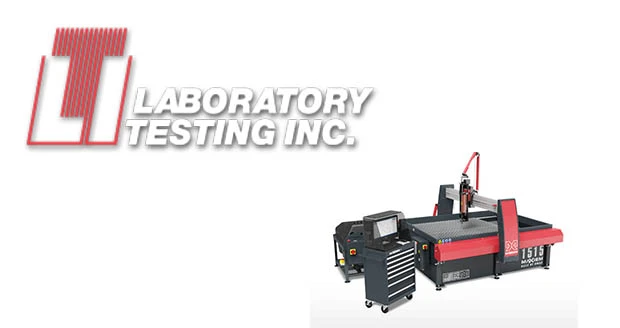
Philadelphia, Pennsylvania – Test specimens are prepared by Laboratory Testing Inc.’s in-house Machine Shop for all mechanical testing performed at the Lab. The Machine Shop runs two work shifts to keep up with the volume of orders needed for testing or sold directly to customers for use in their own labs. Fast turnaround and accuracy are specimen requirements. A well-run, efficient Machine Shop equipped with the latest computer-controlled cutting and machining centers for speed and accuracy is how the obligations are met.
The most recent piece of equipment purchased for the machine shop is an OMAX Corp. Maxiem Model 1515 abrasive waterjet system with a cutting area that fits material stock up to 5ft x 5f. It provides faster, more efficient cutting of test specimens than more traditional methods, and in addition, with the cold cutting process, cleaner parts are produced without heat-affected zones.
Samples can be cut closer to finished size than with rough-cut saws, thereby requiring less machining time.
The waterjet can be set up for automated cutting to run unattended.
Holds a tight tolerance of around 0.005” (depending on material thickness).
Workpieces can be cut from virtually any material at significantly faster speeds than traditional machines.
Machining at LTI will produce the precision specimens customers depend on to get reliable test results. Specimen machining is Nadcap accredited by the Performance Review Institute and performed to ASTM A370, ASTM E8 and ASTM E23.
LTI has the staff and equipment to prepare a wide-range of test specimens such as the following:
- Jominy
- Flat & round tensile
- Izod impact
- Charpy V-notch impact
- Dynamic tear
- Compact tension
- Stress corrosion
- Gleeble
- Stress rupture
- Flat fatigue
- Rotating beam & low cycle fatigue
- Fracture toughness
- Round compression
- Hydrogen embrittlement
- Face, root, & side bend
- Frequency severity (steel cleanliness)
Latest from Today's Medical Developments
- Gore completes acquisition of Conformal Medical
- Medical textiles designed for cardiovascular, orthopedic, dental prosthetic applications
- Micro-precision 3D printing: Trends and breakthroughs in medical device manufacturing
- One-component, dual-cure adhesive system for medical device assembly
- #82 Manufacturing Matters - Forecasting 2026 with GIE Media's Manufacturing Group
- Flexing prosthetic finger offers lifelike appearance and movement
- How the fast-evolving defense market impacts suppliers
- Medtronic’s Hugo robotic-assisted surgery system makes US debut