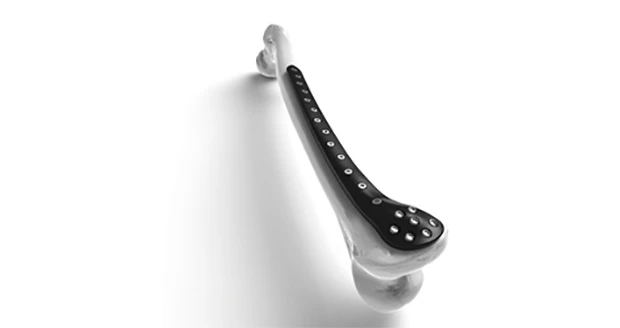
Tampa, Florida & Thornton Cleveleys, United Kingdom – Trauma plates composed of a high performance polymer provide patients at risk of complications with a greater window for healing compared to metallic plates. The new trauma device technology is based on a composite called PEEK-OPTIMA Ultra Reinforced polymer. It delivers similar mechanical strength to metallic plates, with 50x greater fatigue resistance. Invibio Biomaterial Solutions presented details and hosted a panel discussion of its technology at the Orthopaedic Trauma Association (OTA) meeting.
Delayed or non-unions cost healthcare providers more than $2 billion in failed operations in the US alone. Non-union rates in the literature have been detailed as high as 18% for distal femur plating. Despite this and the fact that patients risk profiles for non-unions vary enormously there are very limited material options for treating patients.
“Patients who are at risk for slow or delayed healing can benefit from implants composed of PEEK-OPTIMA Ultra-Reinforced because the fatigue life is so much greater than metal. They're more likely to be able to heal their fracture before their implant fails due to fatigue. There's a whole host of patients that are slow to heal, including smokers and patients with diabetes, poor bone quality or open fractures, who have an enhanced potential to heal,” states David J. Hak, MD, MBA, orthopaedic surgeon at Denver Health, University of Colorado. He adds, “I've been using the material for about two years in the proximal humerus and I've been very pleased with the outcome of those patients.”
Invibio Trauma Device Technology is a turnkey platform that allows medical device manufacturers to quickly design, validate, and manufacture semi-rigid anatomic plates composed of PEEK-OPTIMA Ultra Reinforced polymer.
“At Invibio, we’ve spent more than 5 years developing the expertise, design and manufacturing processes and building manufacturing facilities to quickly and cost effectively bring composite device components to market,” John Devine, emerging business director at Invibio explained. “Now, we are able to offer our customers a technology platform from which they can deliver differentiated PEEK-composite trauma implants up to three times faster than if they developed programs on their own. Customers can save as much as $1.8 million in start-up and development costs and redeploy their development staff to other business initiatives.”
PEEK-OPTIMA Ultra-Reinforced polymer, a composite of PEEK-OPTIMA Natural polymer reinforced with continuous carbon fibers, provides the strength and fatigue resistance demanded by high-load trauma implant applications. Using PEEK-OPTIMA Ultra-Reinforced polymer, designers can alter stiffness and develop trauma implants that are less rigid than metal implants, increasing dynamic loading, and promoting secondary healing at the fracture site. This Invibio Trauma Device Technology gives surgeons a new option for treating patients at high risk of developing complications related to internal trauma fixation, such as non-unions, delayed unions, and implant failures.
The imaging characteristics of PEEK-OPTIMA Ultra Reinforced give surgeons the ability to see the fracture site from all angles under x-ray. During the procedure, this can ease reduction and ensure proper alignment for healing to occur. After the procedure, it offers greater visibility of the fracture-healing site so that surgeons can make more informed decisions about when to return patients to load-bearing activities.
Source: Invibio Biomaterial Solutions
Latest from Today's Medical Developments
- Exchangeable-head solid carbide cutting tools
- NextDent 300 MultiJet printer delivers a “Coming of Age for Digital Dentistry” at Evolution Dental Solutions
- Get recognized for bringing manufacturing back to North America
- Adaptive Coolant Flow improves energy efficiency
- VOLTAS opens coworking space for medical device manufacturers
- MEMS accelerometer for medical implants, wearables
- The compact, complex capabilities of photochemical etching
- Moticont introduces compact, linear voice coil motor