A new paper-based sensor patch developed by researchers at Binghamton University,
State University of New York could allow diabetics to effectively measure glucose levels during exercise.
Credit: Binghamton University Electrical and Computer Science Assistant Professor Seokheun Choi
Today's conventional glucose monitoring measurements are not suitable for preventing hypoglycemia during exercise, says Binghamton University Electrical and Computer Science Assistant Professor Seokheun Choi.
 Left: Credit: Binghamton University Electrical and Computer Science Assistant Professor Seokheun Choi
"This is because 1) the underlying process relies on invasive and inconvenient blood sampling, causing the possibility of sample contamination and skin irritation with sweat containing various electrolytes and proteins; 2) the method needs patients to carry many accessories during physical activity, including lancets, alcohol swabs, and a relatively large glucometer; and 3) the technique requires a sophisticated electrochemical sensing technique and sufficient electrical energy, which makes the technique difficult to be fully integrated in a compact and portable fashion," Choi says.
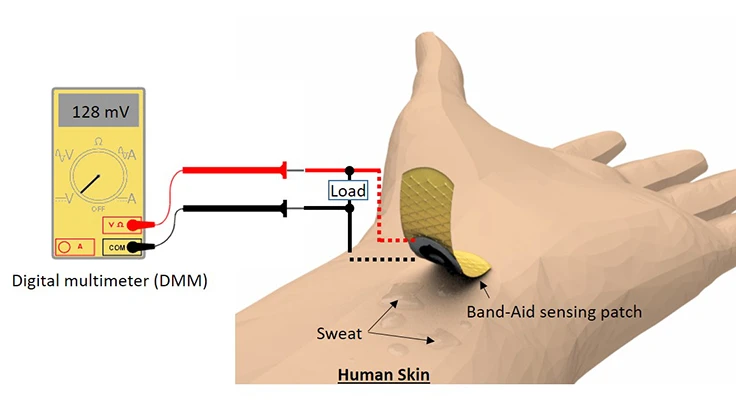
Choi and fellow researchers have developed and demonstrated a self-powered, wearable, and disposable patch that allows for non-invasive monitoring of glucose in human sweat. This wearable, single-use biosensor integrates a vertically stacked, paper-based glucose/oxygen enzymatic fuel cell into a standard Band-Aid adhesive patch.
Sign up for the weekly newsletter…know the latest in the medical design and manufacture market.
 "The paper-based device attaches directly to skin, wicks sweat to a reservoir where chemical energy is converted to electrical energy, and monitors glucose without external power and sophisticated readout instruments," Choi says.
Sweat-based glucose sensing is attractive for managing exercise-induced hypoglycemia because the measurement is performed during or immediately after exercise when there is enough sweat to obtain an adequate sample, Choi says. This potential alleviates shortcomings of conventional non-invasive sweat sensors, which can be hampered by the difficulty of collecting enough sweat for analysis, sample evaporation and the relatively long time required for sample collection.
"The sensing platform holds considerable promise for efficient diabetes management, and a fully integrated system with a simple readout can be realized toward continuous non-invasive glucose monitoring," the researchers wrote.
Credit: Binghamton University
Electrical and Computer Science
Assistant Professor Seokheun Choi
Latest from Today's Medical Developments
- NextDent 300 MultiJet printer delivers a “Coming of Age for Digital Dentistry” at Evolution Dental Solutions
- Get recognized for bringing manufacturing back to North America
- Adaptive Coolant Flow improves energy efficiency
- VOLTAS opens coworking space for medical device manufacturers
- MEMS accelerometer for medical implants, wearables
- The compact, complex capabilities of photochemical etching
- Moticont introduces compact, linear voice coil motor
- Manufacturing technology orders reach record high in December 2025