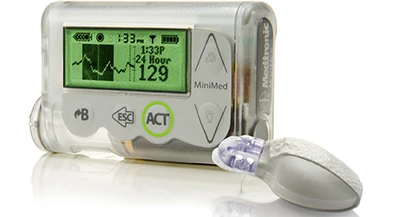
Study results published in the New England Journal of Medicine report that the Threshold Suspend feature of a sensor-augmented insulin pump from Medtronic Inc. safely reduces nocturnal hypoglycemia without affecting glycated hemoglobin level (HbA1C). Threshold Suspend – a first-of-its-kind automated insulin pump feature unique to an investigational MiniMed integrated system - automatically suspends insulin delivery temporarily when sensor glucose values reach a pre-set low level. It is also an important step toward Medtronic's ultimate goal to develop a fully automated artificial pancreas for people with diabetes.
"Hypoglycemia can be catastrophic for people with diabetes, especially at night when patients are likely to be unaware of symptoms because they are asleep," states Richard M. Bergenstal, M.D., executive director of the International Diabetes Center at Park Nicollet Health Services in Minneapolis and past president of medicine and science, American Diabetes Association. "These data are very important because they provide strong evidence that sensor-augmented insulin pump therapy with a Threshold Suspend feature can reduce hypoglycemia at home – and it can do it safely, without increasing the patients' risk for long-term complications by raising their A1C."
Under an investigational device exemption (IDE) granted by the FDA, the ASPIRE[1] In-Home study compared two MiniMed sensor-augmented insulin pumps (integrated insulin pump with continuous glucose monitoring): one with the Threshold Suspend feature and one without. While a MiniMed integrated insulin pump with continuous glucose monitoring has been proven to provide better glucose control than multiple daily injections without increasing hypoglycemia[2], this is the first, large in-home study to show the results of the integrated system when Threshold Suspend is incorporated.
"ASPIRE In-Home met both its safety and efficacy endpoints and it provides additional clinical validation for Threshold Suspend, the first diabetes technology to automatically take action based on sensor glucose values," says Francine Kaufman, M.D., vice president of global medical affairs of the Diabetes business at Medtronic. "The study results are important as we continue to move toward our goal of developing a fully automated system, or artificial pancreas, that will one day require very minimal interaction from the patient."
About Threshold Suspend
The first-of-its-kind Threshold Suspend feature, exclusive to MiniMed insulin pumps, works by suspending insulin delivery for up to two hours when an individual's sensor glucose value reaches a preset low sensor level. Once the threshold is met, the insulin pump will alarm and suspend all insulin delivery for two hours. Insulin delivery can be resumed by the patient at any time. The feature is commercially available internationally in the MiniMed Veo System (where the feature is called Low Glucose Suspend). Threshold Suspend is also a part of the MiniMed 530G, which is not commercially available in the U.S. at this time, and is currently under review at the FDA. The MiniMed 530G system is the first system submitted for approval under the new product classification, "OZO: Artificial Pancreas Device System, Threshold Suspend," created by the U.S. Food and Drug Administration. www.medtronic.com
[1]Automation to Simulate Pancreatic Insulin REsponse
[2] Bergenstal RM, Tamborlane WV, Ahmann A, et al. Effectiveness of sensor-augmented insulin-pump therapy in type 1 diabetes. N Engl J Med 2010;363:311-320.
Latest from Today's Medical Developments
- Stryker’s flexible syndesmotic fixation device stabilizes ankle injuries
- Mergers & acquisitions news: MGS, Quantum Surgical bolster medtech portfolios
- Exchangeable-head solid carbide cutting tools
- NextDent 300 MultiJet printer delivers a “Coming of Age for Digital Dentistry” at Evolution Dental Solutions
- Get recognized for bringing manufacturing back to North America
- Adaptive Coolant Flow improves energy efficiency
- VOLTAS opens coworking space for medical device manufacturers
- MEMS accelerometer for medical implants, wearables