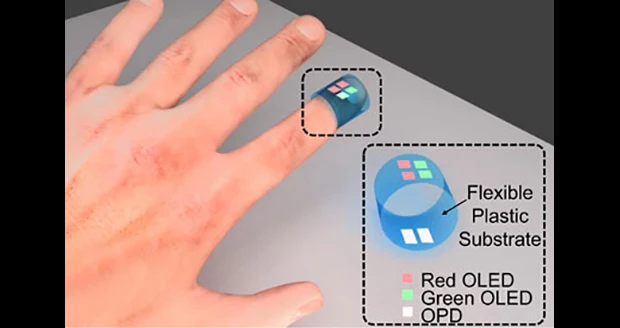
Berkeley, California – Future fitness trackers could soon add blood-oxygen levels to the list of vital signs measured with new technology developed by engineers at UC Berkeley.
“There are various pulse oximeters already on the market that measure pulse rate and blood-oxygen saturation levels, but those devices use rigid conventional electronics, and they are usually fixed to the fingers or earlobe,” said Ana Arias, an associate professor of electrical engineering and computer sciences and head of the UC Berkeley team that is developing a new organic optoelectronic sensor.
By switching from silicon to an organic, or carbon-based, design, the researchers were able to create a device that could ultimately be thin, cheap, and flexible enough to be slapped on like a Band-Aid during that jog around the track or hike up the hill.
The engineers put the new prototype up against a conventional pulse oximeter and found that the pulse and oxygen readings were just as accurate.
The research team reported its findings today (Wednesday, Dec. 10) in the journal Nature Communications.
Giving silicon a run for its money
A conventional pulse oximeter typically uses light-emitting diodes (LEDs) to send red and infrared light through a fingertip or earlobe. Sensors detect how much light makes it through to the other side. Bright, oxygen-rich blood absorbs more infrared light, while the darker hues of oxygen-poor blood absorb more red light. The ratio of the two wavelengths reveals how much oxygen is in the blood.
For the organic sensors, Arias and her team of graduate students – Claire Lochner, Yasser Khan, and Adrien Pierre – used red and green light, which yield comparable differences to red and infrared when it comes to distinguishing high and low levels of oxygen in the blood.
Using a solution-based processing system, the researchers deposited the green and red organic LEDs and the translucent light detectors onto a flexible piece of plastic. By detecting the pattern of fresh arterial blood flow, the device can calculate a pulse.
“We showed that if you take measurements with different wavelengths, it works, and if you use unconventional semiconductors, it works,” said Arias. “Because organic electronics are flexible, they can easily conform to the body.”
Arias added that because the components of conventional oximeters are relatively expensive, healthcare providers will choose to disinfect them if they become contaminated. In contrast, “organic electronics are cheap enough that they are disposable like a Band-Aid after use,” she said.
The National Science Foundation and Flextech helped support this research.
Source: UC Berkeley
Latest from Today's Medical Developments
- NextDent 300 MultiJet printer delivers a “Coming of Age for Digital Dentistry” at Evolution Dental Solutions
- Get recognized for bringing manufacturing back to North America
- Adaptive Coolant Flow improves energy efficiency
- VOLTAS opens coworking space for medical device manufacturers
- MEMS accelerometer for medical implants, wearables
- The compact, complex capabilities of photochemical etching
- Moticont introduces compact, linear voice coil motor
- Manufacturing technology orders reach record high in December 2025