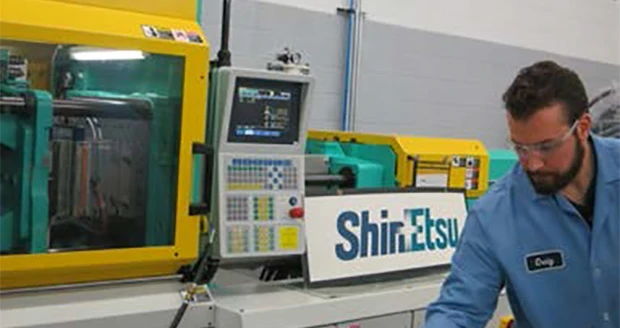
Akron, Ohio – Shin-Etsu Chemical Co. Ltd. is the largest chemical company in Japan, producing more than 4,000 different silicone products. Its subsidiary, Shin-Etsu Silicones of America Inc. (SESA), recently opened its new, 7,020ft2 Liquid Injection Molding System (LIMS) Technical Center in Akron, Ohio, that will be under the leadership of Shin-Etsu’s LIMS Process Engineer Craig Lustek.
At the epicenter of the new Technical Center is an ARBURG, 110 ton, All-Electric horizontal liquid injection molding press. Lustek’s primary focus at SESA is to support the design of new LIMS products, provide full-scale process development of LIMS materials, and assist new and existing customers with training, molding trials, and process improvements.
According to Lustek, “The goals of the LIMS Technical Center are to drive the design of new LIMS products and provide full-scale process development of LIMS materials. Additionally, we provide value-added support for new and existing customers with training, molding trials, prototyping, production start-up, and process improvements.”
Recently, Lustek demonstrated an adhesion overmold tool designed to help application engineers verify silicone-to-plastic bonding on a test specimen at the LIMS Technical Center. The demonstration included the following elements:
- 2-cavity mold designed and built to test adhesion to rigid thermoplastic substrates
- Substrates of allowable thickness for the mold: 0.080”, 0.100”, and 0.120”
- SESA’s new Select-Hesive LIMS product: X-34-4172 that bonds to Nylon 6, Nylon 12, and other high-temperature engineering resins
- ISO/ASTM Standard 90-Degree Peel Test specimens
- Test fixture fabricated by ARDL to quantitatively test adhesion on an Instron device
The ultimate goal of the demonstration is to achieve 100% cohesive failure of the silicone on the test fixture. Once an optimal bond is obtained on the substrate, it proves that the silicone can be successfully overmolded onto the thermoplastic via a 2-shot or insert-overmolding process – eliminating costly secondary operations.
During the production demonstration, Lustek provided a detailed profile on the key advantages of LIMS materials including, but not limited to:
- A wide range of thermal stability (-60°F to 400°F)
- Non-conductive thermally and electrically so it’s a great insulator
- The elastomeric molecule has the ability to expand and elongate naturally without additives and has a wide range of elastomeric hardnesses (5-to-80: Shore A)
- Boasts high tear strength properties, is chemically inert (ideal for healthcare products)
- Is a translucent material but can also be colored with dispersions
- Has a low surface energy so objects don’t stick to it (ideal for the bakeware market)
- Meets USP Class VI and ISO 10993 regulatory standards for biocompatibility
Given this myriad of property benefits, Shin-Etsu LIMS products are increasingly specified for market applications including health care, infant feeding, automotive, and consumer products, which has drawn significant production back to the USA.
According to Lustek, “We will leverage the LIMS Technical Center to provide advanced LIMS analytical testing and competitive studies−providing R&D runs and customer trials to test processing issues with customers’ molds to eliminate defects. Additionally, we are considering more processing equipment which may include vertical, horizontal, and multi-shot presses so customers can come in and work hand-in-hand with us.”
Source: Shin-Etsu Silicones
Latest from Today's Medical Developments
- NextDent 300 MultiJet printer delivers a “Coming of Age for Digital Dentistry” at Evolution Dental Solutions
- Get recognized for bringing manufacturing back to North America
- Adaptive Coolant Flow improves energy efficiency
- VOLTAS opens coworking space for medical device manufacturers
- MEMS accelerometer for medical implants, wearables
- The compact, complex capabilities of photochemical etching
- Moticont introduces compact, linear voice coil motor
- Manufacturing technology orders reach record high in December 2025