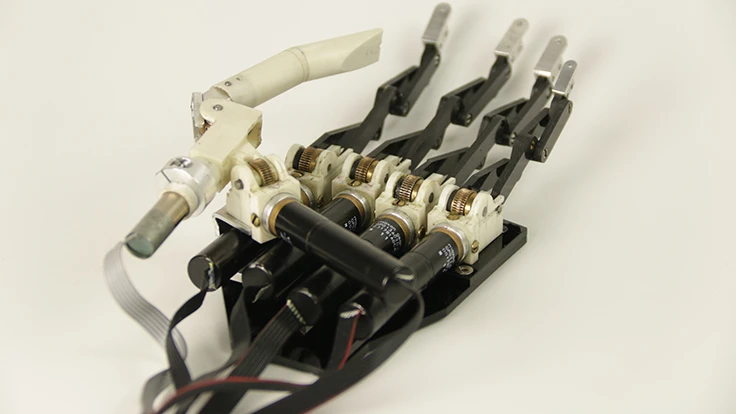
The Electronics and Computer Science Department of Southampton University, in the UK, has chosen South African-manufactured Vesconite Hilube for various parts of an innovative low-mass sensor-rich prosthetic hand.
The polymer’s lower density (compared to alloys) was an important influencing factor in the decision to use it.
“A main constraint in the design of a hand for the replacement of a lost natural hand is that its mass should be kept as low as possible,” notes primary investigator Paul Chappell.
As a result, the Southampton-Remedi hand uses carbon fiber sheet and Vesconite Hilube, with metals only being used on the actuators of the electric drives, he elaborates.
Not only does the University’s prosthetic-hand research program use Vesconite Hilube for the thumb of the hand, it has also used the polymer as the bearing material for the ends of the worm and wheel shafts at the base of the fingers and thumb.
Vesconite Hilube’s self-lubricating properties mean that the gearbox does not require additional bearings at the end of the shafts. The Southampton-Remedi hand has four motors that move the fingers and two motors that allow for flexion (movement towards the palm), and extension (movement away from the palm) as well as rotation of the thumb. The hand can grip and grasp objects securely and, when electrical power is turned off from the batteries, a stable grip should be maintained using worm-wheel gearboxes. In addition, the current generation of the hand also incorporates touch, position, slip, texture, and temperature sensors.
“Battles have resulted in hand-loss and this trauma has led to the development of artificial replacements,” Chappell says. “In the sixteenth century, Götz Von Berlichingen who was a German warrior, and Ambriose Paré, a French surgeon, made hands from metal components,” noting the early origins of prosthetic hands.
Various developments followed, including the split hook – a device that attached to the shoulders with leather straps and used the shoulder muscles to open the hand against a spring. WWI and WWII as well as current conflicts have seen advancements in the design of prosthetic hands, Chappell comments.
The Southampton-Remedi Hand has been developed over several decades and has been the subject of several PhD programs.
Southampton University has been at the forefront of some significant work on artificial limbs, and is also well known for the Southampton Hand Assessment Procedure, which assesses hand function.
Latest from Today's Medical Developments
- NextDent 300 MultiJet printer delivers a “Coming of Age for Digital Dentistry” at Evolution Dental Solutions
- Get recognized for bringing manufacturing back to North America
- Adaptive Coolant Flow improves energy efficiency
- VOLTAS opens coworking space for medical device manufacturers
- MEMS accelerometer for medical implants, wearables
- The compact, complex capabilities of photochemical etching
- Moticont introduces compact, linear voice coil motor
- Manufacturing technology orders reach record high in December 2025