Stanford, California – When we type or perform other precise tasks, our brains and muscles usually work together effortlessly.
But when a neurological disease or spinal cord injury severs the connection between the brain and limbs, once-easy motions become difficult or impossible.
In recent years researchers have sought to give people suffering from injury or disease some restored motor function by developing thought-controlled prostheses.
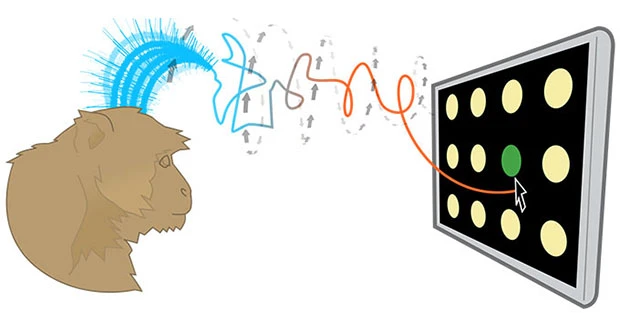
Such devices tap into the relevant regions of the brain, bypass damaged connections, and deliver thought commands to devices such as virtual keypads.
But brains are complex. Actions and thoughts are orchestrated by millions of neurons – biological switches that fire faster or slower in dynamic patterns.
Brain-controlled prostheses currently work with access to a sample of only a few hundred neurons but need to estimate motor commands that involve millions of neurons. So tiny errors in the sample – neurons that fire too fast or too slow – reduce the precision and speed of thought-controlled keypads.
Now an interdisciplinary team led by Krishna Shenoy, a Stanford professor of electrical engineering, has developed a technique to make brain-controlled prostheses more precise. In essence, the prostheses analyze the neuron sample and make dozens of corrective adjustments to the estimate of the brain's electrical pattern – all in the blink of an eye.
Click here to read the full article By Tom Abate, Stanford Engineering
Latest from Today's Medical Developments
- NextDent 300 MultiJet printer delivers a “Coming of Age for Digital Dentistry” at Evolution Dental Solutions
- Get recognized for bringing manufacturing back to North America
- Adaptive Coolant Flow improves energy efficiency
- VOLTAS opens coworking space for medical device manufacturers
- MEMS accelerometer for medical implants, wearables
- The compact, complex capabilities of photochemical etching
- Moticont introduces compact, linear voice coil motor
- Manufacturing technology orders reach record high in December 2025