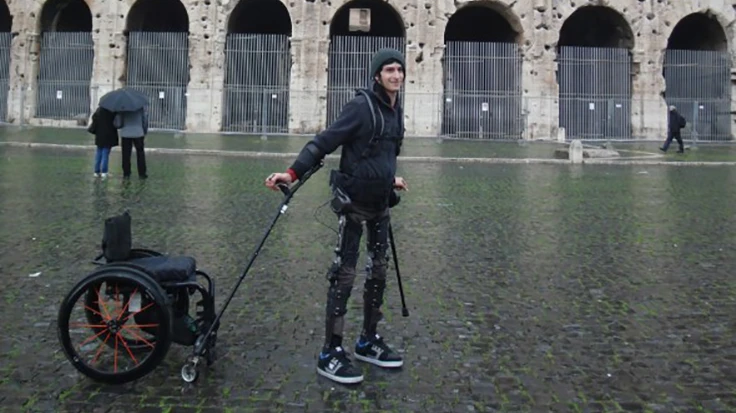
Berkeley, California – suitX, a California-based robotics company designing and manufacturing medical and industrial exoskeletons, is the winner of the $1 million top prize in the international Robotics for Good Competition for its pediatric medical exoskeleton. suitX competed in an original pool of 664 entries from 121 countries to a shortlist of 20 and finally down to three finalists, which presented before the judges in Dubai on Feb. 6, 2016. In addition to this substantial cash prize, suitX presented its medical exoskeleton to the World Government Summit conference of 3,000-plus world dignitaries now taking place, also in Dubai.
The prize-winning pediatric exoskeleton builds on the Phoenix platform, with several modifications in hardware and software to improve the acquisition of locomotion skills by children. The pediatric device will help children affected by neurological conditions like Cerebral Palsy and Spina Bifida in which walking is difficult or impossible. The goal is to develop technologies that lead to an exoskeleton that quickly promotes walking skills among children during the narrow timeframe when children more easily acquire locomotion skills.
"We are honored to be the winner from among this extraordinary group of competitors. Our team is passionate about our desire to create low-cost consumer bionic products to improve the quality of life for people around the world," said Dr. Homayoon Kazerooni, suitX CEO. "By aiming at neurologically disabled children we can make the difference between children spending their lives in a wheelchair or actually standing and walking. We are going to use this cash prize to create a versatile and accessible pediatric exoskeleton."
Dr. Kazerooni and his team just launched the suitX Phoenix medical exoskeleton for people with mobility disorders. At 27 pounds, the Phoenix is one of the world's lightest and most advanced commercial exoskeletons. It uses a wealth of state-of-the-art embedded intelligence and has a minimal design to make the exoskeletons accessible and simple to manufacture. Phoenix has a modular design, making it customizable to fit users with various conditions and costs $40,000 -- two to four times less than competing products. The company is currently taking preorders for the Phoenix.
Source: suitX (also known as U.S. Bionics, Inc.)
Latest from Today's Medical Developments
- NextDent 300 MultiJet printer delivers a “Coming of Age for Digital Dentistry” at Evolution Dental Solutions
- Get recognized for bringing manufacturing back to North America
- Adaptive Coolant Flow improves energy efficiency
- VOLTAS opens coworking space for medical device manufacturers
- MEMS accelerometer for medical implants, wearables
- The compact, complex capabilities of photochemical etching
- Moticont introduces compact, linear voice coil motor
- Manufacturing technology orders reach record high in December 2025