PLATINUM TOOLING
In today’s manufacturing environment, the competition is fierce, making it essential for companies to maximize the productivity of their machine tools. In many cases, this need includes adding accessories to enhance the machine’s capabilities and help them perform at a higher level. Frequently, the type of accessories needed are focused on increasing the rpm of what the machine tool can do. This is not limited to one area of manufacturing. There is a requirement for higher rpm, in machine spindles and lathe turrets, from the largest machining centers to the smallest Swiss-type machines.
With today’s machining practices, many applications dictate the use of smaller cutting tools running at high rpm and high feed rates. The increased rpm helps optimize the results of the cutting tools and final product. Those required rpms aren’t always available in the machine spindle or turret. Additionally, when running the machine at its maximum capacity, premature wear can occur, or thermal growth may result causing out of tolerance workpieces.
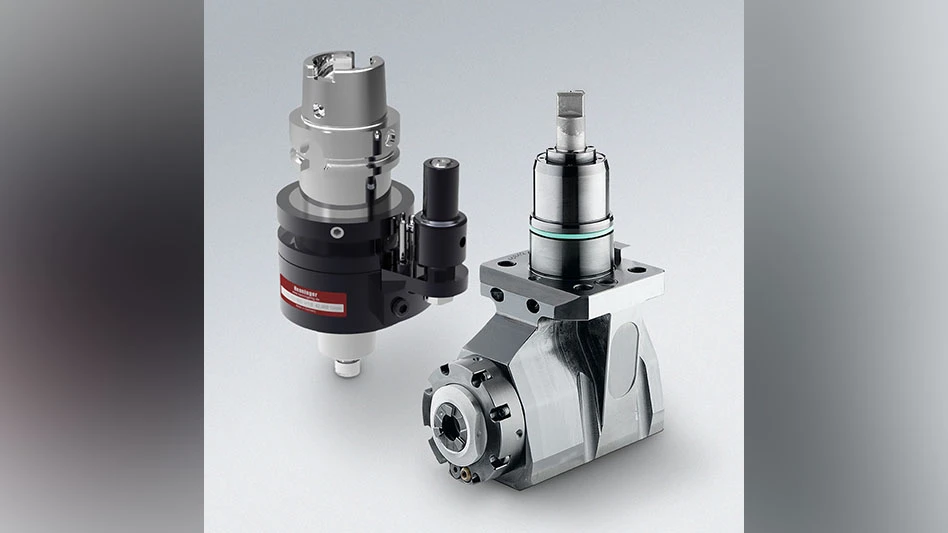
Machine tool builders produce machines for the broadest audience and that does not always take into consideration high-speed applications. Considering this, there is a large variety of speeders available to complement the wide range of machines in the market.
Depending upon your machining center application needs, one can choose from air driven, geared, or motor speeders. For the highest rpm requirements, air speeders are available that can run up to 80,000rpm continuously. They are best suited for very small diameter milling, drilling, and engraving, in particular, when long duty cycles are involved. Geared speeders are available in a wide range of sizes from ER 11, with 1:8 gear ratio, which can run at 50,000rpm. In addition, large 50 taper output tools can achieve 4,000rpm with 50hp. These are the extreme cases, but many other tool options exist for mid-range applications.
For very special applications, electric motor spindles are also available. Motor spindles and built-in spindles have their own drive and therefore are completely independent of the respective machine spindles. If required, these auxiliary spindles can be equipped with common tool holders and interfaces making them suitable for all types of applications. Some tools can be supplied with a capacity up to 80,000rpm or 20hp.
Turning centers face similar challenges but, in these cases, it is not the main spindle that requires additional rpm but rather the turret tooling. Live tool speeders are available for the most popular machine brands with gear ratios from 1:2 up to 1:4 with a maximum rpm of 48,000. Speeders can be supplied in a variety of styles including straight, 90 degree, and universal adjustable. Live tool speeders are also offered on the market today with internal coolant capabilities when there is a requirement for a coolant-through cutting tool.
Undoubtedly, these invaluable tools for high-speed applications will continue to gain popularity in the manufacturing world, offering increased productivity regardless of the size and shape of the machine tool.
Latest from Today's Medical Developments
- Arcline to sell Medical Manufacturing Technologies to Perimeter Solutions
- Decline in German machine tool orders bottoming out
- Analysis, trends, and forecasts for the future of additive manufacturing
- BlueForge Alliance Webinar Series Part III: Integrate Nationally, Catalyze Locally
- Robot orders accelerate in Q3
- Pro Shrink TubeChiller makes shrink-fit tool holding safer, easier
- Revolutionizing biocompatibility: The role of amnion in next-generation medical devices
- #56 Lunch + Learn Podcast with Techman Robot + AMET Inc.