CREDIT: PVA TEPLA AMERICA
Plasma pens integrated into production lines provide targeted plasma treatments, reducing failure rates by improving adhesion and bonding in various critical applications.
Plasma is a state of matter, like a solid, liquid, or gas. When sufficient energy is applied to a gas it becomes ionized, transitioning into the plasma state. With precise application and control, plasma can alter surface properties of a metal or plastic part without compromising the underlying material.
“Plasma contains ions, electrons, neutral particles, and reactive species that can be used for precision cleaning, decontamination, increasing surface wettability, and other surface modifications,” says Ryan Blaik, sales manager of Corona, California-based PVA TePla. “These techniques can boost the bond strength up to 50x in certain cases.” While there are multiple methods for applying plasma to a medical device’s surface, one of the most popular and accessible are plasma pens. These tools ionize gas, such as air or noble gases, under normal atmospheric pressure conditions using electrical discharges.
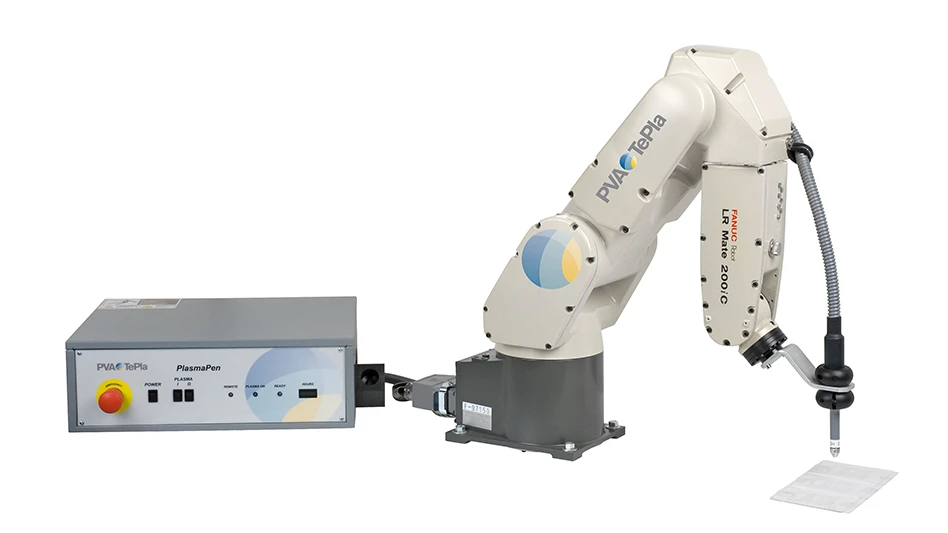
“Plasma produced from the tip of the pen can be applied to very specific areas, or the entire part,” explains Blaik, adding plasma pens are often incorporated into automated inline manufacturing processes or controlled by robots.
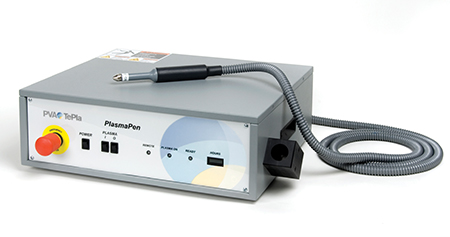
In medical device manufacturing, plasma pens are widely used to improve adhesion in critical applications. Their ability to activate, clean, and functionalize surfaces without needing solvents makes them particularly valuable in a field where cleanliness, precision, and biocompatibility are paramount. These handheld or automated tools are used to prepare surfaces of polymers, metals, glass, and ceramics before bonding, coating, printing, or molding, ensuring strong, reliable adhesion in permanent and temporary assemblies.
In catheter production, for example, plasma pens are used to improve bond strength between polymer tubing and connectors or coatings – essential for mechanical performance and fluid compatibility. In surgical instruments, diagnostic devices, and wearable monitors, plasma treatment enhances adhesion of adhesives used to assemble housings, attach sensors, and apply protective coatings. It’s also used to improve ink adhesion in printing lot numbers, calibration marks, or functional sensor inks on curved or irregular surfaces.
For implantable devices, plasma surface activation can be used to improve bonding of encapsulants, coatings, or biointerfaces while maintaining strict cleanliness and non-contaminating requirements of medical-grade materials. It’s also frequently employed to activate thermoplastics prior to over-molding or insert molding processes, enabling the formation of complex, multi-material components with strong interfacial adhesion.
Plasma pens are often integrated into cleanroom production lines, where the dry, non-contact operation is compatible with sterile environments. Their flexibility and precision make them particularly useful in prototyping and low-to-medium volume production, where design changes and varied geometries require adaptable surface preparation techniques.
Unlike traditional vacuum-based plasma chambers where parts are processed in high volume batches, the plasma pen can be installed inline, costs less, requires less energy, and incurs lower operational costs. Other advantages include reduced upfront investment, simplified exhaust management, and suitability for smaller-scale production requirements.
“For manufacturers that only need to spot treat a part or operate high-speed production lines, a solution as simple as a pen may make more sense,” Blaik explains. “Plus, if you’re comparing the cost, a pen is going to be more affordable than a larger batch processing system.”
Solving complex adhesion challenges
For most applications, plasma treatments are used to increase the surface free energy of the material. Surface energy is defined as the sum of all intermolecular forces on the surface of a material and the degree of attraction or repulsion force a material surface exerts on another material.
When a substrate has high surface energy, adhesives and other liquids often spread more easily across the surface. There are several mechanisms for increasing surface energy with plasma, including precision cleaning, chemically or physically modifying the surface, increasing surface area by roughening, and applying primer coatings.
“Most materials are initially hydrophobic. To make them bondable, their surface is typically modified to become hydrophilic,” Blaik explains. “The plasma pen excels at making raw materials hydrophilic, enhancing their ability to bond effectively with chemical adhesives.”
The plasma pen is particularly effective for preparing materials in overmolding processes, including polypropylene applications, dip coatings, or any method involving encasing or encapsulating components.
“The key aspect is enhancing the surface’s wettability,” Blaik says. “This allows the overmold to spread more effectively across the surface and minimizes the formation of bubbles or air gaps caused by low-energy surfaces. The result is a stronger and more reliable bond.”
A common application of silicone overmolding is to safeguard electronic boards against exposure to humidity or liquid. Without proper adhesion, silicone can begin to delaminate, not only at the edges of the printed circuit board (PCB) but also in small air pockets on or around components. This can lead to moisture ingress and subsequent corrosion or electrical shorts.
Another challenge is the topography of a PCB, meaning silicone must bond to many types of materials, including polymers, metals, alloys, ceramics, and the FR-4 board itself, which all have unique surface energies and chemistries.
PVA TePla developed a specific process starting with a precision cleaning/surface activation treatment followed by the deposition of an inert chemical primer serving as a tie layer for the overmolding and providing a uniform surface energy for the silicone to bond.
Plasma generated from atmospheric air exhibits strong oxidative properties, making it highly effective for surface cleaning and activation. Layers of absorbed molecules, such as oil and water on metallic surfaces, can be easily removed to improve adhesion.
Plasma pen selection
Atmospheric plasma pens can generate two forms of plasma: blown plasma and corona discharge.
Blown plasma is created at atmospheric pressure and expelled through a nozzle using a carrier gas, typically air, nitrogen, or other inert gases. The gas flow produces a plasma plume capable of treating larger surface areas.
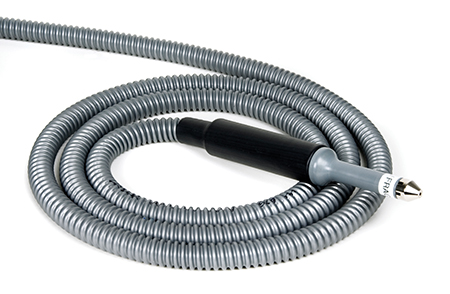
very specific areas, or the entire part.
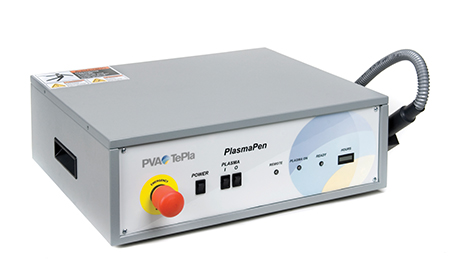
PVA TePla’s PlasmaPen, for example, can deliver a directed beam 3mm to 10mm wide, with a plume length up to 14mm.
Process gasses flow through the PlasmaPen assembly and are activated and ejected through the nozzle, keeping high voltages and current safely inside the pen body, away from the plasma jet and substrate surfaces. The absence of electrical voltage in the plume allows heat-sensitive or electrically delicate materials to be treated.
“Since the plume is electrically neutral, there’s no risk of electrical arcing or damage to sensitive components,” Blaik says.
Corona discharge plasma is the other alternative and is among the most commonly available pen types on the market. In this approach, a high-voltage electrical field is created to ionize a localized region of gas, creating plasma. The strong electric field enables effective treatment of tough surfaces, and the discharge can be highly targeted, making it ideal for precision surface treatments in small or difficult-to-reach areas.
However, the downside is the electrical discharge, eliminating it from use in heat-sensitive and sensitive materials.
In some systems, corona discharge can be blown by introducing a gas flow. This method is effective for covering larger areas or distributing energy more evenly. However, this approach has limitations, as the plume’s length is relatively short, and the process still relies on the presence of an electrical discharge.
Customization options
Although plasma pens follow a standard design, significant variations exist between models. PVA TePla provides various options and customizations to meet specific needs, including adjustments to the aspect ratio of the plasma plume, intensity, and dwell times.
“When atmospheric plasma is delivered by a pen, a significant amount of heat is produced and it can cause scoring and marking of plastic or composite surfaces,” Blaik explains.
PVA TePla addressed the issue by designing a pen head with extra cooling channels to keep the tip cooler. The company also offers different pen tips to control the aspect ratio of the plasma plume.
“With a plasma pen you need to be able to fine-tune the distance of the plume from the surface to control the intensity, while also considering the dwell time,” Blaik says.
Even the angle of the approach can be a factor.
“If you are blowing plasma down at a 90° angle, you could potentially blow the contaminant you’re cleaning off back onto the surface,” Blaik says.
Blaik recommends tilting the pen at a 30°to 60° angle so plasma can bounce off the surface and leave a cleaner surface, better for bonding.
Integration options
Plasma pens can be seamlessly integrated into existing inline processes with varying degrees of automation. This flexibility is particularly beneficial, as plasma treatments are often introduced after initial processes have been validated, typically in response to high failure rates.
“Our PlasmaPens allow customized programming and integration into any manufacturing line concept, and we can partner with any robot manufacturer,” Blaik says.
PVA TePla also offers automated packages including multi-access robots or even a Cartesian robot. The company’s RoboPen provides multi axis or X, Y, and Z robotic operations and can be customized to meet a broad variety of manufacturing applications.
When more than a spot application is required, the pen can be programmed to raster back and forth over the surface to treat a complete part. Other alternatives include moving the pen by multi-axis robot around a stationary part, or keeping the pen stationary and moving/rotating the part.
By leveraging plasma pen technology into inline processes, medical device manufacturers can achieve stronger, more reliable bonds, improved wettability, and enhanced performance across various materials. With their ability to precisely treat surfaces, improve adhesion, and enhance surface energy, plasma pens have become an indispensable tool for the medical device manufacturing industry.Latest from Today's Medical Developments
- Gore completes acquisition of Conformal Medical
- Medical textiles designed for cardiovascular, orthopedic, dental prosthetic applications
- Micro-precision 3D printing: Trends and breakthroughs in medical device manufacturing
- One-component, dual-cure adhesive system for medical device assembly
- #82 Manufacturing Matters - Forecasting 2026 with GIE Media's Manufacturing Group
- Flexing prosthetic finger offers lifelike appearance and movement
- How the fast-evolving defense market impacts suppliers
- Medtronic’s Hugo robotic-assisted surgery system makes US debut